· via Hacker News – Front Page (hnrss.org)
Opus 5.5 uncovers 1615 dodo-hunting eyewitness account in Dutch East India Company archives
A historian paired Opus 5.5 with semantic search over Dutch East India Company records and surfaced a 1615 ship's log describing dodo hunting on Mauritius, plus a possible lead on the emperor Jahangir's famous dodo.
An unnoticed 1615 eyewitness account
A historian has used the frontier model Opus 5.5 to surface what looks like a previously unnoticed eyewitness report of dodo hunting on Mauritius, contained in a Dutch ship's log dating to 1615. The find is described in a step-by-step writeup on the Res Obscura newsletter that reached Hacker News' front page, and it appears to fill a documented gap in the timeline of a bird hunted to extinction around 1681.
The research pipeline
The author, who studies the seventeenth-century exotic animal trade and is planning a book on early modern extinctions, starts from a position many AI-sleuthing stories lack: genuine specialist knowledge used to frame a narrow question. From there the method is deliberately unglamorous. The GLOBALISE archive of digitized Dutch East India Company records was downloaded and run through an embedding model to enable semantic search. Candidate passages were surfaced by search, then read and ranked by frontier models for human review, with the loop repeating on new terms or new archives whenever passages came up empty.
As the author points out, this closely mirrors how they already work: hunting through databases, skimming results, reading closely, iterating. The difference is scale and parallelism. An agent like Opus 5.5 can spawn dozens of copies of itself to read sources across multiple languages, and, given an API key, run its own embedding searches on new material that turns up mid-research — as it did during the run that produced the new dodo passage.
What the search found
The centerpiece is a journal probably written by Isbrant Cornelisz van Petten, captain of the merchant vessel Wapen van Amsterdam, held at the Nationaal Archief in The Hague. The ship stopped at Mauritius in April 1615 to take on water and provisions, and the log records that the crew "caught many tortoises, dodos [dodeersen], and some geese and parrots." After checking the secondary literature, including Parrish's 2013 book The Dodo and the Solitaire, the author concludes the dodo's documented record had a gap between 1611 and 1616 that this passage appears to close. The transcription and translation are flagged as imperfect, with corrections invited from specialists in early modern Dutch.
The same run produced a probable new reference to another extinct Mauritian bird, the red rail. A 1638 account describes "field-hens" using the Dutch word velthoenderen, a term experts already link to red rails, but the reference had been missed because a French scholar mistranslated it as perdrix — partridges — in 1890. According to the writeup, Opus 5.5 returned to the original manuscript and corrected the error.
A lead on the Mughal court's dodo
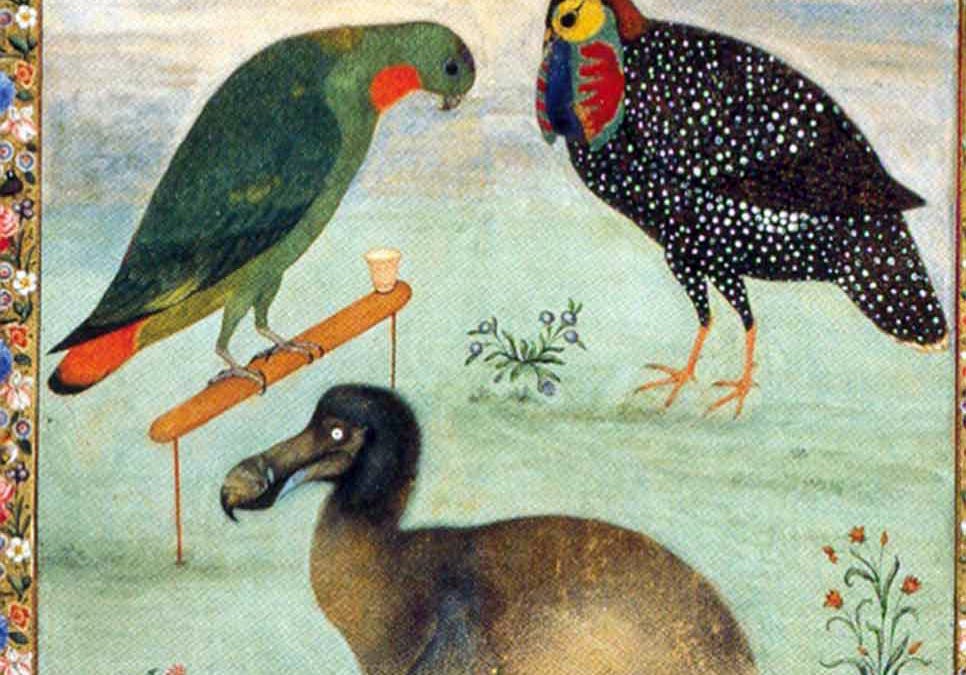
The most tantalizing result is also the least settled. The Mughal emperor Jahangir kept a living dodo, painted by his court artist Ustad Mansur in an image biologists still cite as the most accurate surviving representation of the bird. Nobody knows who gave Jahangir the animal, or when; scholars date the painting variously to circa 1615 or circa 1625. Opus 5.5 surfaced a possible connection to a bird a Portuguese Jesuit described on Mauritius in 1616 and called an "ostrich" — a bird the island has never had. Experts already suspected that "ostrich" was a dodo, but the link to Jahangir's bird had apparently not been drawn. The original Portuguese text is lost, only a French translation survives, and the chain of transmission is unproven — though the author notes a documented 1612 precedent of another exotic bird, an American turkey, traveling from Portuguese Goa to Jahangir's court, something they plan to investigate further.
Part of a broader pattern
The writeup opens by citing a parallel result: security researcher Carter Church announced he had used GPT-6 Astra, working for six hours, to break a Napoleonic-era cipher that had resisted all previous decryption attempts. The author treats both cases as evidence that frontier models now operate in epistemically unfamiliar ways on historical research tasks, surfacing primary sources through workflows that look nothing like traditional academic scholarship.
Why it matters
This is a concrete, reproducible demonstration of frontier models as research instruments rather than coding assistants: semantic retrieval, multilingual reading and cross-referencing against secondary literature, applied to archives measured in millions of records that no human team can read exhaustively. The results here are modest — one publishable archival find, one corrected mistranslation, one promising but unproven theory — but the bottleneck visibly shifts to human verification, corpus quality and knowing which question to ask. For digital humanities and archival institutions, the pipeline is the real story: expect more forgotten historical records to surface this way, and expect the hard part to remain confirming them.
- #ai
- #digital-humanities
- #archival-research
- #semantic-search
- #history