· via Hacker News – Front Page (native)
Orbital AI data centers could reach cost parity within 3-5 years, analysis finds
Forethought's analysis finds orbital AI data centers could become cost-competitive with terrestrial facilities within 3-5 years, but only if Starship cuts launch costs from roughly $1,500/kg toward $250/kg.
Several of the world's largest technology companies are now planning to run AI compute in orbit, and a new analysis from research group Forethought concludes the idea is more technically and economically credible than commonly assumed — provided SpaceX's Starship cuts launch costs by an order of magnitude or more.
Google announced Project Suncatcher in November 2025, a plan to place TPU-equipped satellites in dawn-dusk sun-synchronous orbit. In early 2026, SpaceX filed with the US Federal Communications Commission for authorisation to launch and operate a constellation of up to one million data center satellites. Blue Origin, Ramon.Space, Starcloud and Aetherflux are also working on orbital compute, and China's Three-Body Computing Constellation already operates 12 satellites and has run Alibaba's Qwen3 model in space. NVIDIA joined the field at GTC in March 2026, announcing the Space-1 Vera Rubin Module, a GPU platform built to be space-rated.
Forethought frames the underlying driver as energy. New data center capacity on Earth is queued behind multi-year grid connection delays, and AI labs have responded by generating their own power — the report cites xAI's hundreds of megawatts of onsite gas generation in Memphis, plus large turbine orders from OpenAI and Oracle for Texas campuses. Once operators accept off-grid power, the question becomes where power and hardware are cheapest. Elon Musk, quoted in the report, has claimed space will be "the lowest-cost place to put AI" within two to three years.
The economics hinge almost entirely on launch cost
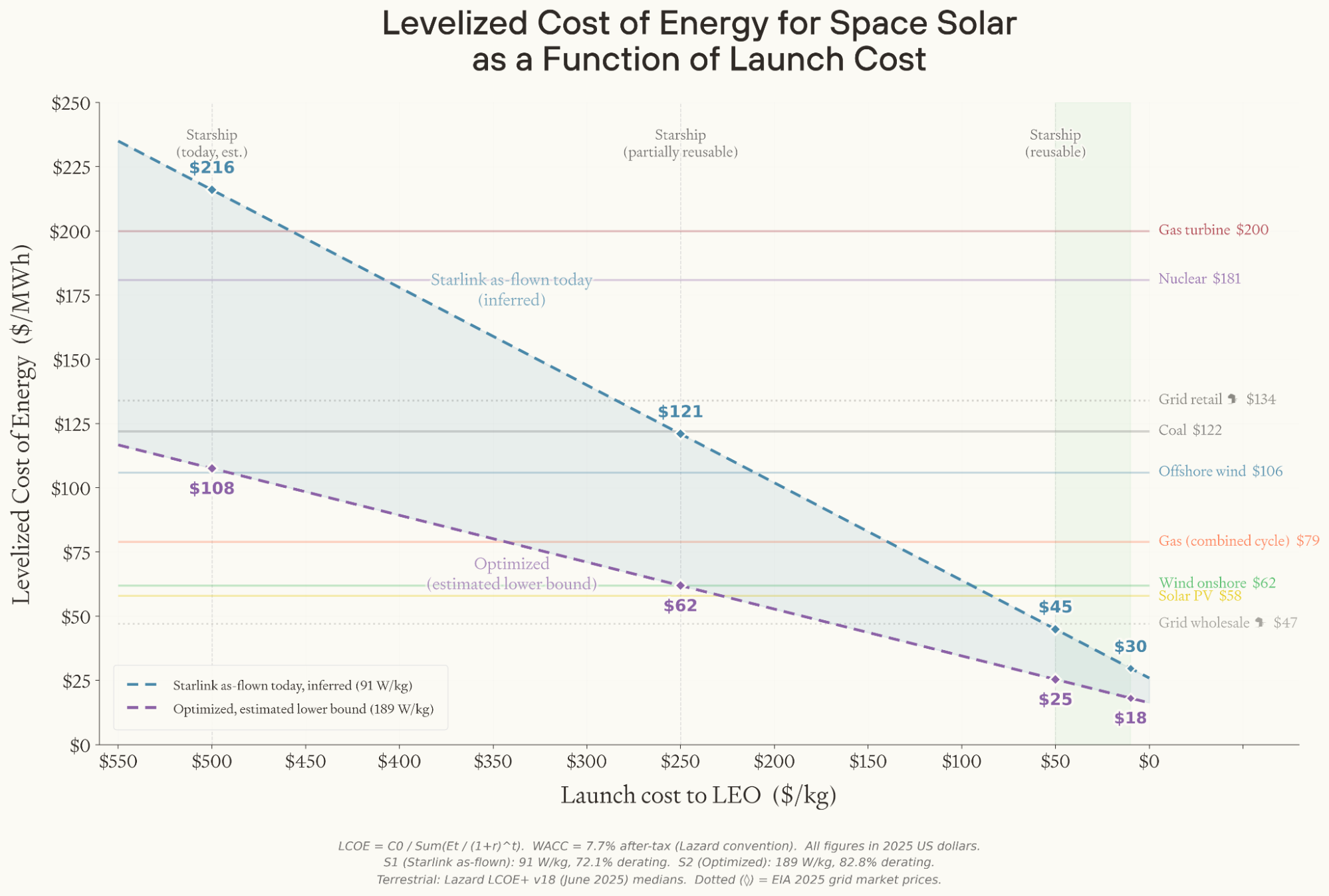
Solar panels in dawn-dusk sun-synchronous orbit collect roughly three to five times more energy than the same panels at a good terrestrial site, according to Forethought's modelling. At current launch prices of around $1,500 per kilogram, that advantage is wiped out by the cost of getting hardware upstairs. The report puts the break-even at roughly $250/kg, where space-based solar matches present-day off-grid terrestrial power, and estimates that at about $50/kg — which it associates with a Starship achieving full reuse with Falcon-level reliability — space solar could land between $25 and $45 per MWh, cheaper than any terrestrial option available today. Against an aggressive terrestrial buildout, orbital facilities become competitive at about $100/kg, assuming modest reductions in the mass of servers and cooling systems.
For orbital data centers, launch is the dominant line item; for terrestrial ones, power and operating costs dominate. That makes Starship the linchpin. Forethought judges it the only vehicle currently on track to deliver the required launch cost and cadence, with competitors years behind. SpaceX aims to complete Starship development in late 2026, and the report estimates the necessary cost and cadence could arrive within three to five years if the programme stays roughly on schedule — by which point chip manufacturing, not launch capacity, may be the binding constraint.
Cooling looks manageable, maintenance does not
Radiative cooling is often cited as a fatal obstacle, but Forethought finds it surprisingly tractable. Passive radiators using selective coatings and lightweight carbon fibre panels could reach 163-346 W/kg at system level, a 13-28x improvement over ISS-era hardware. At that performance, thermal systems would account for only 2-5% of total data center cost, less than terrestrial operators spend on cooling over a comparable lifecycle. The catch is that no radiator of this class has been deployed at anything like the scale an orbital data center requires.
Maintenance is a heavier penalty. Failed chips cannot be swapped out in orbit, so operators would need roughly 38% more non-compute hardware — solar, racks, cooling — over five years to hold effective capacity steady. Inter-satellite bandwidth limits are also likely to confine early orbital facilities to inference workloads rather than training. Forethought's overall verdict: orbital data centers are unlikely to carry a meaningful share of compute before 2030, but could become cost-competitive with present-day terrestrial data centers within three to five years if Starship stays on track.
Why it matters
If even a modest slice of new AI compute moves to orbit, the economics of cloud infrastructure change fundamentally, with launch cost replacing power and operations as the dominant expense. Forethought also flags governance risks: terrestrial data centers sit under national and regional regulation, while compute in space may fall into jurisdictional grey zones. And because the cheap route to orbit runs through a single launch provider — SpaceX, which now operates a frontier AI lab following its acquisition of xAI — a shift to orbital compute would further concentrate power in one company's hands.
- #data-centers
- #spacex
- #ai-infrastructure
- #cloud-computing
- #orbital-compute