· via Hacker News – Front Page (hnrss.org)
Pangram claims 99.7% AI detection accuracy across 26 models, citing university researchers
AI detection startup Pangram says it flags 99.7% of AI-generated text across 26 frontier models and points to University of Maryland and University of Chicago researchers as independent validation.
A detector with academic backing, it says
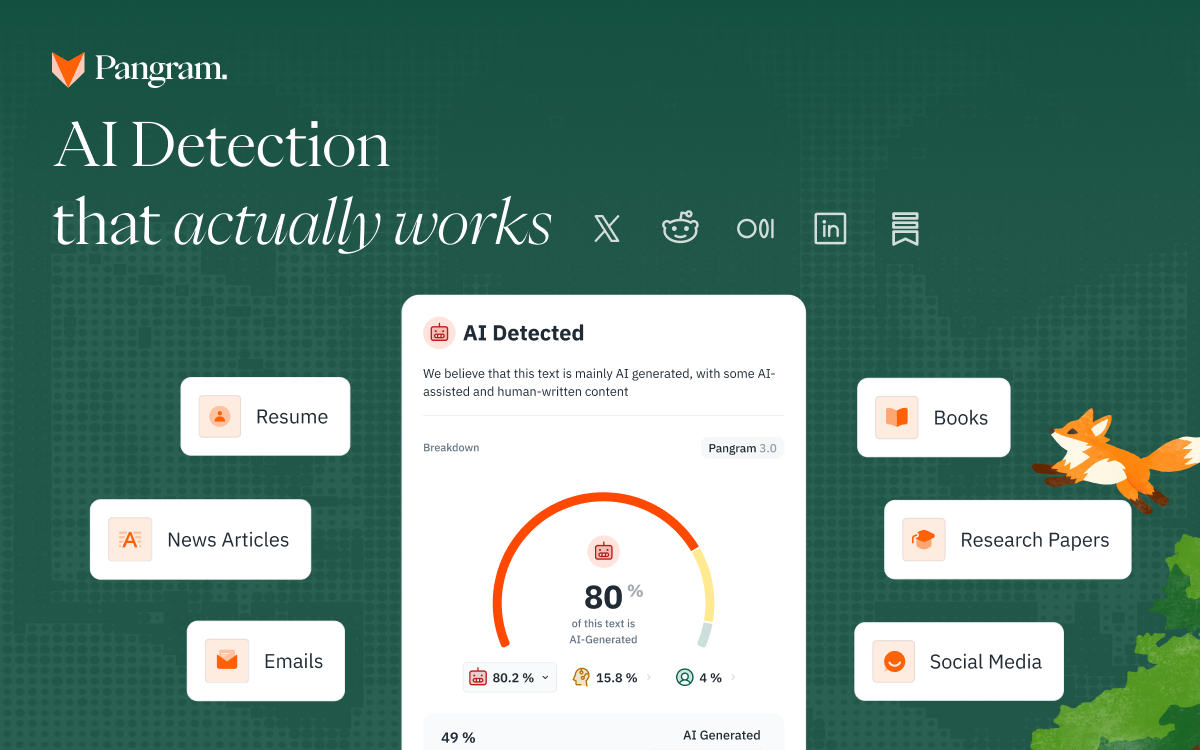
Pangram, a startup selling detection of AI-generated text and images, drew attention this week after its site reached the front page of Hacker News. The pitch that separates it from a crowded field is its claim that independent academic researchers have rated it the most accurate AI detector available.
What Pangram claims
According to the company's website, Pangram is trained specifically to recognize output from recent models released by OpenAI, Anthropic, Google, Meta, DeepSeek and xAI. The company says it benchmarks against 26 models so far, publishes the results in a model card, and retests both on every release of its own detector and whenever a major new model ships.
The headline figure is 99.7 percent accuracy on AI-generated samples. Per-model numbers listed on the site cluster tightly around that mark: 99.9 percent on Claude Sonnet 5, 99.8 percent on GPT-OSS 120B, 99.7 percent on GPT-5.4 and Qwen 3.7 Max, 99.6 percent on DeepSeek V4 and Gemma 4, and 99.5 percent on Llama 3.3 and GLM 5.2, among others.
The validation pitch
The load-bearing claim in Pangram's marketing is outside evaluation. The company attributes its top ranking to third-party researchers, including teams at the University of Maryland and the University of Chicago, and says some of its more advanced features, which aim to help users trace where a piece of writing originated, are grounded in peer-reviewed research.
Those figures and rankings, however, come from the vendor's own site. Whether the cited academic evaluations tested the same detector versions now on offer, and how the tool performs on edited, paraphrased or mixed human-and-machine writing, are open questions any institution would want answered before depending on the results.
More than text
Pangram pairs AI detection with plagiarism checking, pitching the combination as a single assessment of whether a document is authentic. It also flags AI-generated images, extending beyond text. The target customers are explicit: universities, schools and enterprises. According to its About page, the company was founded in Brooklyn in 2023 by AI researchers who previously worked at Tesla and Google, and says it continues to publish research of its own.
A crowded and contested market
AI detection carries a troubled reputation, largely earned in education, where early tools produced false positives that wrongly accused students of submitting machine-written work. High scores on clean benchmark samples do not guarantee performance on real-world text, where a user may lightly edit model output or write with AI assistance rather than wholesale.
Pangram's own testing cadence points to the structural problem: because it retests on every major model release, its published numbers age quickly. Detectors are on a treadmill, chasing every new model the frontier labs ship, and yesterday's accuracy figure is no promise about tomorrow's.
Why it matters
The volume of AI-generated prose now flowing through classrooms, publishing and enterprise workflows has forced a practical decision on institutions: detect it, ignore it, or redesign assessment around it. If Pangram's claimed accuracy holds up under the independent scrutiny it cites, detection becomes a usable policy tool again after years of warranted skepticism. If it does not, it is one more vendor benchmark in a market already saturated with them.
The specifics worth watching are the ones marketing pages rarely settle: false-positive rates on purely human writing, behavior on hybrid drafts, and how quickly accuracy decays as new models arrive. For now, the sensible reading is that Pangram is making unusually strong, unusually specific claims — and that the burden of proof sits with the detector, not the accused.
- #ai-detection
- #generative-ai
- #machine-learning
- #startups
- #edtech