· via Hacker News – Front Page (native)
Paris studio ships Search, a 10.8 MB WebKit Mac browser with Chrome extension support
Office Commun has released Search, a free, open-source macOS browser that uses the system WebKit engine, weighs 10.8 MB, and installs extensions from the Chrome Web Store.
A browser that ships without an engine
Office Commun, a design studio in Paris, has released Search, a free and open-source web browser for the Mac that has been drawing attention on Hacker News's front page. Version 1.0.14 occupies 10.8 MB on disk — the project's site also describes the app as about 7 MB in its FAQ — because it bundles no rendering engine of its own. Instead it uses WebKit, the engine Apple ships inside macOS and the one behind Safari, so pages render exactly as they would there.
The size contrast the site draws is with browsers that carry their own engine: it lists Safari at 36 MB, Dia at 1,321 MB and Chrome at 1,429 MB on the same machine.
Search requires macOS 14 or later and runs on both Apple silicon and Intel Macs, with a separate self-updating build for Intel. It is also installable through Homebrew.
Chrome extensions on top of WebKit
The headline feature for anyone hesitating to leave Chromium is extension compatibility: according to the project's site, Search installs extensions directly from the Chrome Web Store in a click. That capability needs macOS 15.4 or later.
Migration is covered too. A "Bring Things Over" command imports bookmarks, history, passwords and extensions from Chrome, Arc (including its spaces), Brave, Edge, Firefox, Zen, Dia and others, or from an exported file. Passwords land in the macOS keychain and are shown only after Touch ID.
A deliberately small feature set
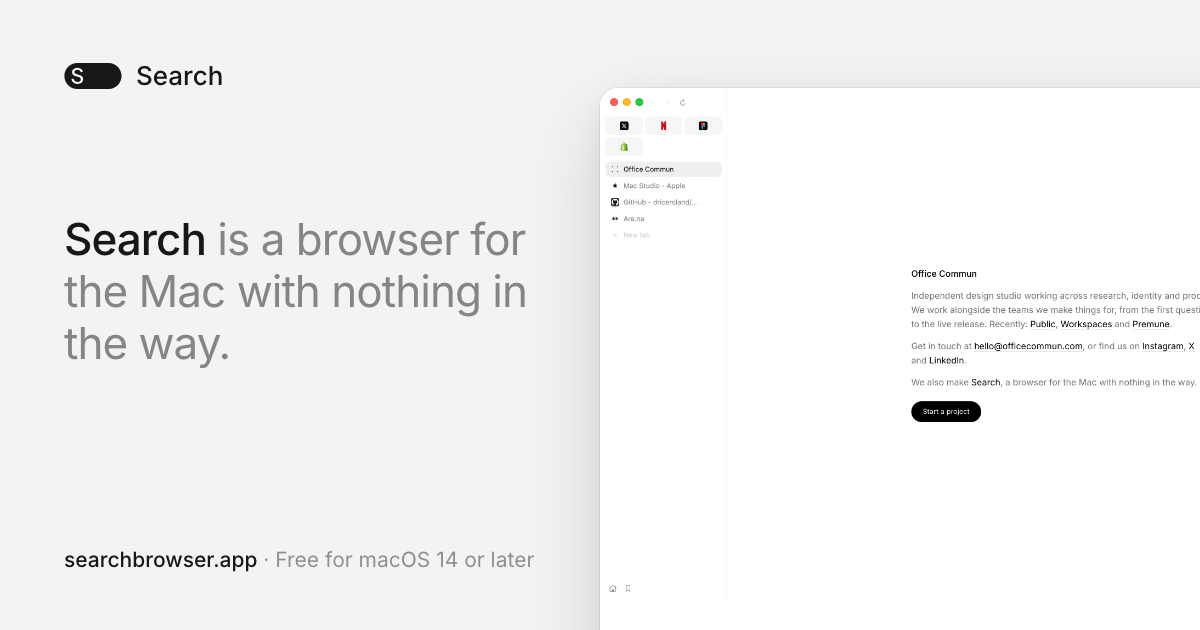
What surrounds the page is intentionally thin: an address field, tabs shown either across the top or down a foldable sidebar, pins that reduce a site to a single letter or icon and survive force-quits, and spaces that keep separate tab sets. Swiping sideways over the tabs with two fingers switches spaces, with the option of staying signed in or starting clean.
Reading mode strips a page to its text and pictures, and leaving a tab playing YouTube or Netflix keeps the video going in a small window floating above other apps. Ads are blocked in the network layer before scripts load, any page element can be hidden from a site permanently with a keyboard shortcut, and WebKit's own Web Inspector is available for development work.
There is no account system. Syncing between a user's own Macs happens through a folder the user chooses in iCloud Drive or Dropbox, covering spaces, pins, bookmarks and a few settings — never history or passwords. Updates arrive via builds signed by Office Commun that the app checks hourly.
The performance numbers come from the developer
The site publishes benchmarks it measured itself — medians of three runs on the same Mac and the same pages — showing Search at 320 ms to a cold first window against Chrome's 526 ms and Safari's 730 ms, 51 MB of memory before the first page against Safari's 203 MB and Chrome's 663 MB, and 11 processes with five tabs open where Chrome runs 29 and Safari 21. These are the developer's own figures; the site says its method and every run are published, but they have not been independently verified.
Why it matters
Most Mac browsers face a binary choice: ship Chromium and inherit its gigabyte-scale footprint, or be Safari. Search argues for a third path — use the WebKit Apple already put on every Mac, keep the app minimal, and add just enough compatibility, in the form of Chrome Web Store extensions and an import path from every major browser, to make switching realistic. With Chrome at 1.4 GB and newer entrants like Dia past 1.3 GB by the site's own measurement, a ten-megabyte open-source alternative that still supports the extension ecosystem is a useful proof that resource weight is a design decision, not a requirement. The trade-offs are real: the browser is Mac-only, tied to Apple's engine and OS cadence, and its extension support stops at macOS 15.4. But for minimalist-minded users — including those leaving Arc, whose spaces migrate across — it is a serious, inspectable option rather than a toy.
- #macos
- #browser
- #webkit
- #open-source
- #chrome-extensions