· via Hacker News – Front Page (native)
Platypush voice assistant rebuild pairs microWakeWord with Silero VAD and OpenAI plugins
A Platypush blog post details a voice assistant overhaul: microWakeWord for wake words, Silero VAD for speech boundaries, and OpenAI plugins for transcription, replies and TTS, with local fallbacks throughout.
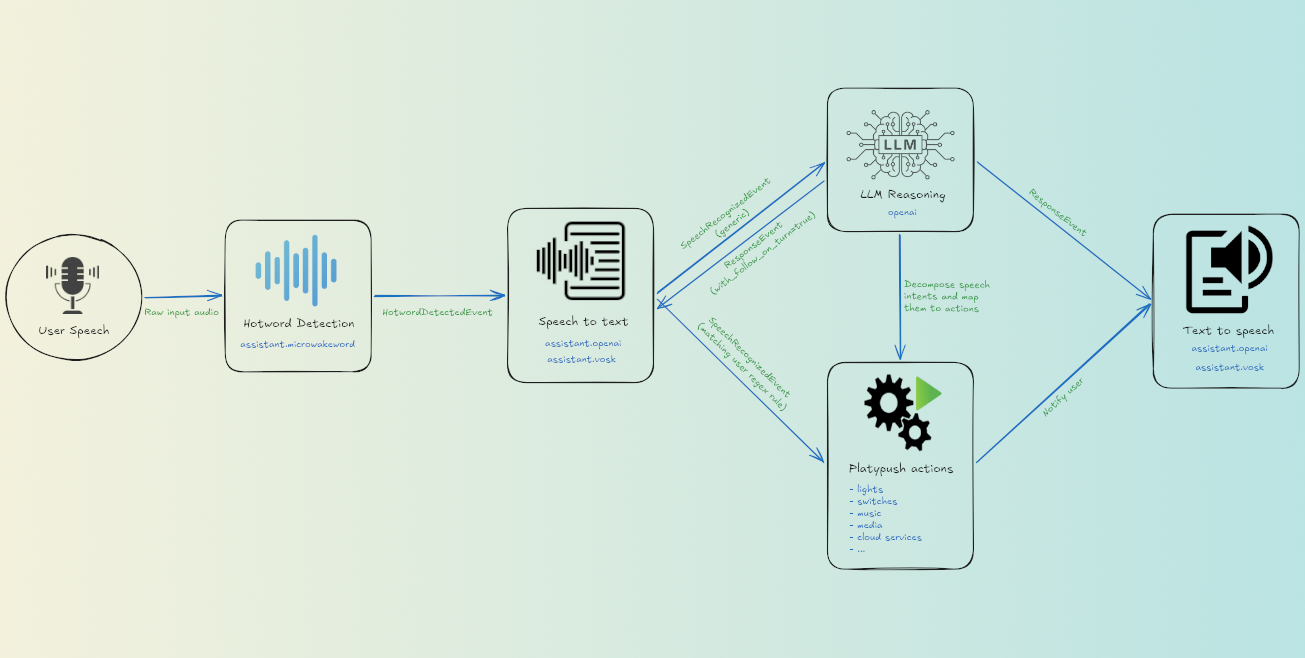
A detailed write-up on the Platypush blog, which surfaced on Hacker News's front page, walks through a full rebuild of the project's self-hosted voice assistant pipeline. The author had been running the previous version, described in an article a few months earlier, as a daily driver but found it fell short of commercial assistants: the wake-word detector produced frequent false positives on background noise and false negatives unless the speaker was close to the microphone, and detecting where speech started and ended was unreliable in noisy rooms with cheap microphones.
A new wake-word engine
The old setup used a plugin wrapping openWakeWord. According to the post, that project has been quiet for a while and its pre-trained models remain v0.1 files from 2023, mostly trained on synthetic speech. The replacement, assistant.microwakeword, wraps microWakeWord through the pymicro-wakeword Python bindings.
The author notes that microWakeWord is the engine behind ESPHome and Home Assistant Voice, that its models are actively maintained, and that several built-in models (okay_nabu, hey_jarvis, hey_mycroft and alexa) ship with the package, so no extra download is needed. Custom models are supported too: drop a microWakeWord JSON manifest and its .tflite file into the plugin's models directory and reference it by name.
The new plugin deliberately mirrors the old one's API, so migrating is a configuration change. A few design details stand out: without an explicit threshold, each model uses the probability cutoff from its own manifest (0.9 for alexa); patience_frames defaults to 0 because the models already smooth output over a sliding window; and the audio thread never touches the TFLite models directly, instead queueing frames to the main thread, because MicroWakeWord's reset method reloads the interpreter and is not safe to call concurrently.
Fixing end-of-speech detection
Speech-to-text runs through assistant.openai, which records audio during a conversation and transcribes it with Whisper. The hard part, the author writes, was knowing when the user stopped talking. The previous implementation used a per-frame boolean from WebRTC VAD, and any single frame classified as speech reset the silence timer — so with even modest background noise, phrases only ended when the maximum conversation duration was hit.
The shared audio preprocessing layer has been reworked in three ways. Silero VAD is now the primary backend, running through onnxruntime with no PyTorch required, with WebRTC VAD and an RMS-based detector as fallbacks. Second, hysteresis and a sliding window mean a frame counts as speech above the threshold and stays speech until its score drops by a margin, with per-frame decisions smoothed by majority vote over a 0.5-second window. Third, an adaptive noise floor is tracked over time, and frames quieter than a configurable multiple of it (default 2.0, roughly 6 dB) are never considered speech.
On a synthetic benchmark mixing Piper-generated phrases with babble and burst noise, the old settings kept conversations open for 6–10 seconds after speech had ended; the new pipeline closes them 1.0–1.6 seconds after the last word. Because the changes were made in the AudioPreprocessor shared by other speech-to-text integrations, plugins like assistant.vosk benefit as well.
Responses, hooks and speech synthesis
The transcribed phrase goes to the openai plugin, which handles the API key and conversation context; if a response ends with a question mark, the conversation continues with a follow-up. Custom hooks can intercept phrases before the model is called — the post shows a home-automation command handled locally without an LLM round-trip. The plugin also accepts a custom base URL, so an OpenAI-compatible local provider such as an Ollama instance can serve responses instead of the cloud.
Responses are rendered by tts.openai, with voice and volume configurable. The author reports that tts.piper also produced good results and runs entirely locally, but on a Raspberry Pi 5 it added roughly 3–4 seconds of latency compared with tts.openai. Wake-word detection is paused while a conversation is active so the assistant does not hear itself through the speakers.
Why it matters
The post is a practical blueprint for the hybrid architecture most self-hosted voice assistants actually need: wake-word detection and optionally STT and TTS on-device, with heavier inference in the cloud or on a local model server. It also documents concrete, reproducible results — cutting end-of-speech lag from up to 10 seconds to under 1.6 — and engineering details like thread-safety constraints, VAD hysteresis and adaptive noise floors that developers building similar pipelines can borrow directly. The author's own history underscores the churn in this space: Snowboy, DeepSpeech and the Alexa integration from earlier iterations are all now defunct, which is a strong argument for building on actively maintained engines like microWakeWord rather than abandoned ones.
- #voice-assistants
- #speech-recognition
- #open-source
- #home-automation
- #openai