· via Hacker News – Front Page (native)
Police justified Flock searches across 19,000 cameras with 'LMAO', EFF logs show
An EFF review of Flock Safety search logs found police justifying licence-plate queries across a network spanning 1,558 cities with entries like 'LMAO', 'idk' and 'TBD'.
What the search logs show
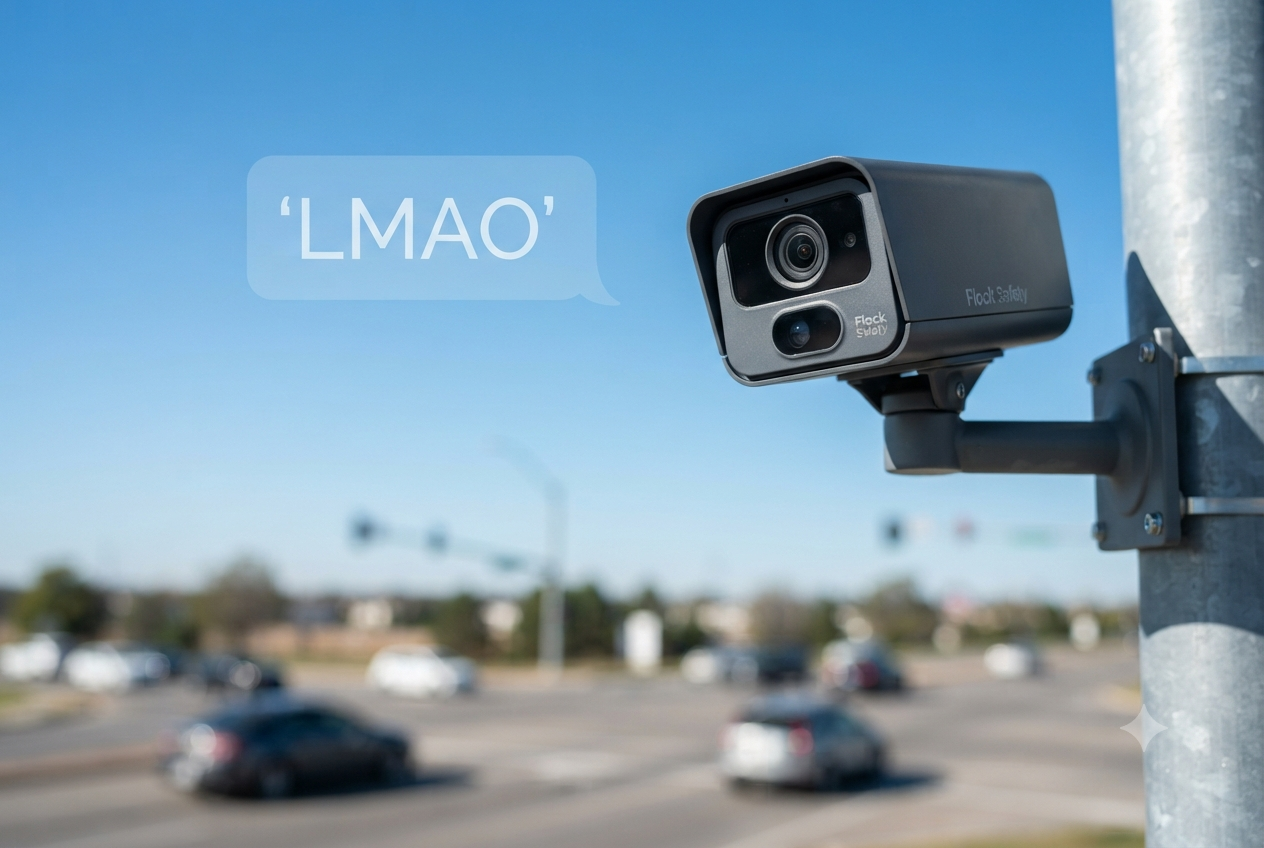
An analysis of Flock Safety's search logs by the Electronic Frontier Foundation has produced a blunt illustration of how loosely some police departments supervise access to automated licence plate reader networks. In July 2025, an officer with the Lake County, Indiana, Sheriff's Department ran a plate query across Flock's system — more than 19,000 cameras spanning 1,558 cities and towns — and entered "LMAO" in the field intended to record why the search was being made, according to Tech Times.
That entry was not an isolated case. The EFF's review, covering police departments across the United States between 2023 and late 2025, identified dozens of searches whose stated justifications were jokes or gibberish: "LOL", "Hehe", "Haha", "idk", "blah", "asdfg" and strings of apparently random keyboard characters. One officer wrote "robbery I don't remember the case number leave me alone". Beyond the jokes, the analysis counted more than 6,300 searches across more than 30 agencies where the entire stated reason was "TBD".
The scale behind a single query
Flock's automated licence plate readers collect vehicle data and allow law enforcement agencies to query footage gathered by cameras far outside their own jurisdiction, meaning one search can sweep across thousands of communities at once. The EFF has argued that this design hands officers access to sensitive location information about ordinary drivers, and has raised concerns about the absence of judicial oversight before ALPR searches are run.
The network's footprint keeps expanding. Futurism, citing The Washington Post, reported that Flock's network has grown beyond 120,000 cameras. The same reporting noted that President Donald Trump publicly endorsed the company, saying he likes it because of law enforcement, while acknowledging that critics view the cameras as an infringement — remarks the report described as his first public endorsement of Flock.
Flock tightens the reason field
In late 2025, Flock replaced the free-text reason field with a list of pre-populated categories that officers must select before running a search. The EFF criticised the change as a setback for transparency, arguing that picking a generic category can reveal less about a search's actual purpose than even a carelessly filled text box.
The EFF also contacted the departments whose officers appeared in its analysis. According to Tech Times, some agencies said the officers involved had been counselled, while others said they would investigate or review the flagged searches.
Why it matters
The "LMAO" entry by itself does not prove the underlying search was improper — the officer may have had a legitimate case and simply skipped the paperwork. What it demonstrates is that nothing required him not to. When a single query can reach camera data from 1,558 cities and the only safeguard is a self-reported justification field, oversight is effectively voluntary, and the logs suggest that voluntariness is frequently declined.
The stakes rise with the network's size. Pooled plate reader systems no longer just record traffic on one street; they allow an officer to reconstruct where a vehicle has travelled across vast distances, on data contributed by departments with no connection to the case. Whether that capability should be gated by warrants, mandatory case numbers, or meaningful after-the-fact auditing is a policy question most jurisdictions have yet to answer — and Flock's shift from free text to dropdown categories suggests the audit trail is getting thinner, not stronger, as the network grows.
- #surveillance
- #privacy
- #police-tech
- #license-plate-readers
- #eff