· via Hacker News – Front Page (native)
Pomerado (YC F26) turns any website into a self-healing API for AI agents
YC F26 startup Pomerado turns websites without APIs into deterministic, self-healing MCP tools that agents can call in seconds, and has open-sourced its core under an MIT licence.
Pomerado, part of Y Combinator's F26 batch, has launched on Hacker News with an open-source platform that turns any website — including sites its users don't own and that ship no public API — into a deterministic, self-healing API or Model Context Protocol (MCP) server that agents call like any other tool.
Founders Alan and Akshay, previously at McKinsey and Scale AI, wrote in the launch post that the constraint on agents today is no longer capability but access: airlines, banks, insurers, government portals and legacy enterprise apps rarely expose APIs, so agents fall back on browser automation or computer use, which the founders describe as slow, expensive and unreliable — and which many companies ban outright on security and compliance grounds.
Compiling the web into tools
The core idea is to pay for expensive exploration once. According to the launch post, an agent opens a browser, explores the target site and performs the requested task a single time, writing HTTP requests or a Playwright script as it goes. That example run, plus everything recorded during it, is then used to generate a generalizable, repeatable API. A separate Guardian model reviews the build against guardrails, synthetic-input tests check that the API has not overfit to one example, and a final publication agent shapes the input and output schema. Integrations are typically ready in under an hour, the founders say, with subsequent calls returning in five to 30 seconds.
Authentication runs as a deterministic process, so neither the model nor the recorder ever reads customer credentials; users can store TOTP seeds or link a Pomerado phone number to have two-factor codes filled in automatically.
Self-healing when sites change
When a site changes and a call fails, Pomerado kicks off a maintenance job to repair the tool and finish the original request. The company's site walks through an example where a claims lookup on an insurance portal broke after the date-of-service filter moved into a new search panel; maintenance found the relocated field, patched the step, passed its test and updated the original run with 24 claims. Per the founders, maintenance can also fix renamed buttons, add functionality or introduce new guardrails, and users have improved tools just by asking for them to run faster.
The numbers, with caveats
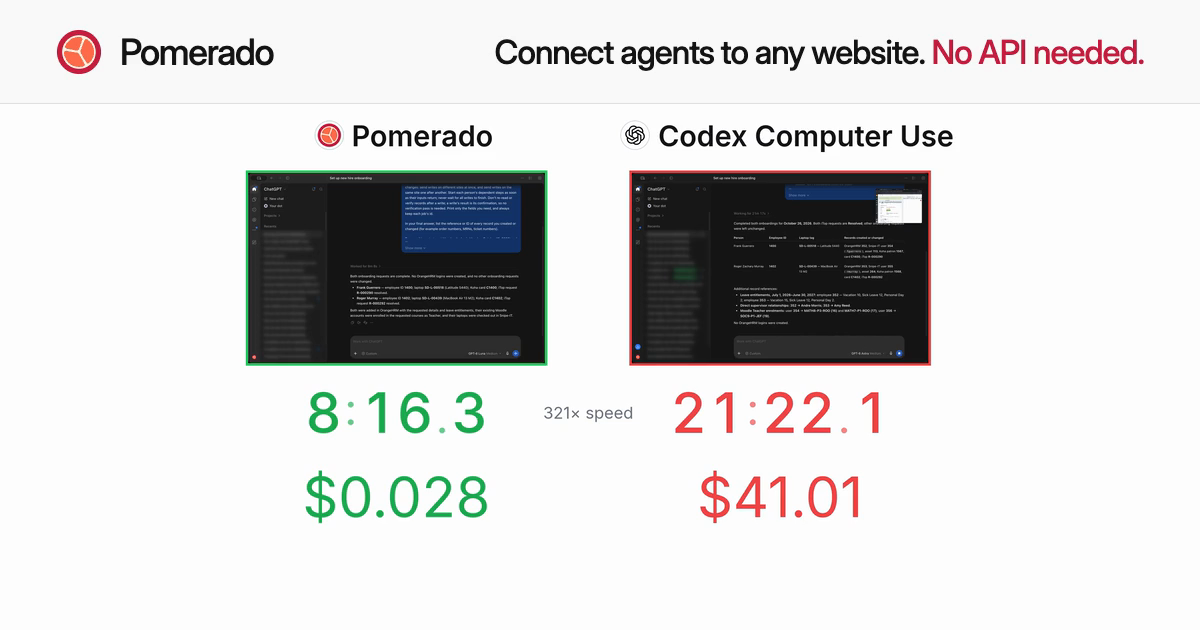
All performance figures are the company's own. Pomerado's site claims customers have seen 7x speedups, and that across a benchmark of 30 tasks in 25 business apps — including OpenEMR, ERPNext, Moodle, Zoho Books and Koha, one attempt each — it was 2x faster, 10 to 1,000 times cheaper and 30% more accurate than Astra Computer Use, Instinct and Muse. That comparison had Codex calling pre-built Pomerado tools while rivals used browser use, and Pomerado itself notes that Instinct and Muse do not publish costs. On a single onboarding task spanning HR, IT, course and library systems, the company reports finishing in 8 minutes 16 seconds for 3 cents, against 21 minutes 22 seconds and $41.01 for Codex Computer Use.
Access, pricing and data handling
The core is open source under an MIT licence on GitHub, alongside a free hosted tier with 100 tool calls per day and 10 new integrations per month. A $50 per month plan raises that to 1,000 calls and 100 integrations, and an enterprise tier starts at 100,000-plus daily calls with private integrations, role management, audit logs and SLAs. The company says task results are erased once delivered — or within 60 minutes if never read — PII is stripped by redaction models, and rate limits and anti-bot checks are handled natively, including through residential proxies.
Early users named in the launch post include a personal trainer whose agents now log into a client site to prepare workouts and message clients, and car dealerships wiring Grok bots into legacy dealer marketplaces, CRMs and ERPs where computer use previously took over an hour per task.
Why it matters
MCP is becoming the standard way agents discover tools, but coverage of the long tail of legacy, consumer and internal websites will always lag. Pomerado's bet is that the messy web can be compiled: accept one slow, agentic first run, then collect cheap, fast, deterministic calls afterwards, with automated repair when sites drift. That reframes web automation from per-step visual reasoning into a build-and-maintain problem, a better fit for repeated, high-volume workflows. Real questions remain — the terms of service and legality of automating third-party sites, whether self-repair holds up at scale, and benchmarks no third party has verified — but with the core open-sourced, those claims can at least be tested by anyone.
- #ai-agents
- #mcp
- #open-source
- #automation
- #api