· via Hacker News – Front Page (native)
Project CETI profile highlights the AI bid to translate sperm whale communication
A Hacker News-trending profile of Project CETI founder David Gruber traces a winding career in ocean science that led to an AI effort to decode sperm whale communication.
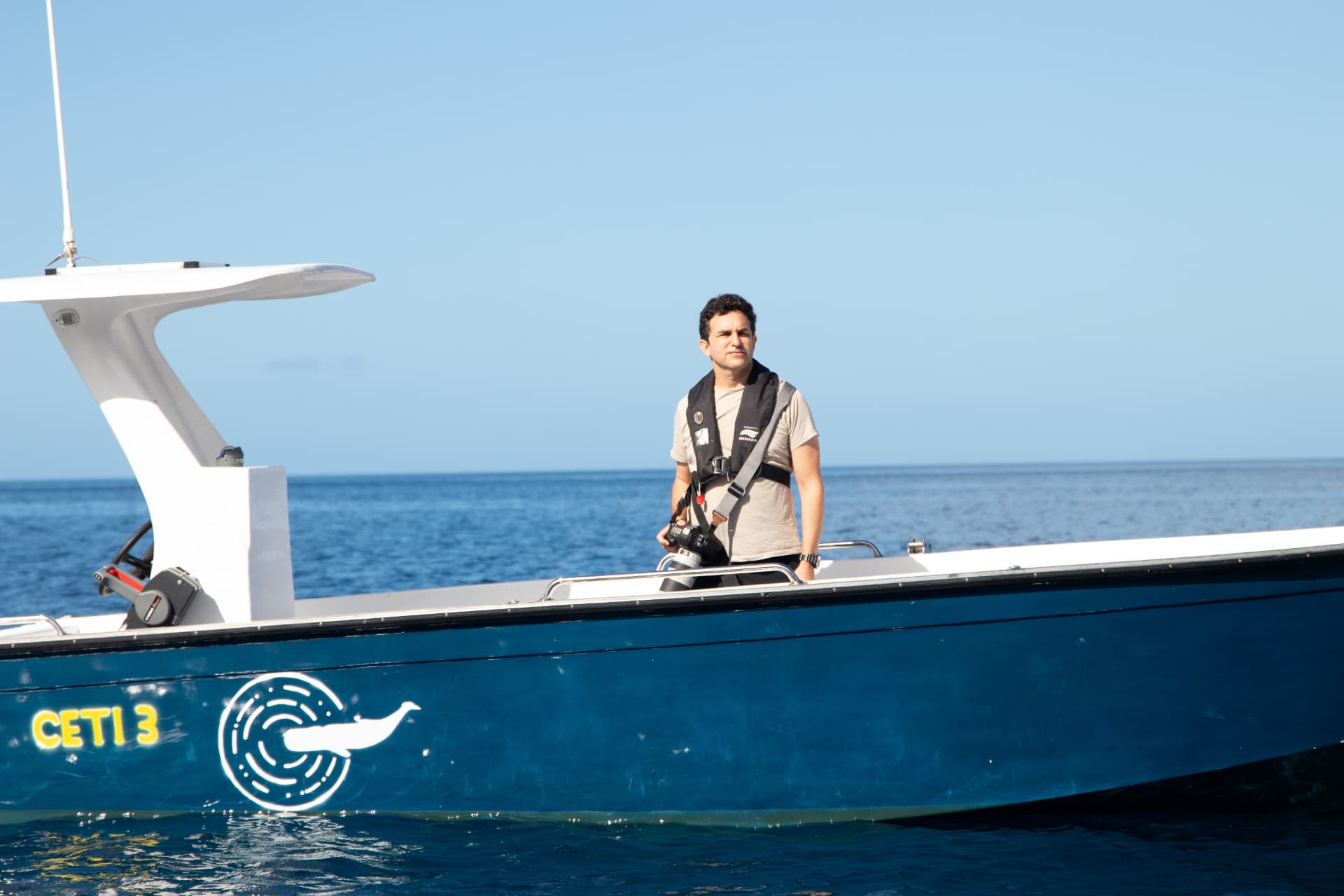
A profile of the scientist behind Project CETI
A profile published September 30 on blue-continuum.com, which subsequently reached the front page of Hacker News, examines the marine biologist and professor David Gruber, founder of Project CETI — the Cetacean Translation Initiative. The project's goal is to apply artificial intelligence and machine learning to one of biology's most stubborn open questions: whether sperm whale vocalizations carry a decodable communicative structure.
The profile lays out the split verdict on the effort. Admirers place it among the boldest scientific undertakings of the current era; skeptics see it as a well-intentioned quest almost certain to end without a translation in hand. Gruber, according to the piece, positions himself outside that argument, treating the initiative as the logical next step in a long line of inquiry rather than a reckless gamble.
From backyard ants to the open ocean
The accessible portion of the article is heavily biographical. Gruber grew up in New Jersey as a sensitive, awkward child who, in the writer's telling, felt a stronger connection to the small creatures in his backyard than to other kids — the boy crouched in the grass watching ants with something closer to kinship than detached study. That quality, the profile argues, never left him and eventually became his scientific method.
His route into cetacean research was anything but a straight line. According to the profile, his academic career passed through microbiology, biological oceanography, the interactions between bacteria and protozoa, and work on fish, sharks, sea turtles and visual communication before arriving at his present focus. The implied thesis is that this breadth — a career spent asking how organisms signal one another across very different scales — is what prepared him for a project that treats whale sound as a dataset.
What the initiative is attempting
Sperm whales are among the loudest animals in the ocean, communicating through intense trains of clicks, and Project CETI's premise is that machine learning can process recordings of those vocalizations at a scale no human analyst could manage, searching for patterns that might amount to a code. The profile frames this as a natural extension of Gruber's long-running interest in how living things exchange information.
It is worth noting that the publicly available text of the article functions largely as an introduction, closing with a newsletter subscription pitch, so readers hoping for deep technical detail on the machine-learning pipeline will find the piece oriented toward the person and the ambition rather than the engineering. The broad interest is easy to understand regardless: the project sits at the intersection of two subjects — large-scale pattern recognition and animal cognition — that each draw intense attention on their own.
Why it matters
Project CETI is an unusually pure test of what machine learning can and cannot do when applied to communication we cannot yet read. Unlike human-language AI, where researchers have abundant text and shared context to train against, whale vocalizations come with no ground-truth labels and no native speakers to consult. Any claimed breakthrough has to survive the possibility that researchers are finding pattern where there is no meaning, or meaning in a form that resists human categories entirely.
That makes the initiative relevant well beyond marine biology. It is effectively an interpretability problem: detecting genuine structure in high-dimensional data and validating it against something other than intuition. A convincing positive result would reshape how researchers approach non-human communication; a rigorous null result would itself be informative about the limits of the approach. The Hacker News attention suggests the technical community recognizes the project as a benchmark worth watching, whichever way it resolves.
For now, the profile serves as an accessible on-ramp: the story of a researcher whose path from backyard ants to ocean acoustics led to one of the more audacious applications of machine learning now underway.
- #machine-learning
- #marine-biology
- #animal-communication
- #research
- #ai