· via Hacker News – Front Page (native)
Qualcomm's Oryon 3 puts Snapdragon X2 Elite on par with top x86 laptop cores
Chips and Cheese's deep dive into Qualcomm's Oryon 3 finds a 5 GHz, 9-wide core with SVE2 support, putting the Snapdragon X2 Elite in the same league as AMD's Zen 5 and Intel's Lion Cove.
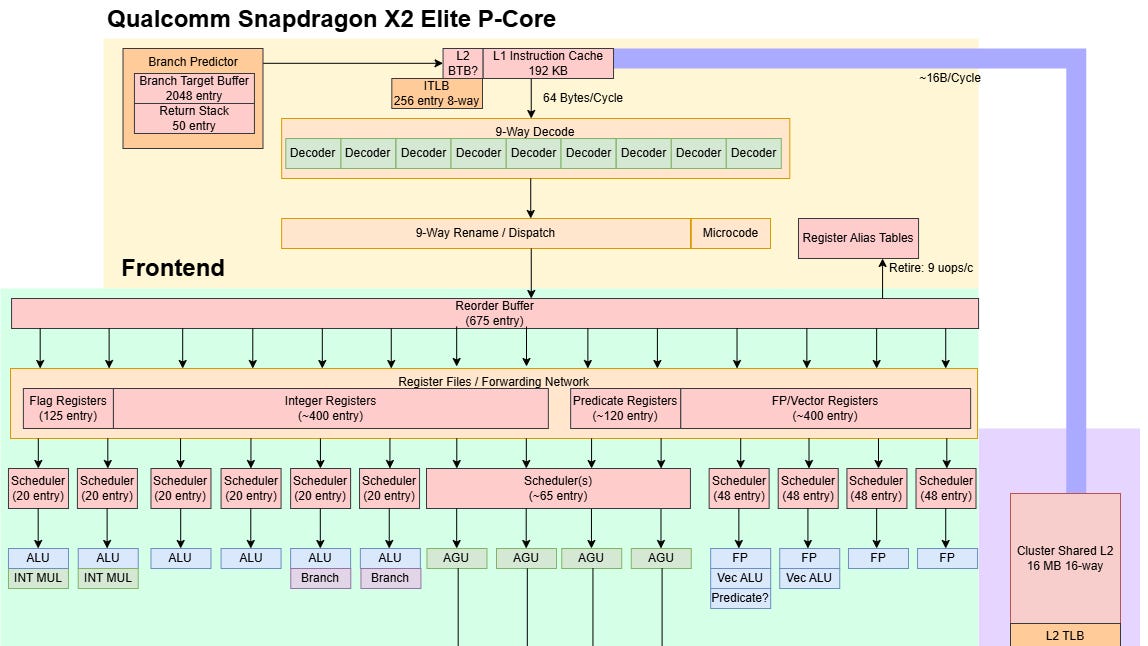
Qualcomm's third-generation Oryon CPU core delivers laptop performance that challenges the best x86-64 chips available, according to a technical deep dive by Chips and Cheese. The design powers the Snapdragon X2 Elite Extreme and marks a turning point for a company whose first Arm-based Windows laptops struggled to keep pace with even low-end Intel hardware.
From phone chips to prime cores
As Chips and Cheese recounts, Qualcomm's early laptop efforts reused smartphone SoCs and delivered noticeably poor performance. The company persisted through successive Snapdragon generations aimed at PCs, and the Snapdragon X2 Elite, built on the new Oryon 3 architecture, now competes directly with AMD's Zen 5 and Intel's Lion Cove cores. Arm's Cortex X925, which Nvidia is deploying in its N1X laptop push, is another rival.
The Snapdragon X2 Elite ships Oryon 3 in two flavors: lower-tier cores Qualcomm brands "performance" and flagship cores it calls "prime", terminology the analysis notes sits confusingly close to Intel's E-core and P-core naming. The configuration is inverted relative to Intel's, though. Prime cores outnumber performance cores two to one, so the large cores supply both peak single-threaded speed and the bulk of multithreaded throughput.
A wider, faster core
Despite the generation number, Oryon 3 descends more directly from the first Oryon design than from the second, which Qualcomm only shipped in phones and which its own website suggests was a very minor change. From Oryon 1, the new core inherits an out-of-order window exceeding 600 micro-ops and a two-level cache setup that favors speed over capacity.
The changes on top of that base are substantial. Clock speeds climb from 4.3 GHz to 5 GHz, a 16% jump that Chips and Cheese considers enough on its own for a generational performance gain, and core width grows from 8 to 9 micro-ops, backed by an additional decode slot at the frontend. Qualcomm also kept the branch mispredict penalty at 13 cycles, which is notable because clock speed increases often force compromises such as longer pipelines or smaller structures. The 192 KB, 6-way instruction cache, the 256-entry instruction TLB, and 64 bytes per cycle of instruction cache bandwidth all carry over from the previous design.
Instruction delivery improves as well. Testing with NOP streams shows Oryon 3 sustaining roughly 4 NOPs per cycle from L2, double Oryon 1's rate, which puts it level with Zen 5 and Lion Cove while retaining a much larger L2. AMD and Intel compensate with larger L3 caches, but fetching code from L3 imposes a further drop in instruction throughput. On the ISA side, Oryon 3 adds SVE2 and SME support, keeping the core current with the evolving aarch64 architecture and opening new software optimization opportunities.
Branch prediction gains and one gap
Measured behavior shows the conditional predictor remains 2-cycle, with direction prediction holding up to about 32K patterns before degrading, an improvement over Oryon 1's roughly 24K but still behind Zen 5's approximately 48K. A 2-cycle indirect predictor tracks 2048 indirect targets, and a single branch can jump among 256 targets without significant penalty. The 50-entry return stack is unchanged in size, but it now degrades gracefully once call depth exceeds its capacity rather than taking an immediate hit.
Zero-bubble taken branches now work across a 2048-branch footprint regardless of code size, versus an 8 KB instruction footprint on Oryon 1, which the analysis speculates may come from a fully decoupled 2048-entry branch target buffer. In typical code, that translates to a branch footprint two to four times larger than the predecessor could handle.
One capability is missing: Oryon 3 still cannot process more than one taken branch per cycle, something the newest AMD, Arm, and Intel cores manage. Chips and Cheese suspects Qualcomm may have prioritized the frequency jump over that capability, a trade that would likely pay off at a 16% clock increase.
Why it matters
For developers and buyers, the analysis signals that Arm laptops are no longer a performance compromise. A Qualcomm Windows machine can now sit alongside AMD and Intel flagships rather than beneath them, and the addition of SVE2 and SME gives software authors concrete reasons to optimize for Qualcomm silicon. The competitive picture is also thickening, with Nvidia's N1X, built around Arm's Cortex X925, adding a second Arm challenger to the same segment. After years of treating the PC market as a marathon rather than a sprint, Qualcomm has reached the front of the pack, and Intel and AMD now face genuine pressure in laptops.
- #qualcomm
- #arm
- #snapdragon
- #cpu-architecture
- #laptops