· via Hacker News – Front Page (native)
Raschka analysis: why the Jev AI classifier took technical communities by surprise
A new classifier model called Jev has drawn outsized attention in technical circles. Sebastian Raschka's analysis places it between cheap classic classifiers and general-purpose LLMs.
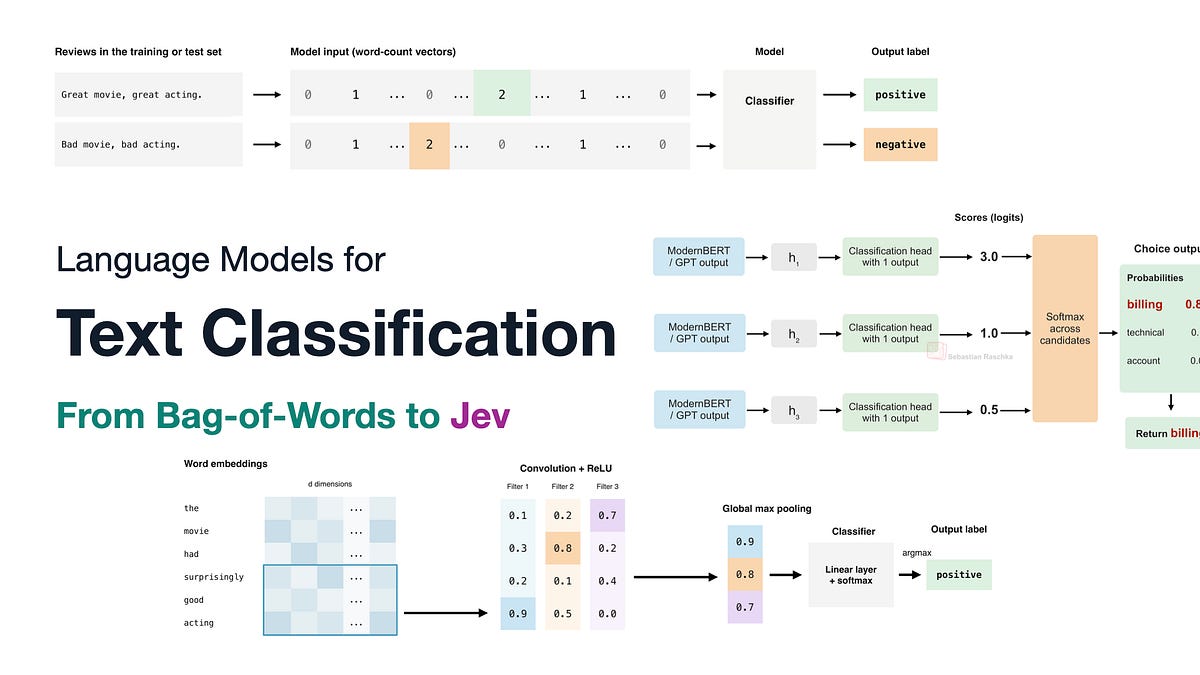
A classifier becomes the story
A newly released AI model called Jev has drawn unusually strong attention across technical communities in the two weeks since it appeared, according to machine-learning researcher Sebastian Raschka. In a lengthy analysis published on his blog and featured on Hacker News' front page, Raschka sets out to explain what Jev does, how it likely works under the hood, and why a model built for classification has generated this much interest.
He is candid that his own assessment shifted while investigating it: he started from the assumption that classifiers were familiar territory he could easily replicate himself, and came away surprised by how well the model performs in practice. He also discloses that he has no affiliation with Jev, received no free access, and frames the piece as technical analysis rather than an endorsement.
Between LLMs and purpose-built classifiers
Raschka positions Jev between two extremes. Modern GPT-class and open-weight large language models can handle the same classification tasks and are also capable of far more general decision-making, but Jev completes those tasks faster and at lower cost. At the other end, a special-purpose classifier trained on one narrow, well-defined problem will probably beat Jev on accuracy, speed and price alike.
Jev's pitch, in his telling, is generality: a single model that covers many classification problems rather than the strongest possible model for any single one. Raschka cautions that his account of the methodology behind Jev is an educated guess rather than official documentation, and the article pairs that reasoning with an overview of the model's API.
A short history of teaching machines to sort text
Much of the article is a compressed history of text classification, which Raschka uses to place Jev in context and cut through the hype. Fifteen years ago, when he was a graduate student, the standard approach was a bag-of-words representation fed into classic models such as naive Bayes, logistic regression, SVMs, random forests or gradient-boosted trees. Typical applications ranged from news categorisation to email spam filtering; Raschka notes that Gmail's original spam filter allegedly relied on naive Bayes over bag-of-words features.
Bag-of-words converts variable-length text into a fixed-size vector by counting how often each vocabulary word appears. It is computationally cheap and works well when particular words are strong signals for a label, but it discards word order entirely. Raschka's illustration: two sentences describing opposite events, a dog biting a man versus a man biting a dog, collapse into identical vectors. Adding n-gram features partially recovers local word order, at the cost of a much larger vocabulary. Even so, he still recommends bag-of-words plus logistic regression as the baseline for any text-classification project because it is so easy to implement.
The next stage in his timeline is word embeddings: dense learned vectors representing individual words, produced by methods such as Word2Vec and GloVe, or learned inside the network itself. Embeddings made it possible for CNN and RNN architectures to process text while preserving structure. But these classic embeddings are context-independent at lookup time, meaning a word like "bank" gets the same vector whether it sits next to "river" or in a sentence about finance. That limitation is where transformer-era models, and eventually models like Jev, pick up the story.
Why it matters
Jev's traction suggests the interesting layer of the AI stack is not always the largest model. If a dedicated classifier wins on a single task and an LLM wins on generality, Jev's bet is that most real workloads sit between those poles and will happily trade a little peak accuracy for cheaper, faster classification across many problems. Raschka's framing gives engineering teams a practical decision rule: use a purpose-built classifier when the problem is fixed and narrow, an LLM when general reasoning is required, and a general-purpose classifier for the broad middle ground where cost and latency matter at scale. His historical tour also works as a corrective to the hype. Jev is, at heart, a text classifier, but its positioning and economics make it more than a routine one.
- #ai
- #machine-learning
- #text-classification
- #language-models
- #llm