· via Hacker News – Front Page (native)
Raspberry Pi Zero 3 W and Pi 4 Model A surface in kernel device trees
Device tree files in Raspberry Pi's Linux kernel reveal an unannounced Zero 3 W built on the Pi 4's BCM2711 chip and a cheaper Pi 4 Model A stripped of Ethernet and analogue audio.
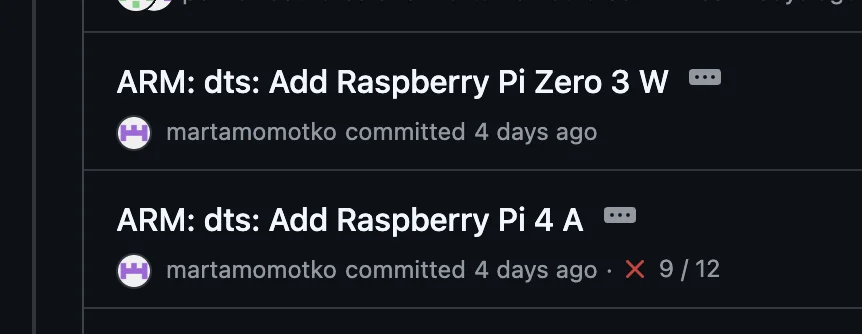
Two unannounced boards appear in the kernel
Raspberry Pi's Linux kernel tree now contains device tree files for two boards that have not been announced: a Raspberry Pi Zero 3 W and a Raspberry Pi 4 Model A. Phoronix spotted the additions first, and bret.dk has since gone through both files in detail. There is no official word on either product, but kernel support landing ahead of launch is typically a sign that hardware is close.
Device trees describe a board's hardware to the kernel — processor, GPIO assignments, controllers and peripherals — and they tend to reveal a lot even without a spec sheet.
Zero 3 W: Pi 4 silicon in a tiny board
The headline detail is the chip. According to bret.dk, the Zero 3 W device tree points to Broadcom's BCM2711, the quad-core Cortex-A72 SoC used in the Raspberry Pi 4. That would replace the RP3A0 in the Zero 2 W — a quad-core 1GHz Cortex-A53 part launched almost five years ago — and represents a significant per-core performance step up for the Zero form factor. The files say nothing about clock speeds, and bret.dk raises the question of thermals, since the BCM2711 is not known for running cool and a Zero board offers little surface for heat to spread across.
Other details read from the tree:
- One HDMI output, with the second HDMI controller permanently disabled.
- An SPI flash bootloader, suggesting the EEPROM-based boot setup of the Pi 4 and the ability to update the bootloader — something the Zero 2 W never had.
- A power button defined on GPIO 46 and mapped to the power key, similar to the Pi 5.
- Wi-Fi and Bluetooth wired up the same way as the rest of the BCM2711 family, with a single ACT status LED.
- The standard 40-pin GPIO header, so existing HATs should keep working.
Two items are more speculative: the PCIe controller is enabled, with lines named for power enable and detect/wake, and the camera configuration uses a 4-lane CSI setup rather than the 2-lane one on the Pi 4 Model B. bret.dk cautions that both device trees share a lot of duplicated content — the Zero 3 W even carries a duplicated GPIO line name — so these may not reflect the shipping hardware. There is also an eMMC hint in the storage controller configuration, but bret.dk expects microSD on the final board, since eMMC would push up the price of a cost-sensitive product.
Pi 4 Model A: the budget variant returns
The Model A formula — take the Model B, remove what most people can live without, and lower the price — has not been seen since the Pi 3 Model A+ in 2018. According to bret.dk, the Pi 4 Model A follows the same recipe:
- No Ethernet: the controller is not enabled, and the GPIO lines that drive the Ethernet PHY on the Model B have been repurposed.
- A single HDMI output instead of the Model B's two micro-HDMI ports.
- No 3.5mm audio or composite jack; analogue audio pins are empty and the composite encoder is disabled, leaving audio over HDMI or USB/I2S.
- microSD storage with 1.8V signalling support for faster UHS card modes.
- External antenna support: two antenna control lines and overlay parameters for choosing between antennas, matching the Compute Module 4's approach for switching to an external U.FL connector. bret.dk finds this the most interesting detail, particularly for anyone mounting a Pi inside a metal enclosure.
- The same SPI flash bootloader and power button definitions as the Zero 3 W.
USB is an open question. The PCIe controller is enabled — the Model B uses PCIe for its USB 3 ports — so USB 3 is possible, but the 3 Model A+ shipped with a single USB-A port and bret.dk expects the same here.
What is still unknown
Device trees do not describe memory, so RAM configurations remain a mystery, and there is no information on pricing, connector types or a release date. Price is the key question. bret.dk notes that memory costs have risen recently — the 1GB Pi 5 launched alongside a round of increases — and argues that a cheaper Pi 4 variant makes sense as a mature, well-supported option for people who do not need a Pi 5. The Zero 3 W is harder to call, since the Zero range has always been defined by its price and the BCM2711 is unlikely to be as cheap to build around as the RP3A0.
Why it matters
For embedded developers and hardware hackers, these files amount to an early spec sheet. A Zero-class board with Pi 4-class CPU performance would be a meaningful upgrade for compact projects, and the bootloader and power button changes bring the smaller boards closer to the Pi 4 and Pi 5 feature set. A Pi 4 Model A without Ethernet or analogue audio, meanwhile, could become the default choice for headless Wi-Fi-only builds if it lands at a lower price, and the possible external antenna support would be a practical win for metal-enclosed deployments. Nothing is confirmed until Raspberry Pi announces the boards, but kernel support appearing first is a strong signal that both are close to shipping.
- #raspberry-pi
- #hardware
- #linux
- #embedded
- #single-board-computers