· via Hacker News – Front Page (native)
Repurposed Google embedding model transcribes an hour of audio in ~13s on a MacBook Air
A project surfaced on Hacker News turns Google's EmbeddingGemma 2 into an on-device speech-to-text tool that transcribes an hour of audio in about 13 seconds on a base M3 MacBook Air.
An embedding model turned transcriber
Google's EmbeddingGemma 2 was built as an embedding model: its job is to map inputs to vectors, not to produce text. According to the project's page at eg2.haku.sh, which reached the front page of Hacker News, its developers have repurposed that model into a speech-to-text system, Embedding Gemma Transcribe, that processes an hour of audio in roughly 13 seconds on a base M3 MacBook Air, entirely on the machine.
How the conversion works
EmbeddingGemma 2 is multimodal: it encodes text, images, audio and video into a single shared vector space. The project's page explains that audio of a spoken word naturally sits near the written form of that word in this space, so the team attempted to retrieve words from it directly.
The implementation leaves the model's audio encoder untouched. A small, newly trained reader component maps each short slice of audio into the model's text space, and the nearest of roughly 229,000 English words is selected as the output. A separate, very small model then inserts punctuation and capitalization.
Training costs were modest. Only the reader was trained, which the project says took under two hours on eight H100 GPUs using openly licensed English speech. The underlying Google model was never trained for transcription at all.
The speed numbers
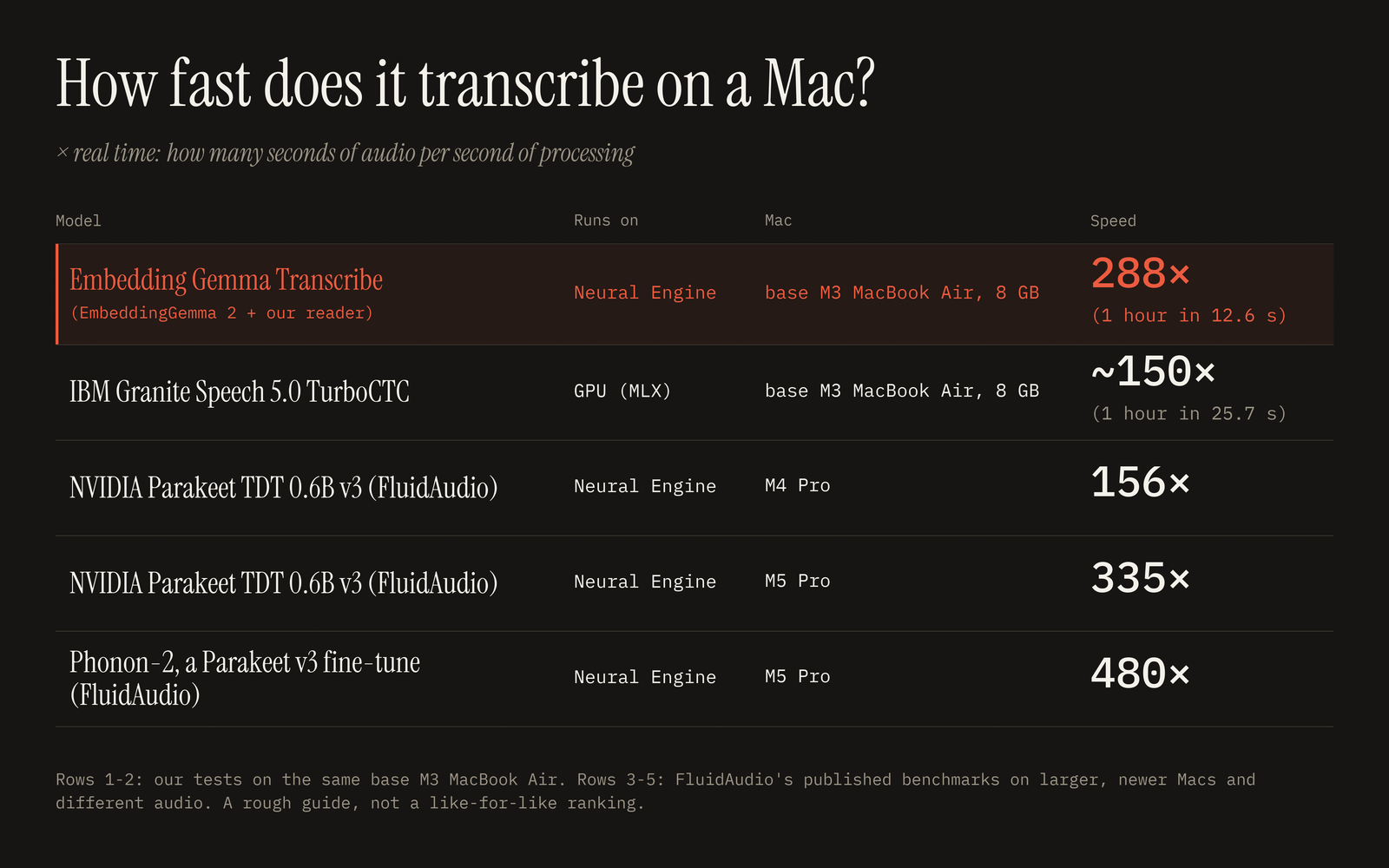
On a base M3 MacBook Air with 8 GB of RAM, executing on Apple's Neural Engine, the project reports 288x real-time throughput: one hour of audio in 12.6 seconds. On the same laptop, the developers measured IBM's Granite Speech 5.0 Turbo CTC, running on the GPU through MLX, at roughly 150x, or 25.7 seconds per hour of audio.
For comparison, the page also cites figures from FluidAudio's published benchmarks: NVIDIA's Parakeet TDT 0.6B v3 at 156x on an M4 Pro and 335x on an M5 Pro, and Phonon-2, a Parakeet fine-tune, at 480x on an M5 Pro. The developers note that these rows were measured on newer, larger machines with different audio, so they should be read as indicative rather than a fair head-to-head ranking.
Accuracy is the catch
Speed is not the whole picture. The project reports a word error rate of about 5% at present, compared with 2-3% for leading speech models. The developers attribute the shortfall to the reader component and say a better-trained version is their next iteration.
What you can actually run
The tool ships as a free Mac application, currently at version 1.6, requiring macOS 14 or newer on Apple Silicon; the models, about 715 MB, download on first launch. It accepts audio files for transcription and supports dictation into any app by holding the right Option key, speaking and releasing. Everything runs on the Neural Engine, and the developers state that audio stays on the machine at all times.
Why it matters
The demo is striking on two levels. First, raw local performance: an hour of audio in about 13 seconds on a fanless, entry-level laptop shows that on-device transcription can be fast enough to replace cloud workflows for many uses, with the privacy benefit that recordings never leave the machine.
Second, the method itself. A model trained purely to embed multimodal inputs evidently contains enough structure to be steered into a generative task by a small, cheaply trained adapter. If the accuracy gap does close, the same recipe of a frozen encoder plus a lightweight reader could plausibly be tried on other tasks, other modalities and other languages. For now, the claims are developer-reported and the error rate remains roughly double that of the best systems, so this is best read as a compelling proof of concept rather than an immediate replacement for established speech models.
- #on-device-ai
- #speech-to-text
- #apple-silicon
- #embedding-models
- #local-inference