· via Hacker News – Front Page (hnrss.org)
Rhun is an open-source code editor written entirely in assembly
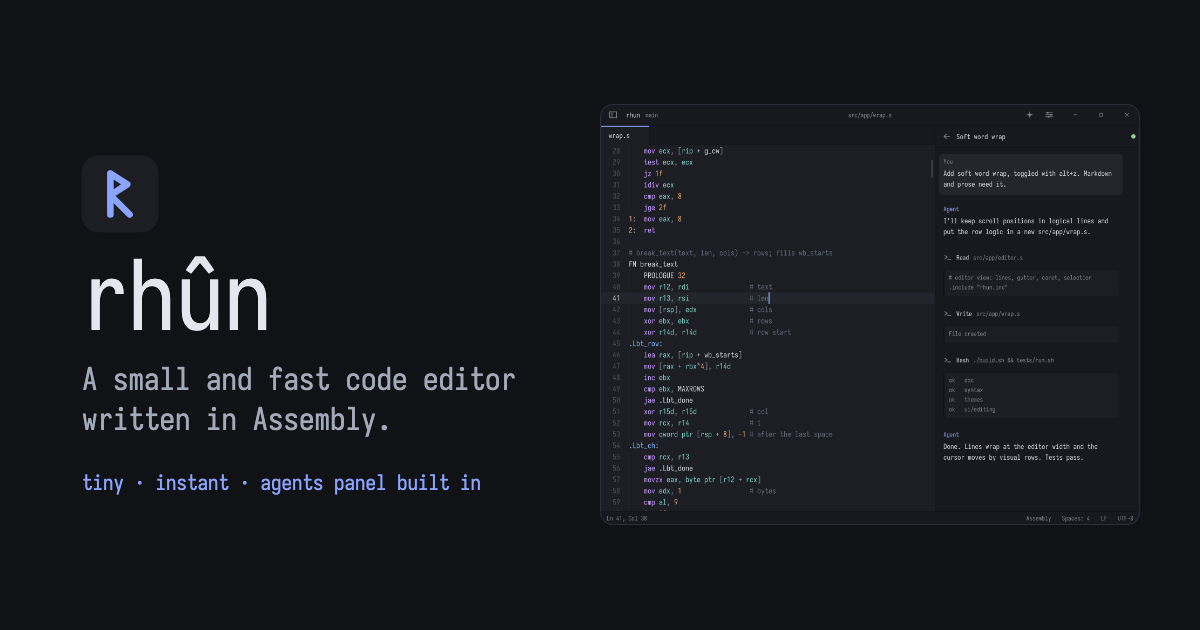
A developer has launched Rhun on Hacker News: a small, open-source code editor written in assembly, offering tabs, syntax highlighting, fuzzy search and optional Vim mode on Windows, Linux and macOS.
An editor built at the lowest level
A developer has launched Rhun, a small open-source code editor written entirely in assembly language, via a Show HN post on Hacker News that reached the site's front page. The project, hosted on GitHub under the account vshvedov and presented at rhun.app, describes itself as a small and fast editor, and its entire selling point is the unusual choice of implementation language.
Almost no modern user-facing software is written by hand in assembly. Editors today typically ship as Electron applications bundling a browser engine, or as native programs written in C, C++, Rust or Go. Rhun's decision to go all the way down to assembly is what made the launch stand out on Hacker News, where low-footprint tooling and unconventional engineering both tend to draw attention.
What Rhun actually offers
According to the project's website, the feature set covers the core expectations of a modern code editor: tabbed editing, syntax highlighting, fuzzy search, and an optional Vim mode for users who prefer modal editing. The editor runs on Windows, Linux and macOS, which is itself notable for an assembly codebase, since assembly is specific to a CPU architecture rather than a portable language.
The announcement does not mention heavier features common in mainstream editors, such as an extension ecosystem, language server integration, an embedded terminal or built-in version control. That absence appears deliberate. The site pitches Rhun with the line that AI now does the heavy lifting, so your editor can stay light, framing the tool as a deliberately minimal surface around code rather than a full development platform.
Installation follows the lightweight theme. On Linux and macOS, the project offers a terminal one-liner that downloads the latest release install script from GitHub. On Windows, users download a ZIP archive, extract it and run rhun.exe directly.
Why writing an editor in assembly is rare
Assembly requires the programmer to work at the level of individual processor instructions, with no abstractions for memory management, string handling or UI construction. That makes it extremely laborious for large applications and notoriously difficult to maintain, debug and extend, which is why it survives mainly in small performance-critical routines, bootloaders, embedded systems and demos.
Building a complete, cross-platform text editor this way inverts the industry's usual direction of travel, where tools grow heavier over time. The trade-off Rhun is betting on is that a tiny native binary can start instantly and consume minimal resources compared with editors that ship an entire runtime. The project has not publicly detailed how it handles the differences between CPU architectures and operating systems from a single codebase, which will be one of the first questions technically minded readers ask.
Why it matters
Rhun is a genuine novelty: an actively distributed, open-source desktop application written in assembly is close to unheard of in 2020s software, and the source being public makes it a rare artefact for developers curious about how such a thing is structured. It also lands at a moment when editor bloat is a running complaint among developers, and when AI assistants are increasingly absorbing tasks that once justified heavyweight tooling. If the project's premise holds, the editor of the future might need to do far less. Whether hand-written assembly can deliver a maintainable, extensible editor is unproven, and its long-term viability will depend on whether a community forms around code that very few programmers are fluent in. As an experiment in radical minimality, though, it is exactly the kind of project Show HN exists for.
- #open-source
- #code-editor
- #assembly
- #developer-tools
- #hacker-news