· via Hacker News – Front Page (hnrss.org)
Screen time at age 1 linked to lower academic scores at age 9 in 502-child cohort study
A Singapore birth cohort study of 502 children links daily screen time at ages 1 and 6 to lower academic performance at age 9 and weaker working memory at 10.5, with the strongest effects in infancy.
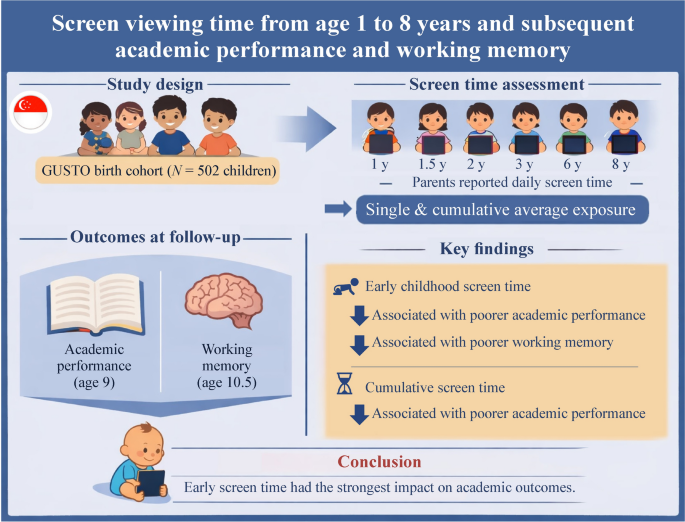
A longitudinal study following 502 children in Singapore has found that daily screen viewing time in early childhood, particularly around age one, is associated with lower academic performance at age nine and weaker working memory at age ten and a half. The paper, published by Springer and currently on the Hacker News front page, is notable for measuring screen exposure at six separate ages and then testing which periods matter most.
How the study was conducted
According to the study, the researchers drew on the Growing Up in Singapore Towards healthy Outcomes (GUSTO) birth cohort. Parents reported how much time their children spent viewing screens at ages 1, 1.5, 2, 3, 6 and 8. Years later, trained psychologists assessed the children at ages 9 and 10.5 using standardized instruments: the Wechsler Individual Achievement Test (Third Edition) for academic performance, and the Letter-Number Sequencing task from the Wechsler Intelligence Scale for Children (Fifth Edition) for working memory. The team then modeled the relationship between screen time and later outcomes using multivariable linear regression.
Screen use in the cohort was far from marginal. Based on parent reports, average viewing time was 2.1 hours per day at age one and rose to 3.0 hours per day by age eight.
What the numbers show
Before adjustment, higher screen time at every measured age tracked with poorer academic performance at 9 and poorer working memory at 10.5. After the researchers adjusted for other variables, the effect sizes shrank, but several associations held:
- Age 1: each additional hour of daily viewing corresponded to 1.47 fewer standard points in academic performance at age 9 (95% confidence interval: -2.37 to -0.57).
- Age 1.5: -0.95 points per additional daily hour (95% CI: -1.85 to -0.06).
- Age 6: -0.88 points per additional daily hour (95% CI: -1.55 to -0.21).
Working memory at age 10.5 showed adjusted associations at age 1 (-1.12, 95% CI: -2.07 to -0.17) and age 6 (-1.01, 95% CI: -1.71 to -0.31).
Cumulative exposure told a split story: higher average screen time across childhood was consistently associated with poorer academic performance, but not with working memory. The authors report that the strongest single-age effects appeared in early infancy.
How to read the findings
Two cautions apply. The gap between the unadjusted and adjusted results means a substantial share of the raw association is explained by other factors the researchers controlled for; what remains is a smaller but statistically significant link concentrated at ages 1, 1.5 and 6. And because this is a cohort study, it establishes association rather than causation, and the paper's abstract frames its results as associations rather than proof that screens cause cognitive harm.
The age pattern is itself informative. The paper reports persisting adjusted associations only at ages 1, 1.5 and 6 for academic performance, and only at ages 1 and 6 for working memory. In other words, the study's value lies in identifying sensitive windows rather than supporting a blanket conclusion that screen time is equally consequential at every age.
Why it matters
The study's own background notes that longitudinal evidence in this area is scarce, which has made it hard to identify when screen exposure matters most. By measuring at six time points and following up with clinician-administered tests rather than self-reports or school grades, the GUSTO analysis offers parents, pediatricians and policy writers something rarer than another correlation: timing. If the findings hold up in replication, the practical implication is that limiting screen time in the first years of life, and again around age six, may deserve priority over generic limits applied uniformly across childhood. For the tech industry, it adds longitudinal data to ongoing debates around child-focused content design and the screen-time controls now built into consumer operating systems.
- #screen-time
- #child-development
- #longitudinal-study
- #research
- #public-health