· via Hacker News – Front Page (hnrss.org)
ShapeLearn quants run Qwen 3.8 27B in 13GB VRAM at near-BF16 quality
ByteShape's finished ShapeLearn GGUFs put Qwen 3.8 27B within reach of consumer GPUs: the top variant needs 13.1GB of VRAM and scores 99.63% of BF16 in the team's benchmarks.
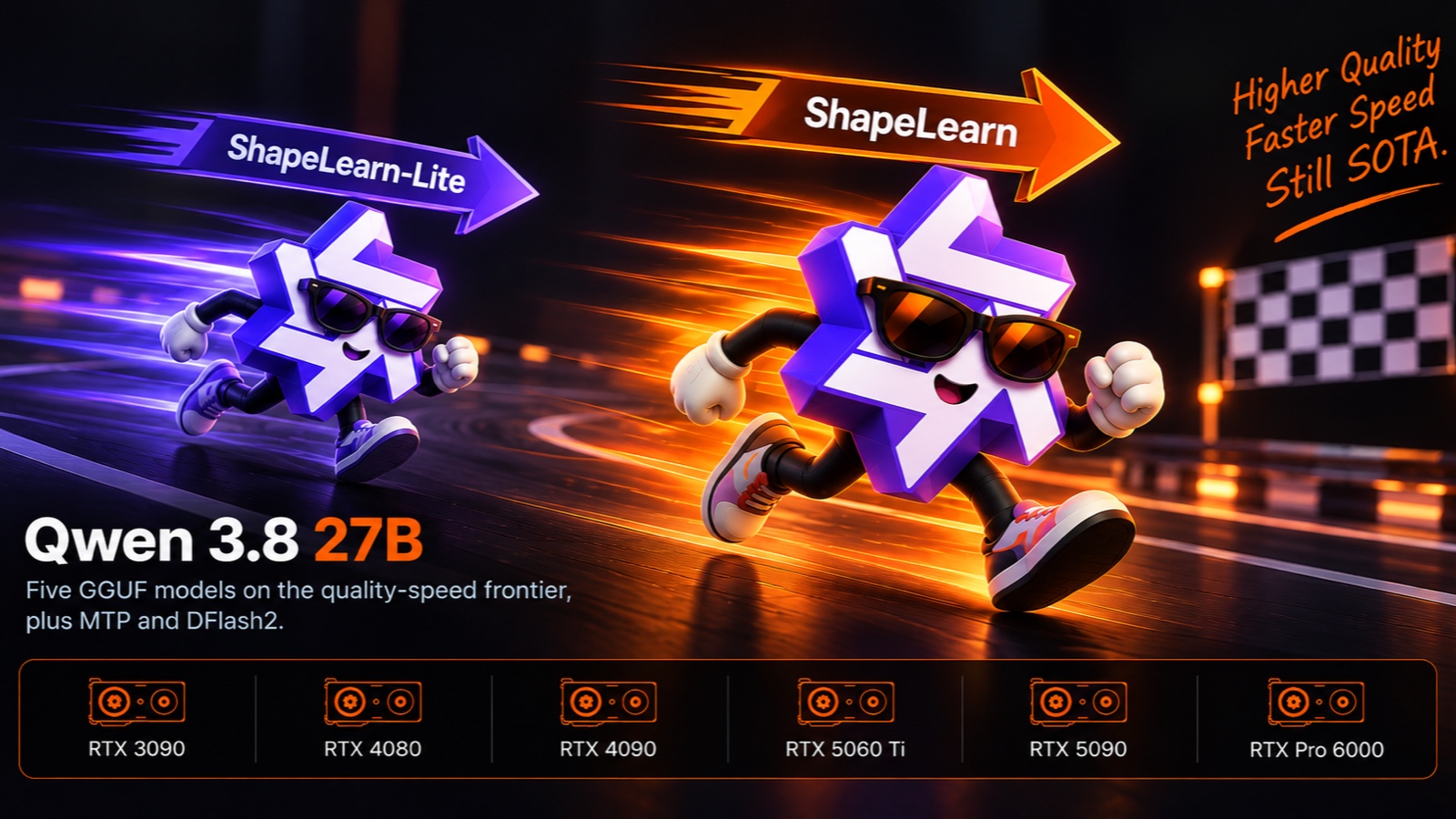
ByteShape has completed the full run of its ShapeLearn quantizations for Qwen 3.8 27B and published benchmarks comparing them against its own quick-turnaround Lite set and competing quants. The standout number: the largest variant in the release, IQ4_XS at 3.84 bits per weight, occupies 13.1 GB of VRAM while retaining 99.63% of the BF16 original's aggregate benchmark score. The post on byteshape.com reached the Hacker News front page.
According to ByteShape, Qwen 3.8 27B shipped on August 14, 2026, and the team published its first GGUFs four days later under the ShapeLearn-Lite name, built with a much smaller optimization budget and fewer checks. The full models took longer to produce and, per the team's measurements, land further out on the quality-speed trade-off than the Lite files.
Five variants, one trade-off
The release spans five GGUFs labelled GPU-1 through GPU-5, ranging from IQ2_XXS at 2.56 bpw up to IQ4_XS at 3.84 bpw. Across all six GPUs tested, larger files scored higher and smaller files generated faster. Because Qwen 3.8 27B is a dense model and memory transfers are the bottleneck, each bit shaved per weight converts into throughput more directly than it does for mixture-of-experts models, ByteShape notes.
On an RTX Pro 6000, GPU-1 runs at 116.11 tokens per second with an accuracy figure of 0.9304 relative to BF16, while GPU-5 delivers 90.42 tok/s at 0.9963. The RTX 5090 shows the same ordering, with GPU-5 reaching 93.66 tok/s.
The default recommendation is GPU-5 wherever it fits. When context length pushes past 13.1 GB, GPU-4 is the fallback: IQ3_S at 3.23 bpw, 11.0 GB in size, 98.72% of the BF16 score, and higher throughput than GPU-5 at 101.11 tok/s on the Pro 6000.
How the quants stack up
The charts compare ShapeLearn against quants from AtomicChat, Bartowski, ISTA-DASLab and Unsloth Dynamic v3. Bartowski's newest releases landed after ByteShape finished testing and are excluded from the plots. By the team's frontier measure, meaning no plotted competitor is simultaneously faster and more accurate, all five ShapeLearn models sit on the frontier in all six GPU comparisons, and GPU-5 posts the highest aggregate score of anything plotted. ByteShape also singles out ISTA-DASLab's GSQ-RCO-IQ3_S, at 3.50 bpw with 0.9943 accuracy and 94.77 tok/s, as another competitive frontier point.
Two routes to speculative decoding
Every GGUF ships with the MTP draft head embedded, so llama-server can switch on speculative decoding with a flag, and it works alongside image inputs through the mmproj projector. The alternative, DFlash2, pairs the main model with a separate 1.1 GB Q4_K_M draft model and is the fastest option for text-only use, but it needs more memory, drops multimodal support in llama.cpp, and requires build b10658 or newer. ByteShape reports that both methods raised throughput on every model and GPU tested, and suggests DFlash2 for maximum text throughput when memory allows, MTP when VRAM or image input matters more.
The Lite set, revisited
The rushed Lite quants aged better than expected. Three of the six Lite models still sit on the frontier in ByteShape's comparison against Unsloth Dynamic v3, outperforming what their KLD ranking had predicted.
Why it matters
A 27-billion-parameter dense model that keeps 99.6% of its benchmark quality in 13.1 GB fits inside a mainstream 16 GB consumer graphics card with headroom left for KV cache and context, and the 11 GB GPU-4 extends that to even more modest hardware. The release also shows how quickly the community quantization pipeline now moves: usable GGUFs appeared within four days of the model's release, followed weeks later by a more rigorously optimized set that competes with established names like Unsloth and Bartowski on measured speed-versus-quality charts. One caveat: all figures come from ByteShape's own benchmark suite and test GPUs, and the frontier is defined only over the quants the team plotted, so independent verification is still outstanding.
- #qwen
- #gguf
- #quantization
- #llama-cpp
- #local-llm