· via Hacker News – Front Page (native)
Simon Willison starts Agentic Engineering Patterns, a living guide to coding with agents
Simon Willison has launched a book-shaped collection of coding patterns for building software with agents like Claude Code and OpenAI Codex, opening with chapters on cheap code and test-driven development.
A structured catalogue for the agent era
Simon Willison has kicked off a new project, Agentic Engineering Patterns, that collects and documents coding practices for getting the best results out of coding agents. In the announcement on his blog, which also surfaced on the Hacker News front page, he frames the effort as an attempt to answer a simple question in one place: how do you actually get good results from these tools?
He is not starting from scratch. According to the post, more than 345 entries already sit under his ai-assisted-programming tag, but that material is relatively unstructured. The new project is meant to organise what he has learned into something closer to a reference.
What counts as agentic engineering
Willison uses agentic engineering to mean building software with tools such as Claude Code and OpenAI Codex, whose defining feature is that they can both generate and execute code. Because an agent can run and test what it writes, it can iterate on its own output rather than depending on turn-by-turn guidance from a human supervisor.
He draws a sharp line between this and vibe coding. In its original sense, vibe coding means paying no attention to the code at all, an activity now often associated with non-programmers using LLMs. Agentic engineering sits at the opposite end of the scale: professional software engineers using agents to accelerate their work by amplifying expertise they already have.
The first two chapters
The project opens with two chapters published on the day of the announcement:
- Writing code is cheap now looks at what Willison calls the central challenge of the discipline: the cost of producing initial working code has dropped to almost nothing, and that upends existing intuitions about how individuals and teams should work.
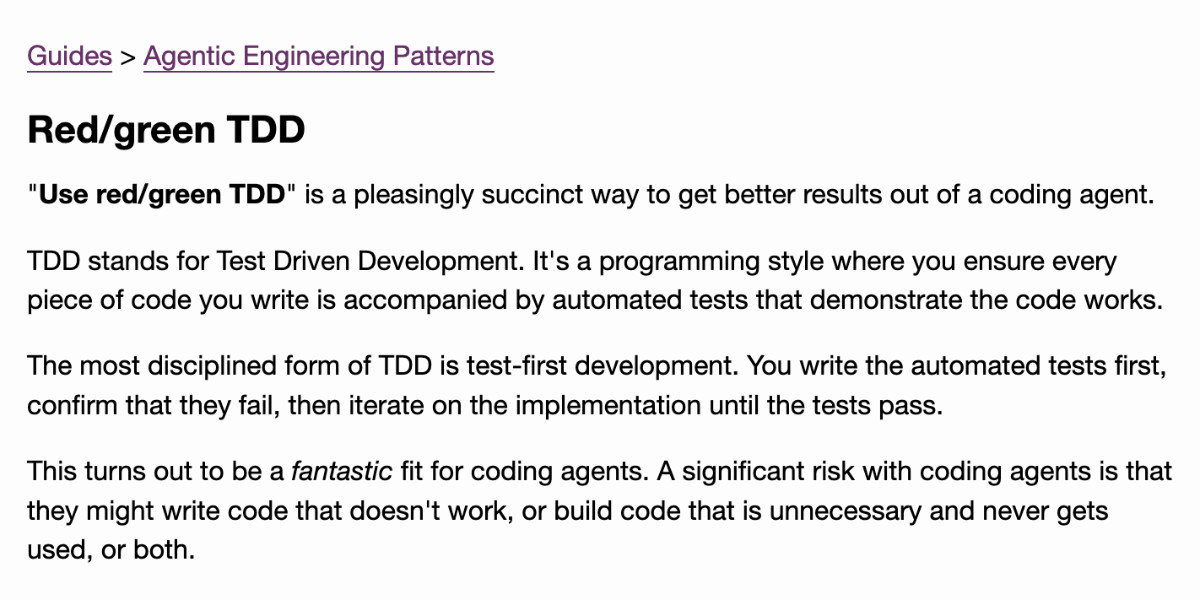
- Red/green TDD describes how test-first development helps agents write more succinct and reliable code with minimal extra prompting.
He plans to add chapters at a pace of one to two per week and says he does not know when he will stop, since there is a lot of ground to cover. The chapter format is loosely inspired by the 1994 book Design Patterns: Elements of Reusable Object-Oriented Software.
A new publishing format, with a meta twist
Agentic Engineering Patterns is not exactly a book, but it is book-shaped. Willison is publishing it on his own site using a new content type he calls a guide: a collection of chapters where each chapter is effectively a blog post with a less prominent date, designed to be updated over time rather than frozen at the point of publication. He describes guides as his long-running attempt to solve the problem of publishing evergreen content on a blog.
There is a pointed piece of metadata attached to the project. Willison maintains a strong personal policy of never publishing AI-generated writing under his own name, and the chapters will be no exception: LLMs will handle proofreading, fleshing out example code and other side tasks, but the prose will be his.
The publishing platform itself, however, tells the opposite story about code. According to the post, the Guide, Chapter and ChapterChange models and the associated Django views were almost entirely written by Claude Opus 4.6 running in Claude Code for web, accessed from his iPhone. In other words, the site hosting a manual for working with coding agents was itself built by one.
Why it matters
As coding agents spread through professional teams, the bottleneck is shifting from writing code to directing, verifying and maintaining it. A structured, continuously updated pattern catalogue from a practitioner with a long track record in this space could become a practical reference for teams rethinking testing, review and planning habits for a world where a first working implementation costs almost nothing.
The opening chapters already sketch the core of that shift: one names the changed economics, the other offers a concrete technique for keeping agents on rails. The project is also worth watching as an experiment in living documentation, and as a demonstration of the division of labour Willison advocates: agent-written infrastructure carrying human-written judgement.
- #ai-agents
- #coding-agents
- #software-engineering
- #tdd
- #simon-willison