· via Hacker News – Front Page (native)
Singapore's GovTech launches FirstDate, a state-run dating pilot built on Gale-Shapley
Three years after the Social Development Network shut down, Singapore's GovTech is piloting FirstDate, a Singpass-verified dating service for civil servants that matches users in cycles using the Gale-Shapley algorithm.
A government matchmaker returns
Singapore is re-entering the dating business. According to a writeup on the Singapore Samizdat newsletter that surfaced on Hacker News, the Government Technology Agency (GovTech) announced a pilot programme called FirstDate in September 2026, with government employees forming the first pool of participants. The launch arrives roughly three years after the Social Development Network, the state's earlier matchmaking effort, was wound down.
The pilot is not out of nowhere: the same reporter had already revealed, in an April article for The Straits Times, that GovTech was exploring the concept.
How FirstDate works
Identity is verified through Singpass, Singapore's national digital identity system, which means every profile is tied to a real, verified person. Matching runs in cycles that the developers call programmatic rounds: each participant receives a single match per cycle, and contact details are shared only if both people accept. Whether you say yes or no, the round is finished, and the next match has to wait for a new cycle with a different pool.
More than 30 questions before you date
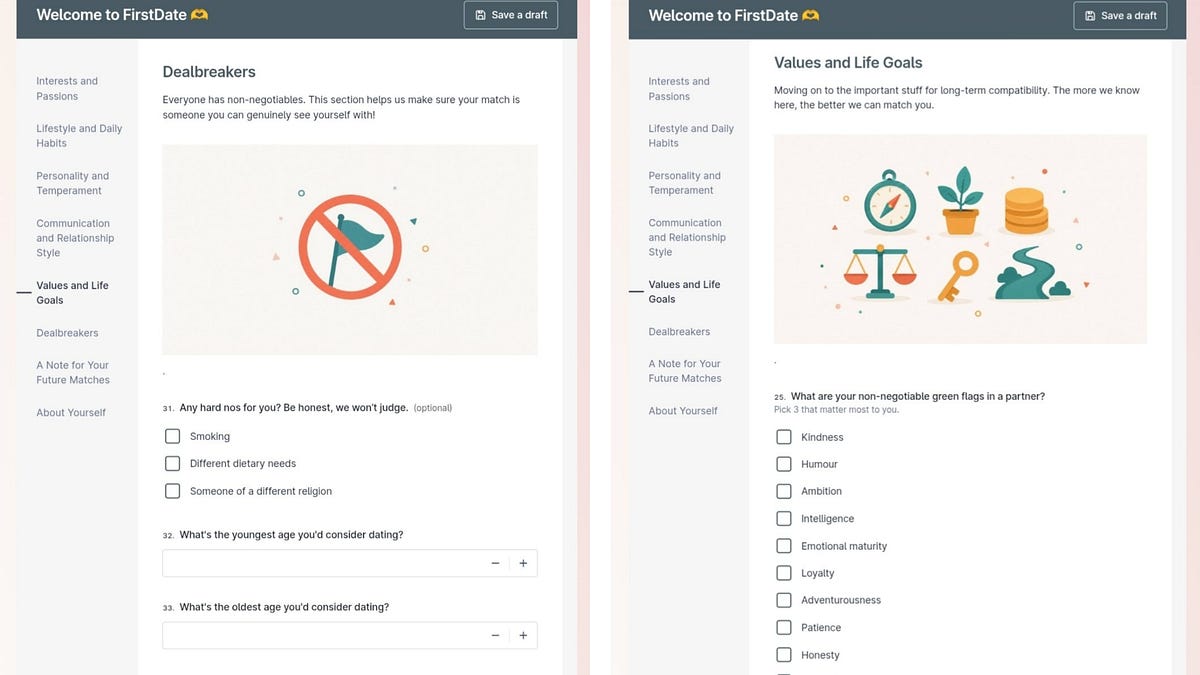
Sign-up starts with a questionnaire of over 30 questions across eight categories, including interests and passions, lifestyle and daily habits, and communication and relationship style. Singapore Samizdat republished the full list, which mixes checklists with optional free-text prompts.
The intake reads more like a personality survey than a form. Applicants check off hobbies, pick favourite cuisines, describe how often they travel, choose between early risers and night owls, and report on exercise, tidiness, and phone habits. Relationship-focused items cover love languages in both directions, instincts during disagreements, views on having children, saving versus spending, religion, and non-negotiables such as smoking or differing dietary needs. Open-ended fields capture the youngest and oldest acceptable dating age, plus a short self-introduction for a future match.
The form also collects a preferred name, a mobile number, and a dating history: first dates in the past year, prior use of dating apps or matchmaking services, and the date of the most recent first date. An earlier prototype reportedly considered free meals for first dates, which the writeup suggests explains the emphasis on food.
The Nobel-winning algorithm underneath
One line on FirstDate's site stands out: the service says it uses a "Nobel prize-winning framework," the Gale-Shapley Stable Marriage Algorithm. As Singapore Samizdat notes, the name is misleading, because the algorithm has almost nothing to do with actual marriage.
Gale-Shapley, also called deferred acceptance, has been used since the 1950s to place medical graduates into hospital residency programmes in the United States. Both sides submit ranked preference lists, and the algorithm produces a stable outcome: no two participants would both prefer each other over the partners they were assigned. Shapley shared the 2012 economics Nobel for this work with Alvin Roth, the economist who recognised the residency application and extended the method to markets such as school choice. The word "marriage" comes from the theory's original thought experiment, not from romance.
FirstDate's cycle design follows from this. The writeup infers that the service ranks each user against participants of the opposite gender based on questionnaire answers, then computes stable pairings for the round. Because deferred acceptance works on an entire pool at once, matches arrive batch by batch rather than as an endless feed.
Stable does not mean satisfying
The sharpest criticism in the writeup is that a stable match is not necessarily a good one. Gale-Shapley guarantees only that no two people in the pool mutually prefer each other over their assigned partners; it says nothing about whether anyone actually likes the result. The mechanism was built for institutional matching, where preferences are explicit and ranked and the objective is systemic coherence. Dating preferences are fuzzier, chemistry is unobservable, and one match per cycle caps each person's chances. The author raises further objections to applying this kind of game theory to romance, but the first is the most fundamental: provable stability is not the same as a date anyone enjoys.
Why it matters
FirstDate is a rare instance of a government building consumer software, and it follows a previous state matchmaking effort that was retired. If the pilot expands beyond civil servants, it will test whether an agency with no engagement or subscription incentives can hold its own against commercial dating platforms built on volume and endless swiping. It is also a live experiment in transplanting institutional matching machinery into a domain where the thing being optimised, mutual attraction, cannot be ranked on a list. However the pilot turns out, it will illustrate exactly where algorithmic matchmaking stops being an operations problem and becomes a human one.
- #singapore
- #govtech
- #dating-apps
- #algorithms
- #public-sector