· via Hacker News – Front Page (hnrss.org)
SolarWindow launches 0.85 mm peel-and-stick solar film with 24.4% efficient IBC cells
SolarWindow's ElectroFlex is a 0.85 mm self-adhesive solar film built on 24.4%-efficient IBC cells, aimed at trucks, trains, aircraft and buildings too weight-sensitive for rigid panels.
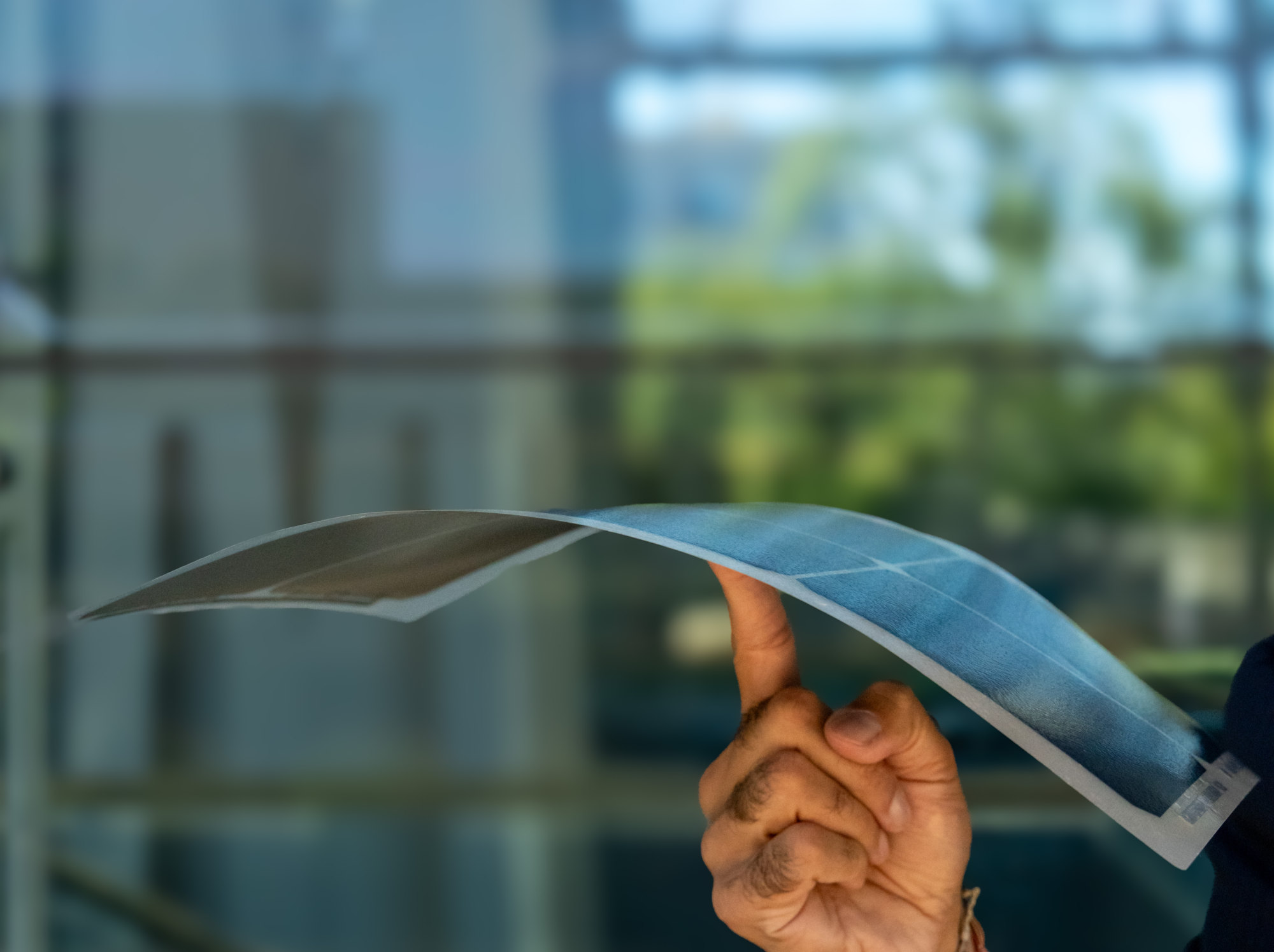
SolarWindow Technologies has commercially launched ElectroFlex, a flexible solar film just 0.85 mm thick that adheres directly to flat and curved surfaces. According to pv magazine, the product combines interdigitated back-contact (IBC) cells with 24.4% efficiency and a power-to-weight ratio of roughly 73 W/kg, positioning it for vehicles, aircraft and buildings where conventional panels are too heavy or too rigid.
A five-layer laminate
pv magazine reports that ElectroFlex is built as a five-layer composite laminate totalling 0.85 mm. The stack consists of a 0.10 mm front encapsulant, a 0.16 mm layer of high-efficiency solar cells, a 0.04 mm copper cell backing, a 0.30 mm composite laminate and a 0.25 mm rear substrate.
The company markets it as a "peel-and-stick" product: it requires no frames, no rigid glass and no conventional support structure, and both size and colour can be customised to customer specifications.
Sold as a system, not just a sheet
SolarWindow does not supply the film on its own. According to pv magazine, it also provides the wiring, harnesses, electrical systems and power-balancing components needed to integrate the product and deliver the electricity it generates.
Target applications
The manufacturer is aiming at transportation, marine, aerospace, architecture, agriculture, infrastructure, utility and specialty-vehicle markets. Examples cited include data centers and buildings, the roofs of commercial trucks and fleet vehicles, curved train surfaces, and drone and aircraft structures — surfaces that rigid glass modules generally cannot cover.
Availability
ElectroFlex is initially being offered to Tier 1 original equipment manufacturers in the United States. SolarWindow told pv magazine it plans to expand sales to selected markets in North America and Asia over the coming quarters.
A transparent coating still in the pipeline
The company is also developing LiquidElectricity, a transparent coating designed to turn glass and plastic surfaces into electricity-generating elements. SolarWindow claims the technology, which remains under development, could generate power from natural and artificial light, as well as low-intensity, shaded and reflected light.
Why it matters
Most solar capacity today relies on heavy, rigid modules mounted on frames or racks, which rules out a long list of surfaces — vehicle bodies, aircraft skins, curved facades — where added weight or mounting hardware is unacceptable. A sub-millimetre film with a power-to-weight ratio around 73 W/kg makes those surfaces candidates for generation, and the impact is largest in aviation, drones and commercial transport, where every kilogram carries a cost.
There are caveats worth keeping in mind. The 24.4% figure is a cell-level efficiency reported by the manufacturer, and real-world buyers will judge the product on module-level output, durability under vibration and weather, and cost per watt — details that should emerge as OEMs begin integrating it. The initial Tier 1-only release also means this is, for now, a business-to-business story rather than something installers or consumers can order directly.
Even so, a commercially available adhesive solar laminate with cell efficiency in the mid-twenties is a notable step for building-integrated and vehicle-integrated photovoltaics, two segments that have long promised more than they have delivered.
- #solar
- #renewable-energy
- #materials
- #hardware
- #manufacturing