· via Hacker News – Front Page (native)
Spanish museum builds full-scale Cray-1 replica powered by 30 old Mac Minis
Spain's Museo de Historia de la Computación has built a 1:1 Cray-1 replica driven by a cluster of 2012-era Mac Minis, reaching 1.3 teraflops — thousands of times the 1976 original's peak.
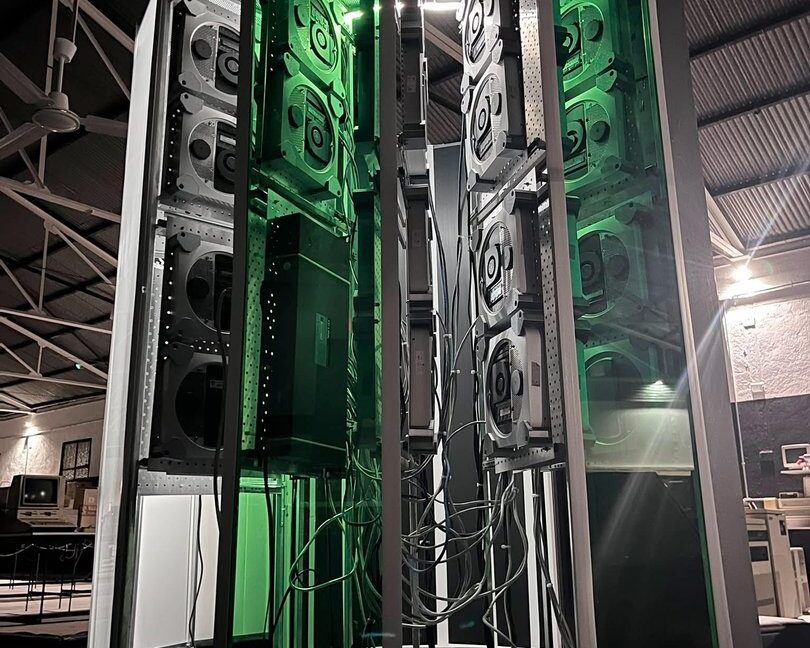
A Cray-1 you can sit at
Spain's Museo de Historia de la Computación has unveiled a full-scale, working homage to the Cray-1, the landmark supercomputer introduced in 1976. According to Ars Technica, the replica reproduces the machine's famous look — the padded bench seating included — but the electronics inside are entirely modern: a cluster of 30 Mac Minis, most of them built in 2012. The project took 18 months and was timed as a double anniversary, marking 50 years since both the Cray-1's debut and Apple's founding.
Thirty Minis, one cluster
The hardware mix is decidedly humble. Five of the machines carry quad-core Core i7 processors and the other 25 use dual-core Core i5 chips; all but two units date from 2012, with the remainder from 2014. Once networked, the nodes operate as a single coordinated system. In the team's most recent benchmarks, produced with a custom Python matrix-multiplication script, the 64 cores currently online delivered a combined 1.3 teraflops. Ars Technica reports that an earlier run reached 1.5 teraflops across all 70 available cores before one node dropped offline.
From vector lanes to message passing
For the museum, the build is as much a lesson in computer architecture as in history. The original Cray-1 relied on vector processing, applying a single instruction to many data elements simultaneously, whereas the replica is a parallel cluster in which independent processors divide a job and trade results. The performance gap is stark: the Cray-1's theoretical peak was roughly 160 megaflops, which makes the Mini cluster's recent 1.3-teraflop result about 8,000 times faster than the machine it imitates. Visitors can watch that scaling happen live, as the system runs matrix algorithms that map performance from a single core up to the full array running in parallel.
Mojave and passive cooling
Two engineering choices stand out. Rather than installing a conventional Linux distribution, the team stayed on macOS Mojave (10.14), taking advantage of the operating system's built-in MPI (Message Passing Interface) support — the software layer that lets every node in the cluster hand tasks to its neighbours. Cooling was the other puzzle, since a gallery full of whirring fans would be unkind to visitors. Each Mac Mini instead sits in an aluminium tray mounted on a steel rack chassis, and heat is dissipated entirely through passive convection. Ars Technica notes that the finished cluster is close to silent, a sharp contrast with the din of a typical server room.
The project has drawn wide attention since surfacing on Hacker News, largely because of the unlikely pairing at its core: a tribute to one of the most expensive computing machines of its era, built from hardware that most people would have written off.
Why it matters
The replica compresses five decades of computing history into a single object. A machine that was once a purpose-built research instrument has been recreated with consumer hardware that was headed for obsolescence — and that repurposed hardware outperforms the original by several orders of magnitude. It also turns an abstract concept into something observable: museum-goers can watch parallel scaling happen in real time rather than reading about it on a placard. And the build is a quiet counterargument to the idea that a decade-old computer is junk. Thirty "obsolete" Mac Minis, networked and cooled without a single fan, now form a working supercomputer exhibit that illustrates both how far architecture has come since 1976 and how much life old hardware still has in it.
- #retro-computing
- #supercomputers
- #mac-mini
- #hpc
- #museums