· via Hacker News – Front Page (hnrss.org)
Spinal promises sub-20ms codebase search and predictive navigation for AI-era repos
A new tool called Spinal surfaced on Hacker News claiming first search results in under 20ms on the Linux kernel, betting that understanding code is the new bottleneck as AI writes more of it.
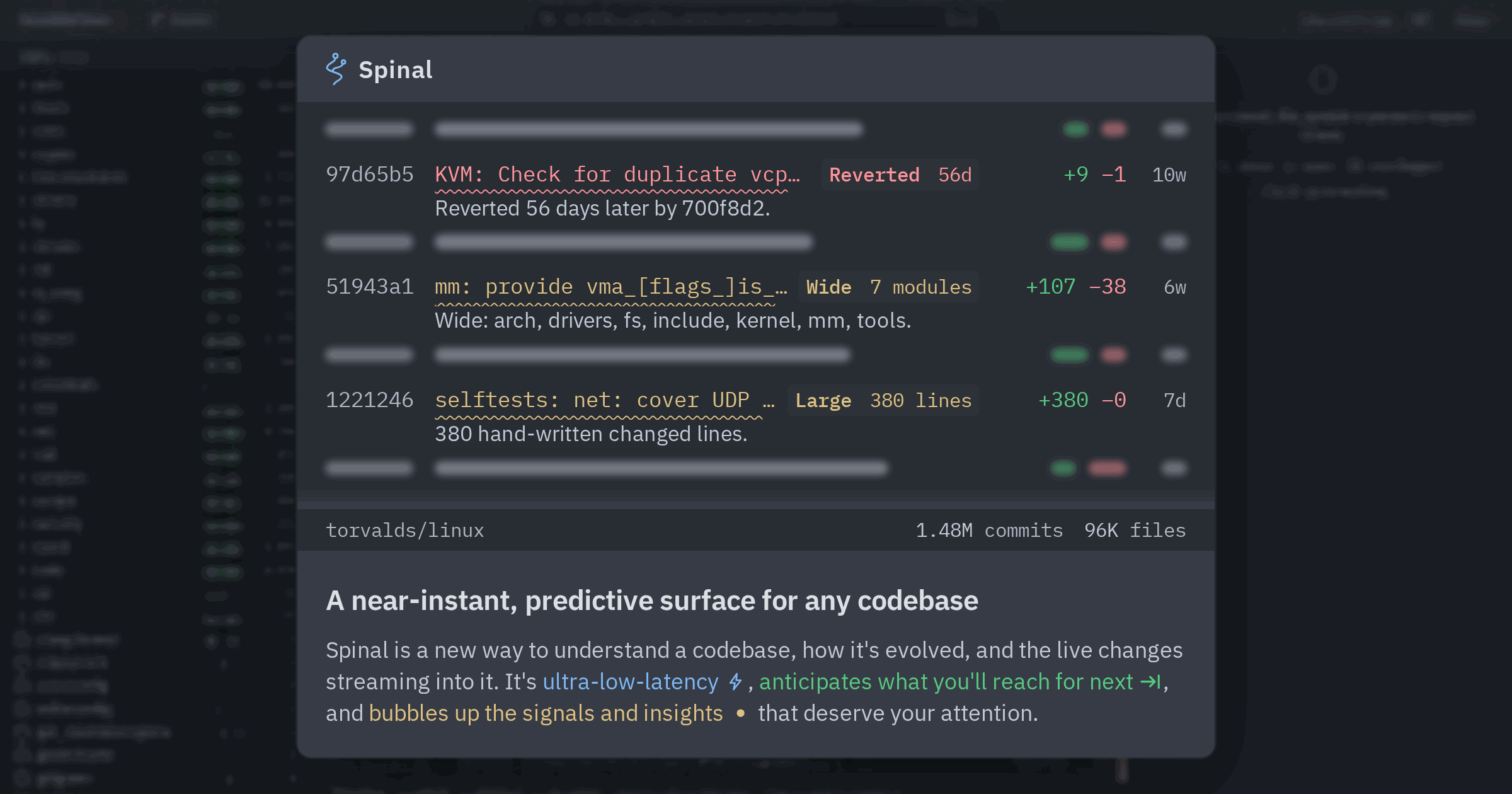
What Spinal is
Spinal appeared on the Hacker News front page on October 9, 2026, with a pitch aimed at a specific frustration: code is now being produced — much of it by AI agents — faster than people can absorb it. Rather than another tool for writing code, Spinal presents itself as a reading tool: a low-latency surface for exploring a repository, its history, and the changes landing in it as they happen.
According to the project's site, linked from the Hacker News listing, the tool is built around three ideas. The first is raw speed, with navigation designed to feel effectively instant. The second is anticipation: the software attempts to predict which file, commit or piece of context a developer will want next and have it ready. The third is filtering — instead of showing everything, it tries to rank the changes and signals most worth a human's attention, addressing the tangle of worktrees, diffs and branches that the site says overwhelms current workflows.
The kernel benchmark
The announcement's most concrete claim is a performance number. The team says its engine returns its first search results in under 20 milliseconds when benchmarked against the Linux kernel repository — roughly 1.48 million commits spanning about 96,000 files. If that holds up, navigating one of the largest open-source projects in existence would feel closer to a local, cached lookup than the multi-second round trips developers often accept from indexing and search tools on repositories of that scale.
The figure is self-reported. No methodology, hardware details or comparison against established code-search products accompanied the announcement, and the Hacker News listing itself offers no independent verification. Under 20 milliseconds for a first result is credible for a query run against a prebuilt index, but it should be treated as a marketing claim until outsiders can reproduce it.
Aimed at people behind their own agents
The framing of the launch is telling. The site describes the tool as built by engineers, for engineers who risk falling behind the autonomous coding agents now writing large portions of the world's software. Generation has become cheap; comprehension has not. Reviews, onboarding onto unfamiliar repositories, and checking what an agent changed overnight remain human-limited activities, and Spinal's bet is that understanding code is becoming a product category of its own, distinct from editors and code generators.
The predictive layer is what separates it from a plain fast index. Guessing what a developer will open next and surfacing live changes as they stream into branches is closer to what an attentive colleague does — but doing it reliably requires modelling both the codebase and the developer's intent, and the announcement gives little detail on how that works in practice, or how it behaves when several agents modify the same repository at once.
Open questions
The source material — a landing page and its Hacker News appearance — leaves practical questions unanswered: the deployment model, pricing, support for private repositories, how indexing is set up, and how well the prediction and ranking features generalise beyond showcase codebases. Those details will presumably emerge as early users get their hands on the tool.
Why it matters
The bottleneck in software is shifting from writing code to understanding it. As agents produce more of the diff, engineers need tools that let them navigate, verify and trust changes at something close to the speed those changes are made. A near-instant, predictive surface over a repository is one plausible answer, and the kernel benchmark sets an ambitious bar for what fast should mean. The open question is whether prediction and signal-ranking genuinely help on arbitrary codebases, or simply add one more layer of noise to workflows that already struggle to keep up.
- #developer-tools
- #code-search
- #ai
- #code-navigation
- #linux-kernel