· via Hacker News – Front Page (native)
Sunk Cost calculator estimates when a local LLM rig pays for itself versus API pricing
A Show HN calculator called Sunk Cost weighs hardware and electricity costs against API spending to estimate when a local LLM rig breaks even, with an option to assume API prices keep falling.
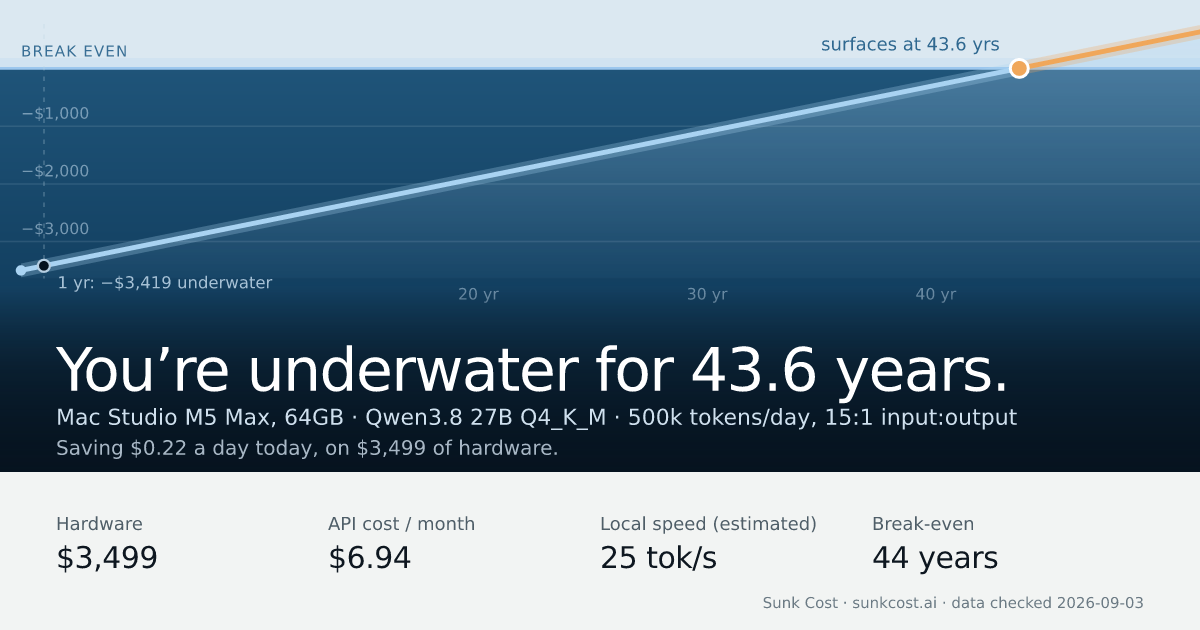
A calculator posted to Hacker News under the title "Show HN: Sunk Cost – How long until a local LLM rig pays for itself?" made the site's front page. The tool, available at sunkcost.ai, tries to answer a question developers keep circling: if you buy the hardware and run models yourself, how long before that works out cheaper than paying an API by the token?
What the calculator asks for
According to the project's page, the inputs cover both sides of the ledger. On the local side, you enter your electricity rate in dollars per kilowatt-hour and your measured generation speed in tokens per second. On the API side, you provide the hosted service's speed in tokens per second and — if you already rent inference rather than own it — your monthly bill. A toggle lets you assume API prices keep falling rather than staying flat, which materially changes how quickly a break-even point arrives, if it arrives at all.
The comparison itself is simple in shape: upfront hardware cost plus ongoing electricity, set against what the same workload would cost through an API, until the two lines cross.
How it handles speed you have not measured
The page is unusually explicit about its methodology. Where no measurement has been supplied, local speed is derived from memory bandwidth divided by the bytes read per token, and the page says such figures are labelled as estimates rather than measurements. That formula is a common rule of thumb for local inference, because token generation on a single machine is usually limited by how fast model weights can be streamed from memory, not by raw compute.
The page also clarifies that the API speed input feeds only the time comparison — how much longer a job takes locally than through a hosted endpoint — and does not affect the cost arithmetic.
The falling-price problem
The most consequential input is the pricing assumption. If per-token costs hold steady, a heavily used local rig can plausibly earn back its purchase price over months of use. If prices keep trending downward, the target moves: every price cut pushes the break-even point further out, or removes it entirely. Making that assumption an explicit checkbox, rather than a buried default, forces users to commit to a view on where API pricing is headed before they trust the answer.
Why it matters
The local-versus-API argument has largely shifted from ideology to accounting. Privacy, offline operation and freedom from rate limits are real reasons to run models yourself, but an honest case also needs a break-even estimate, and that estimate is highly sensitive to electricity prices, how much the hardware actually gets used, and where hosted pricing goes next. A tool that labels its estimates and surfaces its assumptions is more useful than a single confident number, because readers can stress-test the conclusion with their own inputs. The name, a nod to the sunk cost fallacy, cuts both ways: the exercise is worth doing before you buy the hardware, so you know whether the rig will ever pay for itself — not only afterwards, to justify money already spent.
- #local-llm
- #llm-inference
- #developer-tools
- #cost-analysis
- #hacker-news