· via Hacker News – Front Page (hnrss.org)
Tabernetes runs Kubernetes pods on a Linux kernel booted inside browser tabs
Tabernetes exposes a live Kubernetes cluster whose worker nodes are browser tabs, each running a Linux kernel compiled to WebAssembly; close a tab and the scheduler moves its pods elsewhere.
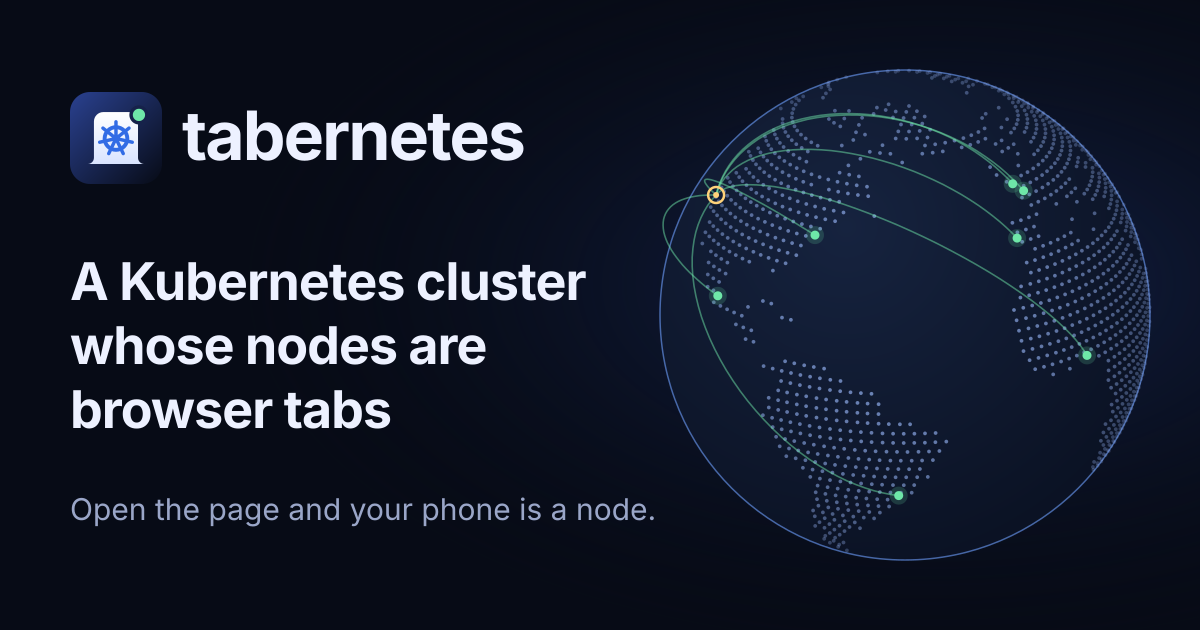
A project called Tabernetes, which surfaced on Hacker News's front page on 28 November 2026, invites visitors to lend a browser tab to a live Kubernetes cluster. Opening the join page — or scanning its QR code with a phone — turns that device into a node, and the cluster's scheduler can then hand the tab a pod. The pod's program runs on a Linux kernel booted inside the tab; close the tab and the node disappears, at which point Kubernetes starts the pod on someone else's tab instead.
How a tab becomes a node
Joining is deliberately cheap, according to the project's site: the page downloads roughly 5 MB and runs a small Linux guest on a single core, staying alive only as long as the tab stays open.
Mechanically, the join page keeps a socket open to an agent that sits alongside the cluster's Kubernetes API server, and that agent registers a Node object for the tab. When the scheduler decides to place a pod on it, the agent starts the pod's container with tabc, a container runtime designed so that the containers it launches live in browser tabs. The tab then boots a kernel compiled to WebAssembly, which executes the pod's program using the tab's own CPU and memory. The pod's filesystem and its network address, however, remain on the cluster's machine, so only compute is borrowed from the visitor.
An ordinary cluster with one new line
What makes the demo notable is how little of Kubernetes changes. The control plane is a stock Kubernetes, and pods are ordinary pods. The only addition is a single field, runtimeClassName: tab, in the pod spec: the scheduler places any pod carrying that field on a tab, while every other pod runs on the cluster's own machine. The site's worked example is an Alpine-based pod that prints its machine architecture and then idles, showing that a conventional container manifest runs somewhere unconventional without any other edit.
Watching the cluster in real time
The front page doubles as a live dashboard. Counters track how many nodes are online, how many pods are running in tabs, how many countries are participating, the median boot time, the cluster's age, cumulative hours of tabs lent, how many pods have been moved off closed tabs, and traffic carried between tabs and the machine.
A topology view puts the control plane in the middle, with one node per tab and each Service sitting in front of its pods; an orange dot marks a request travelling toward the pod that will answer it, and green dots mark tiles of an image on their way to the node rendering each tile. Boot time is measured end to end, from the moment a tab is handed a pod to the moment the pod's program is actually running, which covers page loading, the kernel boot and mounting the image. A nodes table lists each node's device, browser, location, assigned pod, boot time and age, and the site also breaks the fleet down by what the browsers report about themselves.
Why it matters
Tabernetes is best read as two converging demonstrations. The first is that the browser has matured into a real compute target: a Linux kernel compiled to WebAssembly, a container runtime and a node agent all fit into a 5 MB download running on one core of a phone. The second is the depth of Kubernetes' extensibility — a node can be a stranger's phone admitted through a runtime class, and the scheduler, rescheduling logic and Services all behave exactly as they would in a data centre.
The project also exercises the failure model Kubernetes was designed around. Tabs are volunteer nodes that vanish without warning, so the cluster is constantly doing real recovery work, and the counter tracking pods moved off closed tabs measures that live. As a production pattern it raises obvious questions — a visitor is running unknown workloads on their CPU, and Linux under WebAssembly will not match native speed. But as proof that standard container orchestration can treat the world's browsers as a schedulable fleet, it is a novel and working demonstration.
- #kubernetes
- #webassembly
- #containers
- #browsers
- #distributed-computing