· via Hacker News – Front Page (native)
Three Body Orbits maps 3,915 periodic solutions to the famously unsolved three-body problem
A new atlas called Three Body Orbits charts 3,915 periodic three-body solutions on one interactive map, grouping similar orbits into families you can browse and perturb.
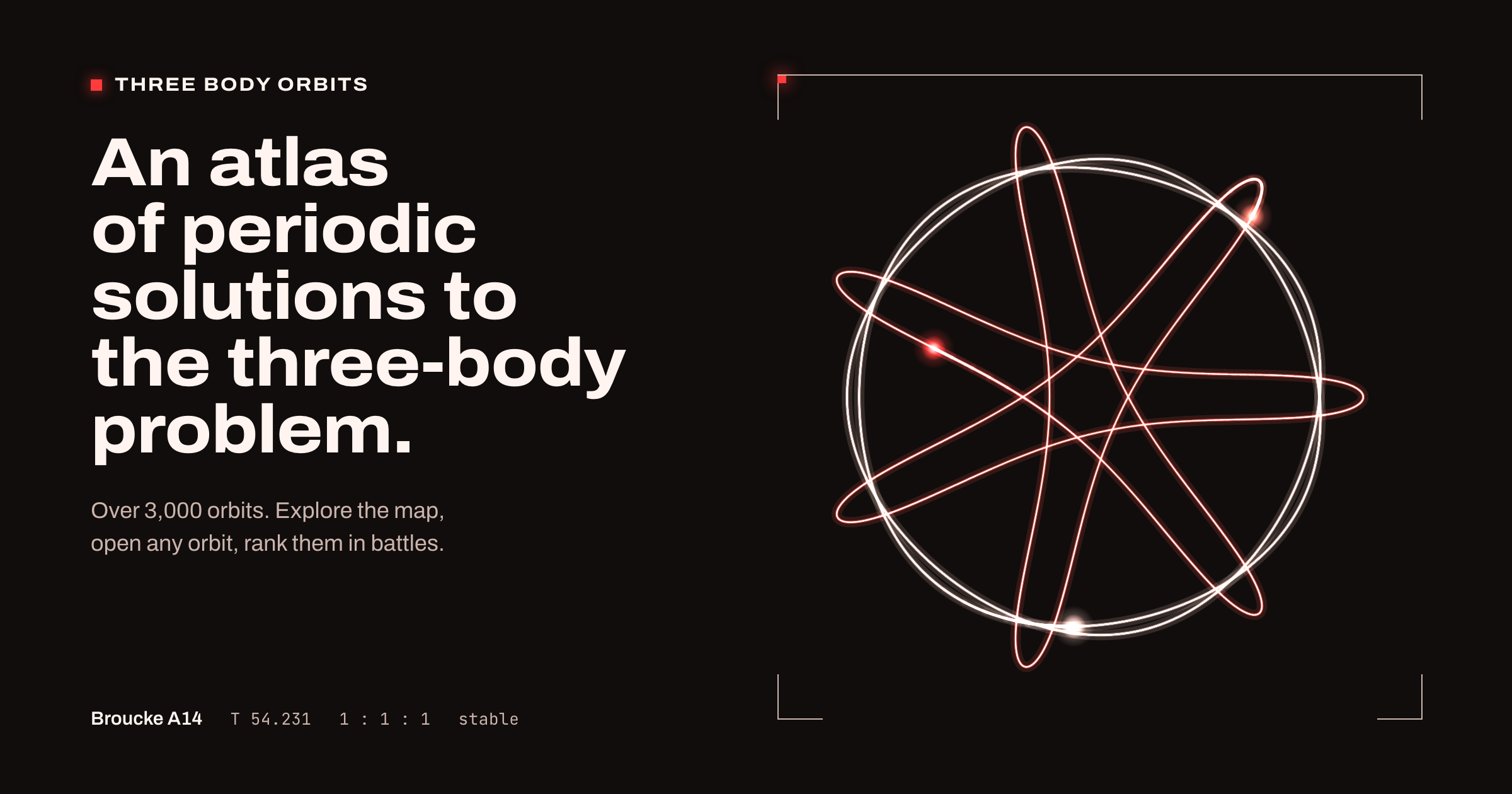
An atlas of 3,915 orbits on a single map
A project called Three Body Orbits, which reached the Hacker News front page on 14 September 2026, presents 3,915 periodic solutions to the three-body problem as one navigable map. According to the project's own description, every orbit in the collection has a spot on that map, placed so that lookalike solutions end up as neighbours; related orbits group into families, which the atlas likens to islands, and each family gets a dedicated page.
Periodic loops inside a famously unsolvable problem
The three-body problem asks how three masses move under their mutual gravitational pull, and it is the classic example of a simple question without a general answer. Henri Poincaré showed in the late nineteenth century that no closed-form solution exists in the general case, and the system's acute sensitivity to its starting conditions later became a cornerstone example in the study of chaos.
What the atlas documents is the set of exceptions that do close: periodic orbits in which three masses swing around one another and, after one full period, return to precisely the positions and velocities they started from, ready to repeat the loop indefinitely in the idealised mathematics. The best known is the figure-eight orbit, found numerically by Cris Moore in 1993 and proven to exist by Chenciner and Montgomery in 2000. A 2013 computer search by Šuvakov and Dmitrašinović added thirteen new families, and subsequent numerical campaigns swelled the known catalogue into the thousands, the territory this atlas now covers.
What the site lets visitors do
Viewed from a distance, the map reads like a constellation; zoomed in, individual orbits animate where they sit. Opening any orbit loads its own page, where the motion plays through one period at a time. From there, according to the project's description, an orbit can be nudged off its track, a hands-on probe in a system where sensitivity to initial conditions is the defining difficulty. Visitors can also rate orbits and enter them into head-to-head 'battles' that rank the collection.
Why it matters
Periodic solutions are the closest thing the three-body problem has to solid ground. They give researchers shared reference points and natural test cases: a numerical integrator can be judged on whether a simulated orbit truly closes, and families of solutions expose structure inside an otherwise chaotic landscape. A single browsable atlas makes that research corpus easier to navigate for specialists and non-specialists alike, and the similarity-based layout turns the family structure, normally buried in tables of initial conditions, into something visible at a glance.
The caveat is the one the site itself leads with: these are special cases, not a general solution. The three-body problem keeps that distinction, and the atlas is best read as a map of the orderly islands charted so far inside it.
- #three-body-problem
- #physics
- #visualization
- #simulation
- #interactive