· via Hacker News – Front Page (native)
US media, film and arts lose 200,000 jobs in four years; analysis weighs AI's role
An Apricitas analysis finds more than 200,000 US creative-sector jobs lost in four years, rivaling recession-era declines despite a healthy economy, with generative AI a leading suspect.
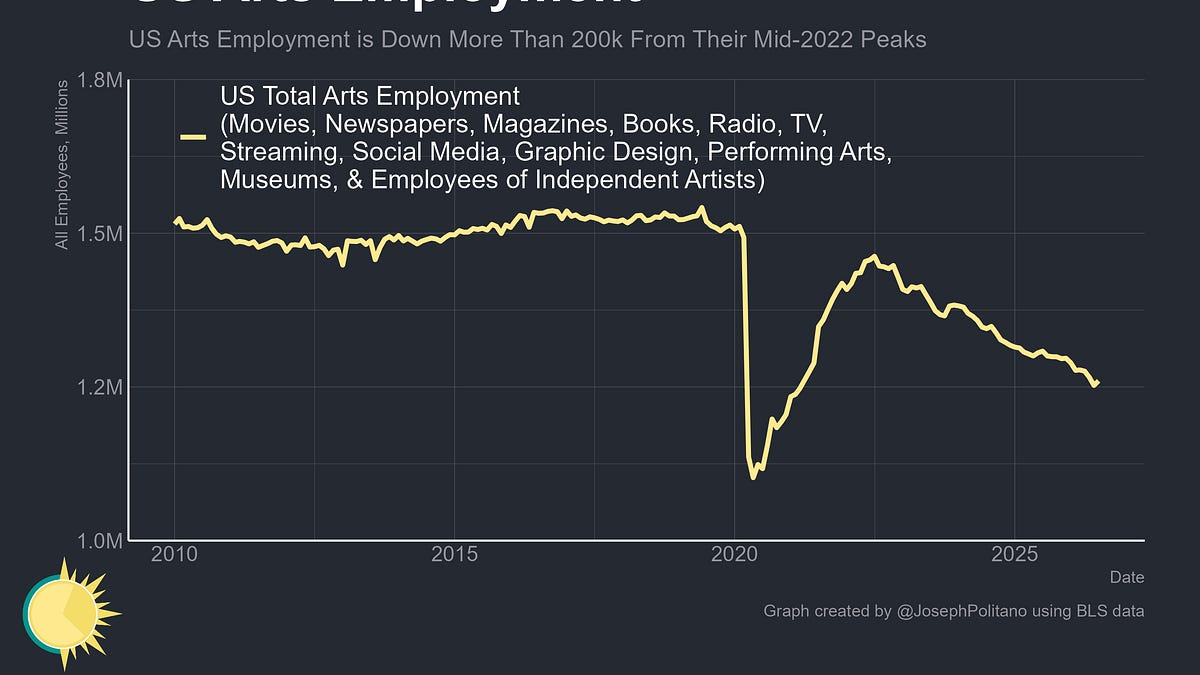
A recession-sized collapse without a recession
The American creative sector has shed more than 200,000 jobs over the past four years, with roughly 50,000 of those losses in the last year alone, according to an Apricitas analysis that recently reached the front page of Hacker News. By the newsletter's measure, only the recessions of 2001 and 2008 compare in the intensity and duration of media job losses. The difference this time is that there is no broader economic downturn to blame.
The timing instead coincides with the maturing of generative AI: systems that can produce complete novels, photorealistic images, soundalike music and most other forms of digital art at very low cost.
Where the losses are concentrated
Apricitas attributes nearly half of the four-year decline to the movie and sound recording sector, which includes Hollywood. Film and TV alone have lost more than 100,000 jobs, close to a third of that workforce, and at the low point reached this summer employment was lower than at any time since the 2008 recession and approaching a 30-year low.
Written publishing accounts for the next-largest share, down more than 70,000 jobs over the same period — though Apricitas notes print media has been shrinking for decades, so those losses partly extend a pre-existing trend. What stands out is the breadth: live broadcasting, streaming and graphic design, all stable for years, are now contracting too, while in-person entertainment keeps growing. Losses have held near 50,000 per year and, according to the analysis, have been accelerating in recent months.
Why AI is hard to prove as the cause
The analysis is careful about causation. Media firms rarely disclose how much AI they use, partly to avoid public backlash and partly because admitting reliance on it could undermine their copyright positions. Other forces are also at work: consolidation in Hollywood, production moving offshore, and audiences drifting from traditional media toward social-media creators.
The strongest circumstantial evidence, Apricitas argues, is that every digital subsector is losing jobs at the same time while in-person entertainment expands — a pattern that fits a general-purpose technology better than a set of unrelated industry problems.
A Napster-shaped precedent
To sketch what might come next, the analysis revisits the music industry's first digital rupture. When Napster made file-sharing mainstream around 2000, Metallica and the Recording Industry Association of America won their lawsuits but lost the war: piracy collapsed the value of recorded music, and streaming services later swept up massive catalogs and offered nearly all of it for a small monthly fee. Streaming revenue still falls short of 1990s physical-media sales even before adjusting for inflation.
Musicians adapted by turning recordings into marketing for live performance. Tours lengthened, venues grew and ticket prices climbed, and without rising concert revenue the business would have collapsed outright. Even counting touring, musicians ended up earning less than before.
Hollywood has no equivalent escape route
Video, the analysis points out, moved the opposite way — out of theaters and into the home — but each earlier technology shift expanded total viewing time enough to keep the industry growing. Streaming broke that pattern. Movie ticket sales ended last year down 25 percent from their 2019 peak even before adjusting for inflation, cable revenue is down 18 percent from its peak, and streaming income has not filled the gap.
Traditional producers now compete on two fronts: free user-generated content on platforms like YouTube, Twitch and TikTok, and a rising flood of AI-assisted and AI-generated video. And unlike music, the analysis notes, there is no live-performance business for Hollywood to fall back on.
Why it matters
This is one of the more serious attempts to put hard employment numbers on AI's labor-market impact rather than treating it as speculation. The pattern it documents — simultaneous decline across every digital creative subsector while in-person work keeps growing — offers a template for how generative systems might reshape other white-collar industries whose output is purely digital.
It also frames the adaptation problem squarely. The music industry survived file-sharing by pivoting to scarce, in-person experiences, at real cost to artists' incomes. Hollywood's losses suggest that when no such pivot exists, an industry can simply shrink. For workers, unions and policymakers watching where AI displacement lands next, the creative sector is now the first large-scale case study with data attached.
- #ai
- #generative-ai
- #jobs
- #media
- #labor-market