· via Hacker News – Front Page (hnrss.org)
US NRC issues first construction permit for a BWRX-300 small modular reactor
The US Nuclear Regulatory Commission has issued the country's first construction permit for a BWRX-300, clearing the Tennessee Valley Authority to build the 300 MW small modular reactor at Clinch River in Oak Ridge, Tennessee.
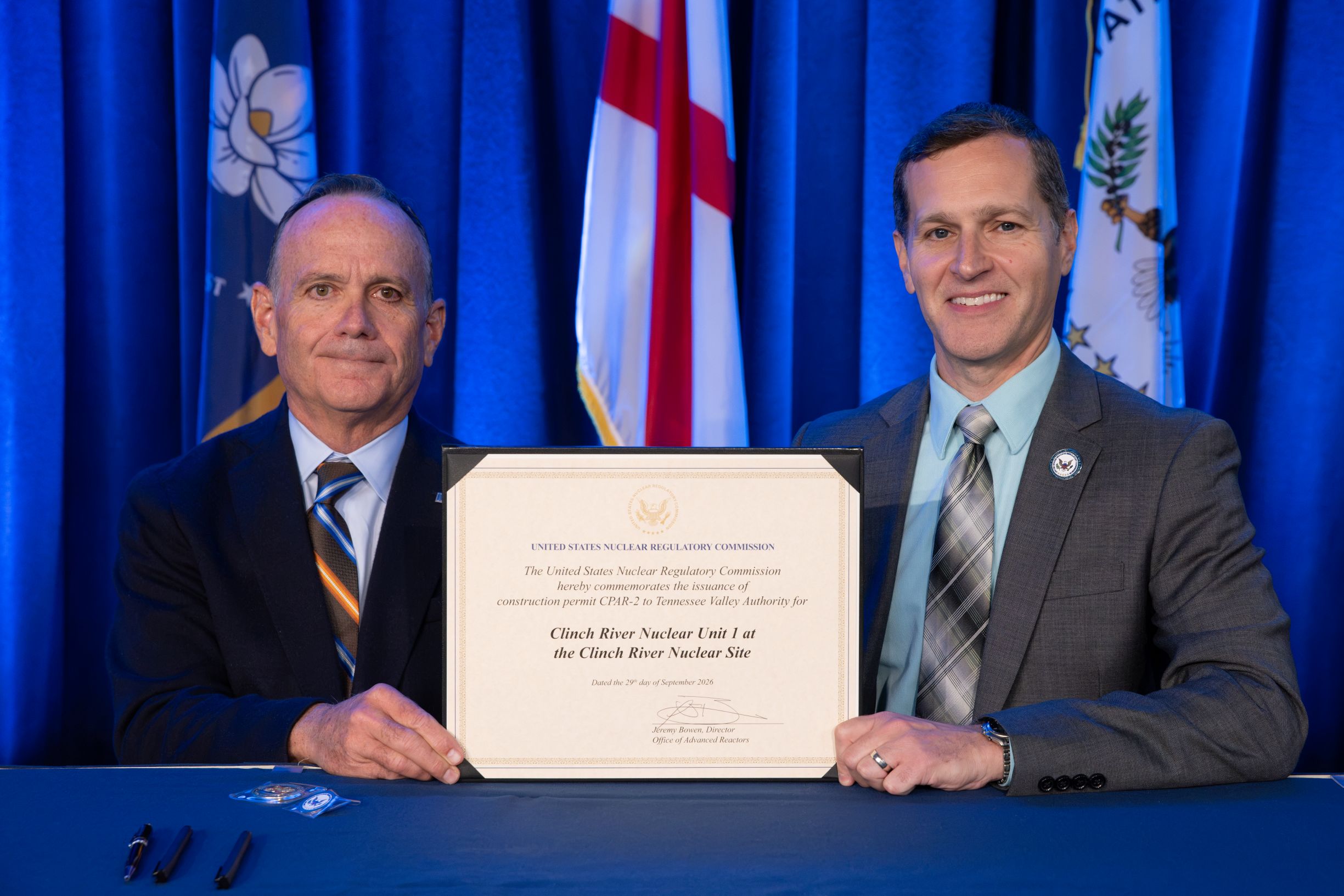
The US Nuclear Regulatory Commission (NRC) has granted the Tennessee Valley Authority (TVA) a construction permit for a BWRX-300 small modular reactor at its Clinch River site in Oak Ridge, Tennessee. GE Vernova Hitachi Nuclear Energy (GVH), the joint venture behind the reactor, announced the decision on September 29 in a press release that was picked up on Hacker News's front page. It is the first construction permit issued in the United States for this reactor design, moving the project from licensing paperwork into the building phase.
What the permit covers
TVA filed its application in April 2025, and the NRC's approval came after what GVH describes as a detailed review, built on sustained cooperation between the regulator, the utility and the reactor vendor. The Clinch River site already holds an Early Site Permit from the NRC and sits near the Department of Energy's Oak Ridge National Laboratory, giving the project an established regulatory and research backdrop.
The reactor itself is a 300-megawatt small modular reactor. Its pitch is simplicity: a reduced-complexity configuration that draws on decades of operating experience with boiling water reactors, aimed at shortening and de-risking construction.
A run of approvals across North America
The US decision fits into a broader pattern of regulatory progress for the same design:
- Canada's regulator, the CNSC, issued Ontario Power Generation a license in April 2025 to build the first BWRX-300 at the Darlington New Nuclear Project, where construction is now underway.
- OPG followed up in March 2026 with its application for a license to operate that first unit, which is under CNSC review.
- In September 2026, Blue Energy submitted the first part of a construction permit application to the NRC for a BWRX-300 planned within a combined gas-and-nuclear project in Texas.
GVH argues that each of these projects adds to a shared pool of licensing precedent that later units can reuse, cutting down repeated work in future reviews.
How GVH framed it
Eric Gray, CEO of GE Vernova's power segment, credited TVA's leadership and the joint efforts of the NRC and the Department of Energy, noting that the work aligns with federal executive orders intended to speed up advanced reactor deployment. Jason Cooper, who leads GVH, made the strategic case: nuclear only scales as a fleet, and a standard design inside a predictable regulatory system allows technology, licensing know-how, supply chains and lessons learned to move from one project to the next.
Why it matters
For US nuclear, the hardest step has often been the first one: getting from an approved design to an approved start of construction. The Clinch River permit gives the BWRX-300 a domestic precedent, just as Darlington did in Canada, with a second US application already in the NRC queue. If licensing experience compounds the way GVH expects, each subsequent unit should face shorter and cheaper reviews — the precondition for ordering these reactors in numbers rather than one at a time. For anyone planning large, always-on compute capacity, a repeatable path to firm, carbon-free generation is the part of this story that reaches beyond the nuclear industry.
- #nuclear-energy
- #smr
- #regulation
- #tva
- #ge-vernova