· via Hacker News – Front Page (hnrss.org)
UTF-8000 proposes an unbounded extension of UTF-8 with a pip-installable reference implementation
A project surfaced on Hacker News proposes UTF-8000, an encoding that extends UTF-8's variable-length scheme to arbitrarily long code units while keeping its properties intact and shipping a Python reference implementation.
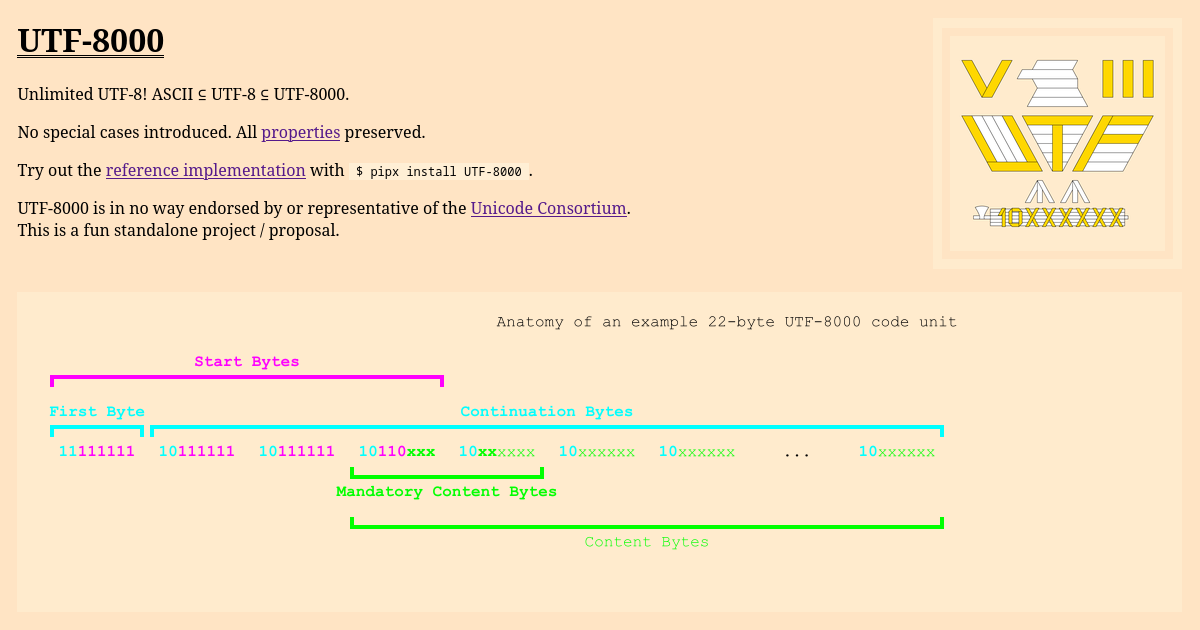
UTF-8000, a self-published proposal for an encoding that removes UTF-8's length limits while preserving every one of its properties, has landed on the Hacker News front page. According to the project's site, the scheme leaves ASCII and conventional UTF-8 completely untouched as nested subsets, and extends the format so that a single code unit can run to arbitrarily many bytes. The site is explicit that this is a fun standalone project and proposal, in no way endorsed by or representative of the Unicode Consortium.
Extending the leading-bit pattern
UTF-8 announces a code unit's length through the high bits of its first byte: 110xxxxx means two bytes, 1110xxxx three, 11110xxx four, with every subsequent byte a 10xxxxxx continuation. As documented on the project page, UTF-8000 simply continues that progression: 111110xx for five bytes, 1111110x for six, and 11111110 for seven. At eight bytes the leading byte is exhausted, because it consists entirely of ones, so the scheme introduces what the project calls multiple start bytes. An eight-byte unit begins 11111111 100xxxxx, a nine-byte unit 11111111 1010xxxx, a ten-byte unit 11111111 10110xxx, and lengths keep climbing from there. A 22-byte example on the site opens with 11111111 10111111 10111111 10110xxx and then runs on with continuation bytes.
Anatomy of a 22-byte unit
The long units are where the design gets interesting. In the 22-byte example, the project singles out byte number four, which is simultaneously a continuation byte (its top bits are 10), a start byte, the final start byte, and a carrier of content bits, holding only some of the mandatory content bits, which straddle that byte and the first non-start byte after it. The project describes its main contribution as one of clarity: splitting the highest bits of UTF-8's first byte into self-synchronization bits and start bits, then showing how to stripe the start bits across the continuation bytes when a unit must grow beyond what one leading byte can express. The site stresses that nothing about the 22-byte example is special-cased; it is a prototypical demonstration of what multiple start bytes make possible.
What stays the same
Only two special cases exist in the entire design, and according to the project both are inherited from UTF-8: ASCII is encoded exactly as-is, and two-byte units carry four mandatory content bits used to check against overlong encodings, rather than the five bits that all longer code units require. No new special cases are introduced, and the familiar properties, from the ASCII subset to self-synchronization and the prefix structure, carry over unchanged.
A reference implementation you can install
For anyone who wants to poke at the idea directly, the project ships a reference implementation that can be installed with pipx install UTF-8000, making the encoding something you can exercise rather than just read about.
Why it matters
Modern Unicode stops at U+10FFFF, and UTF-8 as deployed today reaches that ceiling with four bytes, so nobody is short on code unit space, and the project does not pretend otherwise. Its worth lies elsewhere. UTF-8000 is a clean demonstration that the leading-bit scheme behind UTF-8 is not a fixed four-rung ladder but an extensible system, and it names the parts, self-synchronization bits versus start bits, precisely enough to reason about. For engineers who deal with text pipelines, parser edge cases, or self-synchronizing codes in general, that decomposition is genuinely instructive, and the installable implementation makes the idea testable rather than purely theoretical. The limits are just as clear: nothing in the broader ecosystem will decode these long units, so anything encoded with the reference tooling only round-trips through that tooling, and the Unicode Consortium has no involvement. It is best read as a well-documented thought experiment that happens to ship code, and as a reminder of how much elegant machinery sits inside an encoding most people use without a second glance.
- #unicode
- #utf-8
- #character-encoding
- #python
- #open-source