· via Vercel blog
Vercel CLI adds plain-language command search for coding agents
Vercel's CLI can now turn a plain-language task description into matching commands, help text and ready-made API calls, making the platform easier for coding agents to operate.
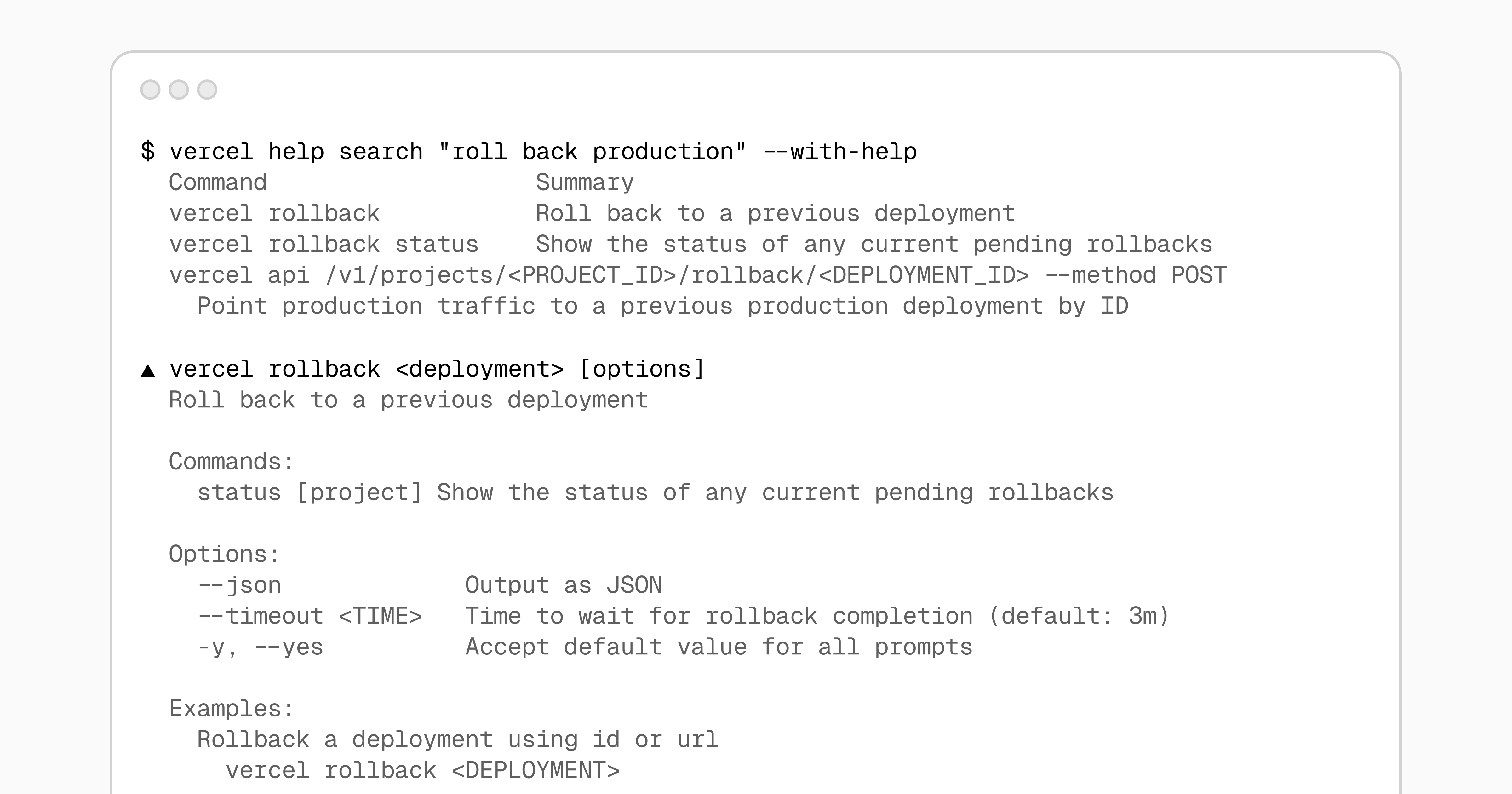
Vercel has added a natural-language search to its CLI that lets coding agents find the right command by describing the task rather than knowing the command name in advance. According to the Vercel blog, the feature ships in the latest release of the tool.
Searching by intent
The new vercel help search command takes a plain-language description as its argument and returns a list of matching commands. Vercel's own example is vercel help search "roll back production", which surfaces the rollback command. Adding --with-help to the same call pulls in the full help page for the first result, including its options and examples, so an agent can discover a command and learn how to use it in a single step.
The matching is forgiving with wording. Vercel says the search maps everyday phrasing such as "show" onto commands the CLI names "list", and it copes with small typos — useful both for agents that paraphrase a task and for humans who cannot recall an exact verb.
API endpoints included
The search does not stop at CLI verbs. When a task corresponds to a Vercel API endpoint, the results include a vercel api command with the request path already in place and a placeholder for every required input. The agent then fills in the values instead of reconstructing the endpoint URL from documentation or memory, which removes a common source of errors in automated workflows.
For programmatic consumption, a --json flag returns search results as structured JSON. Combined with --with-help, the JSON output also carries the usage instructions, options, and examples for the first result.
Built for agents first
Two further details point at the intended audience. The CLI bundles a skill that tells coding agents to reach for vercel help search first whenever they need to locate a command, effectively making the search the default entry point for agent-driven discovery. Vercel also states that it does not log search text, addressing the concern that agentic tooling might send potentially sensitive task descriptions to a vendor's servers.
The feature is available after updating to the newest CLI with vercel upgrade.
Why it matters
Command-line tools were designed around people who read manuals and memorize flags, and agents have had to work around that by paging through help output, guessing at syntax, or falling back to web documentation. A search layer that accepts intent and returns both the command and its usage collapses that discovery process into one call, cutting the number of steps — and the number of chances to guess wrong — in an automated workflow.
The API handling matters just as much. Invented endpoint paths and parameter names are a familiar failure mode for agents working against HTTP APIs, and generating a ready-made vercel api invocation with explicit placeholders shifts the model's job from recalling structure to filling in values.
The change also signals where developer tooling is heading: as coding agents become routine operators of infrastructure, vendors are starting to treat them as primary users of their interfaces. Making a CLI self-describing in plain language is a comparatively cheap way to do that, and the no-logging note suggests Vercel recognizes that agent traffic raises data-handling questions of its own.
- #vercel
- #cli
- #developer-tools
- #coding-agents
- #ai