· via Vercel blog
Vercel Drives adds CLI commands, standalone TypeScript and Python SDKs, and a REST API
Vercel Drives can now be created, listed, forked and deleted via new CLI commands, standalone TypeScript and Python SDKs, and a REST API, removing the need for Sandbox APIs and permissions.
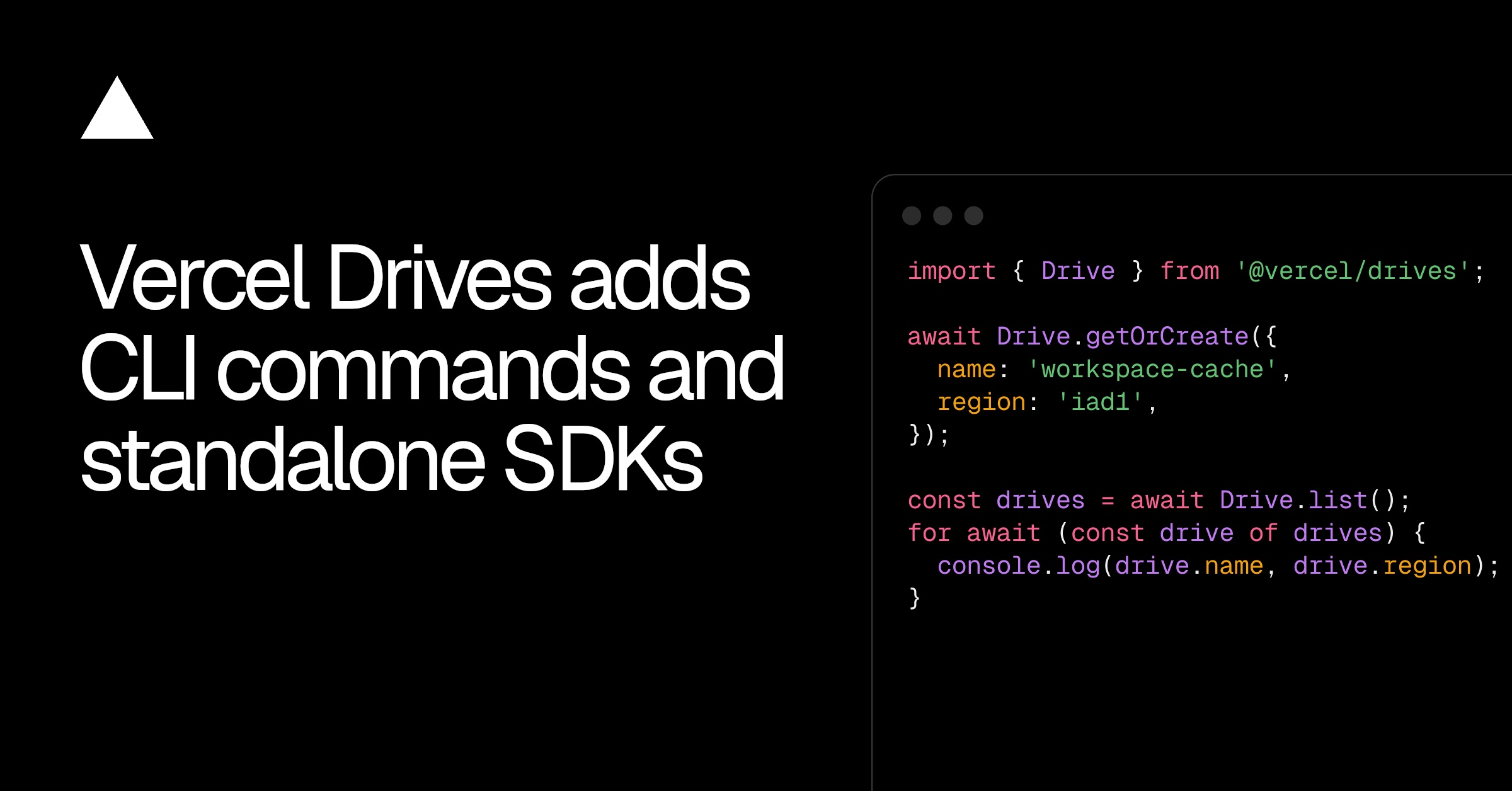
Vercel Drives gets its own management surface
Vercel has given Drives, the storage offering that mounts into Vercel Sandboxes, a management layer of its own. According to the Vercel changelog, developers can now create, list, fork and delete Drives using new vercel drives CLI commands, standalone SDKs for TypeScript and Python, or a REST API exposed at /v1/drives. Drive-specific permissions arrive alongside the new endpoints, which means administering storage no longer requires going through Sandbox APIs or holding Sandbox permissions.
New CLI commands
The commands ship in the latest release of the Vercel CLI. After linking a project with vercel link where necessary, the changelog walks through three examples:
vercel drives get-or-create workspace-cache --region iad1returns an existing Drive or creates one, with the region set through the--regionflag.vercel drives listenumerates the Drives in scope.vercel drives fork existing-drive existing-drive-forkproduces a fork of an existing Drive.
The changelog notes that deletion is also supported through the same command family.
Standalone SDKs
For programmatic use outside the CLI, Vercel published two packages: @vercel/drives for TypeScript, installed with npm install @vercel/drives, and vercel-drives for Python, installed with pip install vercel-drives. Vercel says the SDKs cover the same create, list and fork operations demonstrated in the CLI examples, so applications and automation scripts can manage Drives directly in either language.
REST API, permissions and dashboard integration
Beyond the CLI and SDKs, the changelog introduces a REST API at /v1/drives together with Drive-specific permissions. Drives also now have their own pages in the Vercel dashboard and in Observability, letting teams inspect and manage them without routing through Sandbox views.
Nothing breaks for existing users
Vercel notes that Drives continue to mount into Vercel Sandboxes exactly as before, and that existing Sandbox CLI commands and SDK code keep working. The new tooling is additive rather than a replacement, so projects that already manage Drives through Sandbox APIs do not need to change anything immediately.
Availability
Drives are available across all three Vercel plans: Hobby, Pro and Enterprise.
Why it matters
Until this update, Drives were effectively a subordinate feature of Sandboxes: managing them meant leaning on Sandbox APIs and permissions even when the use case was pure storage. Dedicated CLI commands, language SDKs, a REST API and per-Drive permissions turn Drives into a self-standing storage primitive that can be scripted in CI pipelines, provisioned from application code and governed independently of Sandbox access. The get-or-create command points at repeatable provisioning workflows, such as the on-demand cache Drive shown in the documentation, while fork makes it cheap to duplicate an existing Drive. For teams building on Vercel, the friction of adding managed, region-selectable storage has dropped noticeably, and the finer-grained permission model gives administrators better control over who can touch production data.
- #vercel
- #cloud-storage
- #typescript
- #python
- #developer-tools