· via Vercel blog
Vercel's skills.sh reaches one million agent skills and 280 million installs in seven months
Vercel's skills.sh registry hit one million agent skills and nearly 280 million installs in seven months, a faster climb to the milestone than GitHub, npm or Apple's App Store recorded.
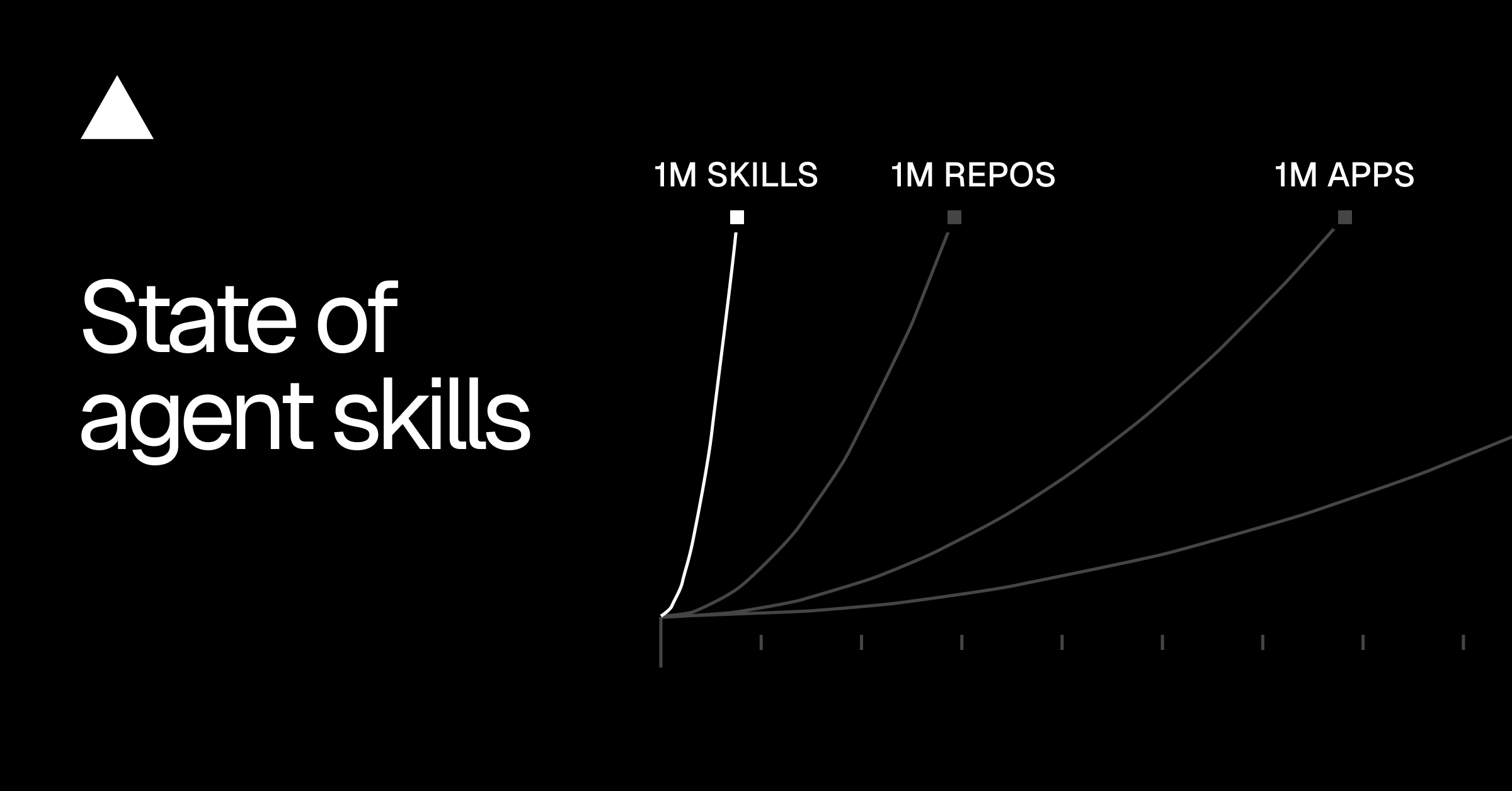
Vercel's skills.sh registry has crossed one million agent skills and recorded nearly 280 million installs in roughly seven months, according to a report published on the Vercel blog. The registry, launched three months after Anthropic introduced its Agent Skills format in October 2025, collects shareable instruction sets that teach AI agents how to carry out specific jobs.
As Vercel describes it, a skill is a reusable set of instructions — sometimes just a file written in plain language — that supplies the context a generic agent lacks: how a particular person, team or company actually performs a piece of work. The underlying model and its tools already provide much of the capability, so a skill only has to capture the judgment behind the job. That, Vercel argues, is why the format scales: far more people can describe how work should be done than can program a computer to do it. For comparison, the report notes that GitHub needed 27 months to reach one million repositories, Apple's App Store took just over five years to reach one million apps, and npm required more than nine years to reach one million packages.
Supply is technical, demand is broader
The report separates what authors publish from what users install. More than half of the catalog's listings cover technical work — software engineering, agent workflows, data, infrastructure or security — with software engineering alone at about a quarter of all listings.
Demand spreads much wider. No category draws more than a fifth of installs: software engineering leads at 18%, agent workflows follow at 15%, and business operations and writing sit near 11% each. Adjusted for catalog size, the pattern is sharper. The average business operations skill draws 74% more installs than the registry-wide norm, writing and documents 50% more, and cloud and infrastructure 42% more. Software engineering skills average about 30% fewer installs than the norm, education and productivity 39% fewer, and research 55% fewer.
Agents improving agents
Skills about agent workflows and automation — how to plan, hand off work, use tools and drive browsers — account for 14.8% of installs in Vercel's classified dataset, second only to software engineering overall. Among skills with at least 100,000 installs, agent workflows are the largest category of all. Vercel's reading of this: people are using agents to improve agents, and because agents also help write skills, the catalog expands using the very machinery it teaches agents to build.
A few skills capture most installs
Install activity is heavily concentrated. Nearly half of all skills were installed exactly once, while 375 skills — 0.04% of the registry — account for 62% of installs, and the top 1.2% account for 94%. Even so, Vercel reports no single winner: the most-installed skill represents less than 1% of total installs. Skills compete within a job, since a team that already installed an expense-report skill has little reason to add a second one, but they accumulate across jobs, so each task crowns its own champion.
Portability wins
Classifying skills by scope, Vercel found that work recurring across industries — tidying a spreadsheet, deploying a site — makes up 66% of classified skills but 87.5% of installs. These cross-industry skills average 3.6 times as many installs per listing as industry-specific ones.
What Vercel expects next
The report frames the first million skills as encoding widely shared knowledge and predicts the next million will encode what individual organizations alone know, such as deciding when a refund is owed or which changes can ship without further review. As public skills and improving models turn general expertise into a baseline, Vercel expects differentiating value to shift toward that company-specific judgment. It also expects the measure of a skill to move from install counts toward effectiveness, supported by tests and benchmarks that check whether an agent does a job better with the skill than without it.
The report carries measurement caveats: catalog totals count unique listings, install figures are aggregate registry counters rather than unique people or necessarily independent choices, and the category and industry findings come from a classified sample rather than the full catalog.
Why it matters
The pace matters less than the shape. A plain-language instruction format has standardised faster than any comparable software ecosystem, and install patterns show it is already reaching beyond developers into business operations, writing and documents. For teams, two lessons stand out: public skill markets concentrate quickly, with a small set of per-task winners taking nearly all installs, and durable advantage is likely to come from private, company-specific skills maintained like code — not from anything generally available on a registry.
- #ai-agents
- #agent-skills
- #vercel
- #anthropic
- #developer-tools