· via Vercel blog
Vercel Sandbox Python SDK hits 1.0 with TypeScript feature parity
Vercel's Sandbox Python SDK has reached 1.0, stabilizing its public API and matching the TypeScript SDK's features for running AI-generated code in isolated environments.
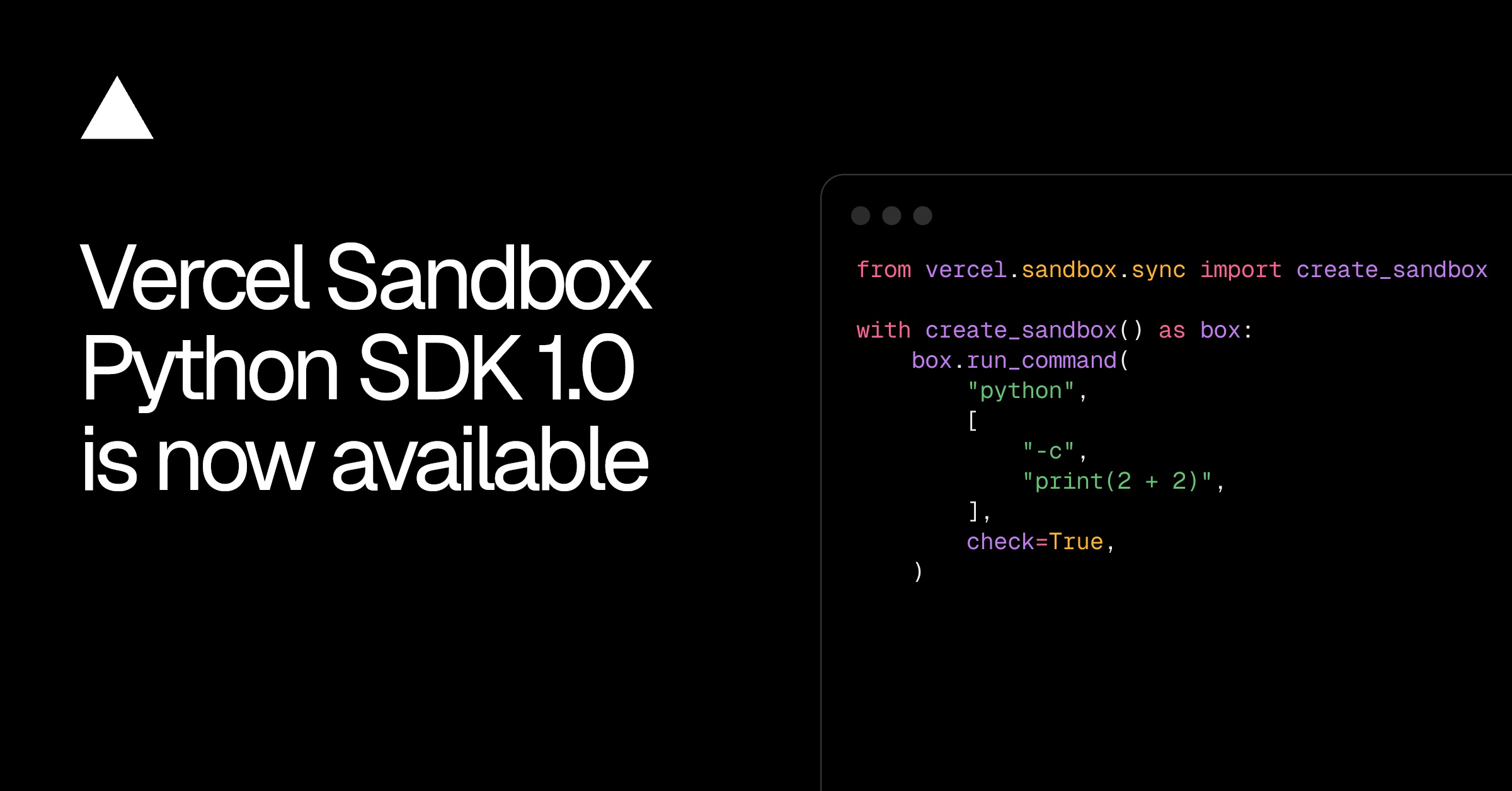
Vercel has shipped version 1.0 of its Sandbox Python SDK, according to a November 17 announcement on the Vercel blog. The release stabilizes the SDK's public API and brings it to feature parity with the TypeScript SDK for the same service.
Vercel Sandbox is Vercel's service for executing code inside isolated, disposable environments. With the Python SDK, a Python application can spin up a sandbox, run commands inside it, and tear it down again. The use cases Vercel names are running AI-generated code, testing changes, and analyzing datasets without letting that work touch the host system.
What ships in 1.0
The notable changes are on the API surface rather than in the underlying service. According to Vercel, the release includes:
- Context managers that automatically clean up a sandbox when the block exits, so environments do not linger after a job finishes.
- Async support built on AnyIO, which means the SDK works with both asyncio and Trio applications.
- A synchronous interface, available at
vercel.sandbox.sync, for code that does not need concurrency.
Installation is a single line with uv — uv add 'vercel-sandbox>=1.0' — followed by authentication configuration.
The example in Vercel's post illustrates the typical workflow: an application creates a sandbox from a Git source, pointing at a repository URL and a specific revision such as a pull request branch, runs a command inside it — in the example, uv run pytest -q with check=True so that failures raise — and lets the context manager destroy the sandbox on exit. The pattern is aimed at automatically testing arbitrary branches without provisioning long-lived machines.
Breaking changes for 0.x users
Vercel advises anyone upgrading from a 0.x release to read the 1.0 release notes. The breaking change it calls out is that command input and output now use bytes rather than strings, which will affect any code that passed text directly to or read text directly from sandbox commands.
Why it matters
Much of the tooling around AI agents — orchestrators, evaluation harnesses, and data pipelines — is written in Python. Until now, a team working in that ecosystem that wanted Vercel Sandbox had either to drop into TypeScript or accept a less mature Python client. Feature parity removes that trade-off, letting Python-first projects adopt the service on equal footing.
The 1.0 designation also carries practical weight. Agent frameworks increasingly generate code and then execute it, and doing that on a developer's machine or a shared server is risky: generated code can delete files, leak data, or simply misbehave. Sandboxed execution is one of the straightforward answers to that problem, and a stable public API means teams can build this isolation layer into production Python systems without expecting the SDK's surface to shift underneath them.
- #python
- #vercel
- #sdk
- #cloud
- #ai-agents