· via Vercel blog
Vercel Speed Insights now measures core web vitals on soft navigations
Vercel's Speed Insights now captures LCP, FCP, INP and CLS during client-side route changes, closing a long-standing blind spot in single-page app performance data.
What Vercel announced
Vercel has extended its Speed Insights product to measure soft navigations — in-app route changes that render new content in the browser without a full page reload. According to the Vercel changelog, the change means developers can now track performance as users move through an app, rather than only when a full page load occurs.
The feature is switched on by default for every project already using Speed Insights, and Vercel says no configuration is needed to activate it.
What gets measured
For each soft navigation, Speed Insights records LCP, FCP, INP and CLS, and includes those readings in the project's Real Experience Score. TTFB is the one omission: because a soft navigation does not request a new document, there is no first byte to time.
The tracking works with modern web frameworks — Vercel names Next.js, SvelteKit and Nuxt — but is currently limited to Chromium-based browsers.
Dashboard filtering and billing
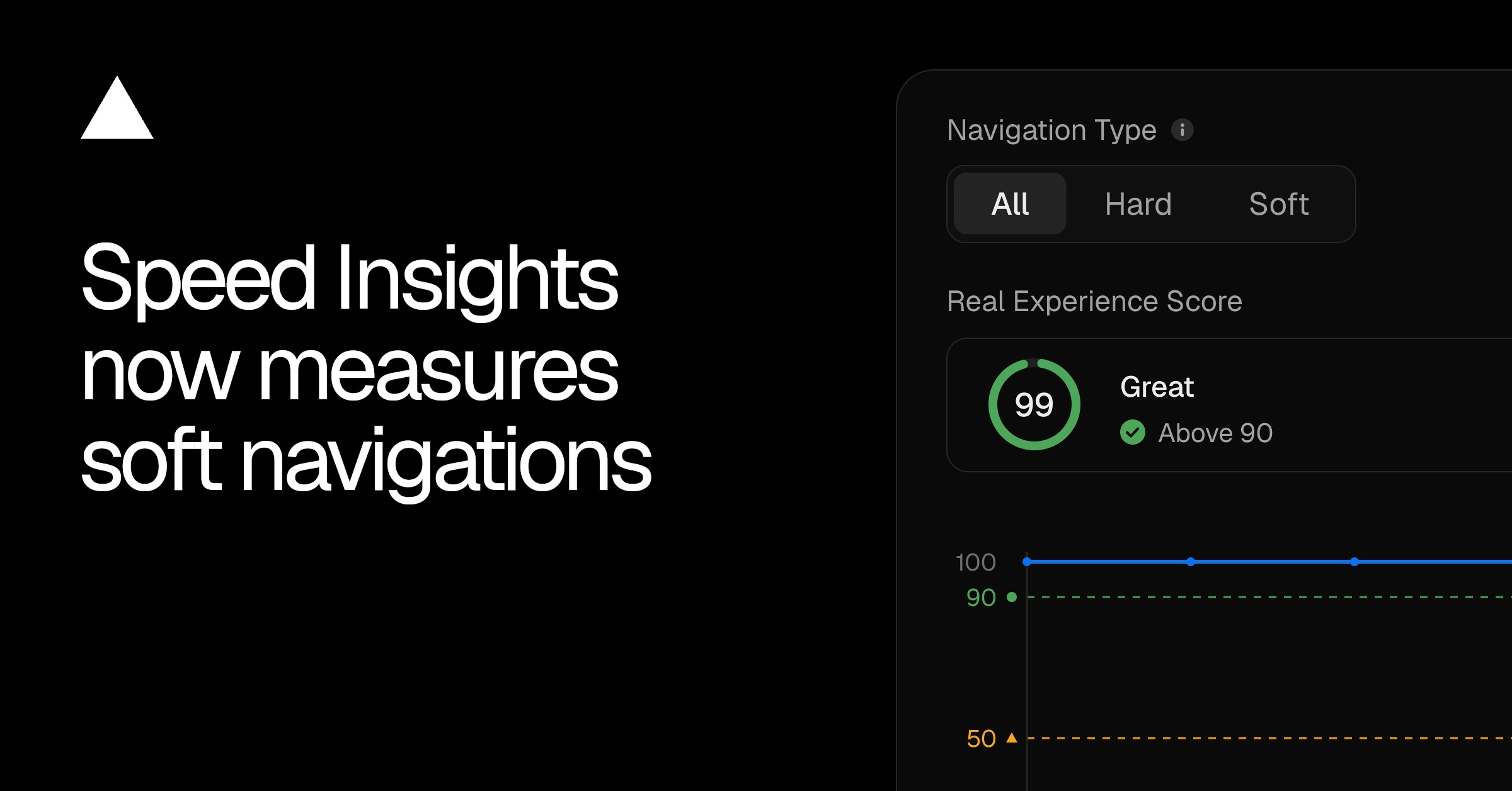
The Speed Insights dashboard gains a Navigation Type filter with three views: All, Hard and Soft. Teams can look at aggregate data, or isolate either full-page loads or client-side transitions to see how each behaves with real users.
There is a cost dimension to be aware of. Soft-navigation events count toward Speed Insights Plus usage. Vercel says existing Plus customers will receive an email explaining when billing for these events begins, while projects that newly enable Plus will be billed for soft-navigation events from the start.
Turning it off
For teams that would rather not collect the data — whether because of cost or data volume — Vercel provides an opt-out. Setting a softNavs option to false, either on the SpeedInsights component or through the injectSpeedInsights function, disables soft-navigation tracking. The option requires version 2.1.0 or later of the @vercel/speed-insights package, and the project must be redeployed for the change to take effect.
Why it matters
Web performance tooling has historically been anchored to the document lifecycle: metrics like LCP and FCP assume a page begins with a navigation and a response from the server. Single-page applications break that assumption, because after the first load most page views are just JavaScript swapping content in place. In those apps, the bulk of a user session has effectively been a blind spot for field-data tools.
With this change, Speed Insights users get per-navigation visibility into the same vital signs they already tracked on hard loads, so a sluggish route transition in Next.js, SvelteKit or Nuxt now feeds into the Real Experience Score instead of hiding behind a fast initial page. That data can also expose regressions tied to client-side rendering, lazy loading or scripts that only run on later views.
The default-on, usage-billed model cuts both ways. The visibility arrives without any setup work, but teams on Plus should watch their event volumes — and use the softNavs flag if the extra data or the added cost is not wanted.
- #vercel
- #web-performance
- #core-web-vitals
- #analytics
- #developer-tools