· via Hacker News – Front Page (native)
Washington University chemists create a polymer that strengthens as it bends
Chemists at Washington University in St. Louis report a hydrogel whose sugar-based rings reinforce strained areas, making it stronger with repeated bending — behaviour they liken to collagen, with possible tissue-repair uses.
Most materials degrade with use: metals fatigue, plastics crack, rubber perishes. Chemists at Washington University in St. Louis report the opposite behaviour — a polymer that becomes stronger the more it is bent and strained. According to a university announcement, the work was published online in Nature Materials on 5 November, and the material takes its design cues from biology, mimicking tissues such as collagen, the protein that gives skin its strength and elasticity.
A hydrogel built from sugar rings
The material is a hydrogel, a soft water-rich network, made from a biodegradable blend of sugar crystals and polyethylene glycol, a compound familiar from laxatives and other health products. It was developed in the lab of Chenfeng Ke, a professor of chemistry in Arts & Sciences at Washington University; co-authors on the Nature Materials paper include graduate students Yufei Chen and Mingliang Bai and postdoctoral researcher Dan Zheng.
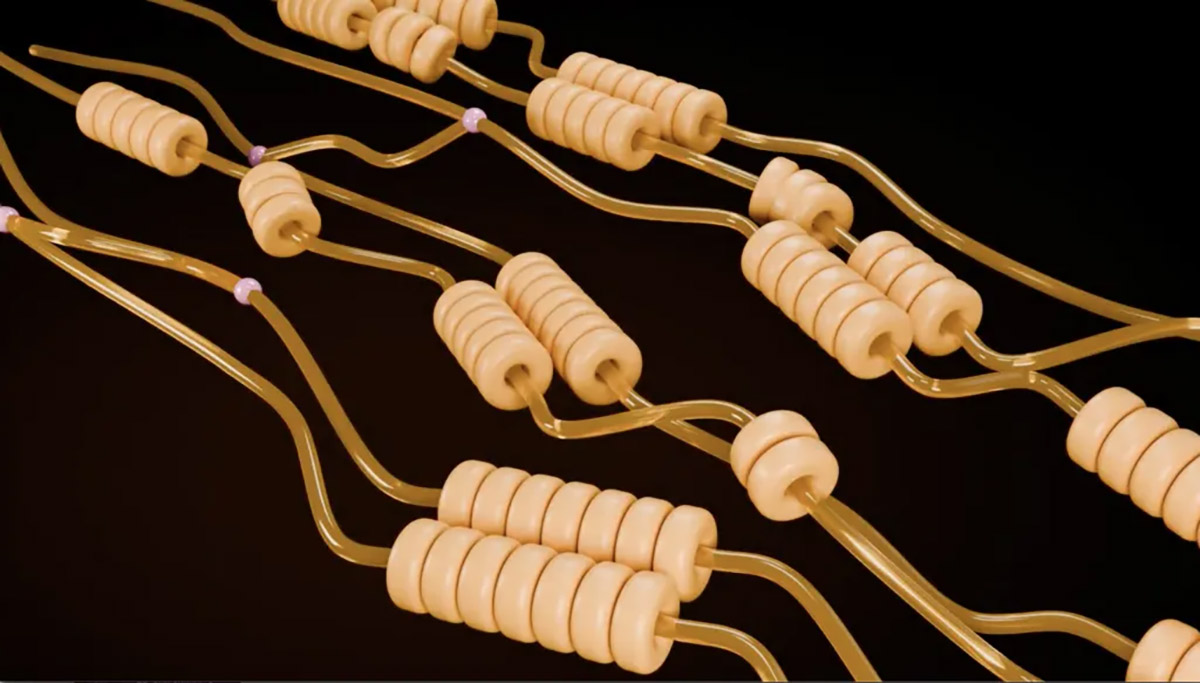
Its unusual behaviour comes from cyclodextrin, a sugar-based compound that forms ring-shaped structures. When the polymer is stretched or bent, these rings slide through the network and settle where the load is greatest, reinforcing the regions under strain. Ke describes the moving rings as central to the design. In testing, the team attached the material to a flexible, knee-like joint and bent it 10,000 times. Ke said it performed as predicted, with the polymer chains becoming more uniform and organised — and therefore stronger — exactly where the strain concentrated.
Nature as the template
The design deliberately borrows from living systems. Ke noted in the announcement that some of the most impressive smart materials are found in biology, and that his team used nature for inspiration. The university highlights collagen as the model: a protein whose strength and elasticity allow skin to flex repeatedly without failing.
The parallel extends to the material's response. Like tissue that adapts to repeated load, the polymer stiffens only where stress is applied. Ke told the university the material has "properties we have never seen before" and can "remember, adapt, learn and grow."
Medical potential, printed parts
Because it is built from sugar and polyethylene glycol, Ke says the polymer is compatible with biological tissue. He expects interest from surgeons and orthopedic medical device companies, and the university points to uses such as supporting artificial joints or repairing damaged tissue. In both scenarios, regions that see little stress would stay soft and pliable; Ke argues that matters for implanted materials, which should not be uniformly rigid.
The polymer is also compatible with 3D printing, and it is patented. Ke frames the result as proof that smart materials can come out of a printer given the right chemistry. The work builds on his broader bio-inspired materials research — in April 2025 he pitched a new generation of smart fabrics at the university's inaugural A&S Innovates research competition.
Scale and open questions
So far the team has produced the material only in small batches, tens of grams at a time, though it believes production could scale now that the concept has been demonstrated. Ke, a chemist rather than an orthopedist or device specialist, acknowledges that other experts may see applications he has not, and says he wants to collaborate with researchers at WashU Medicine and elsewhere. The research was funded by the National Science Foundation and the U.S. Department of Energy.
Why it matters
Engineering practice assumes repeated load degrades materials, and designs around that assumption with safety margins and replacement schedules. A material that converts strain into reinforcement inverts the premise, pointing toward implants, joint supports and load-bearing components that improve with use rather than wearing out.
The biological mimicry is the crucial detail: rather than hardening uniformly, the polymer reorganises only where stress concentrates, much as living tissue does. A soft implant that stiffens exactly where a joint or damaged tissue needs support could fill a gap between rigid metal hardware and fragile grafts. Outside medicine, adaptive gels could serve in wear-prone parts, though durability in real deployments beyond the reported 10,000-bend trial remains to be established. The work is early, with gram-scale production and a single published demonstration, but the mechanism itself — sliding molecular rings that find the strain — is a result other labs can now build on.
- #materials-science
- #polymers
- #medical-devices
- #3d-printing
- #research