· via Hacker News – Front Page (native)
WD 20TB EasyStore hits $549.99 on Black Friday, 2.2x its 2024 price
A self-hoster's eight years of receipts show the WD EasyStore 20TB at $549.99 this Black Friday versus $249.99 in 2024, with recertified enterprise drive prices up 58% to 218%.
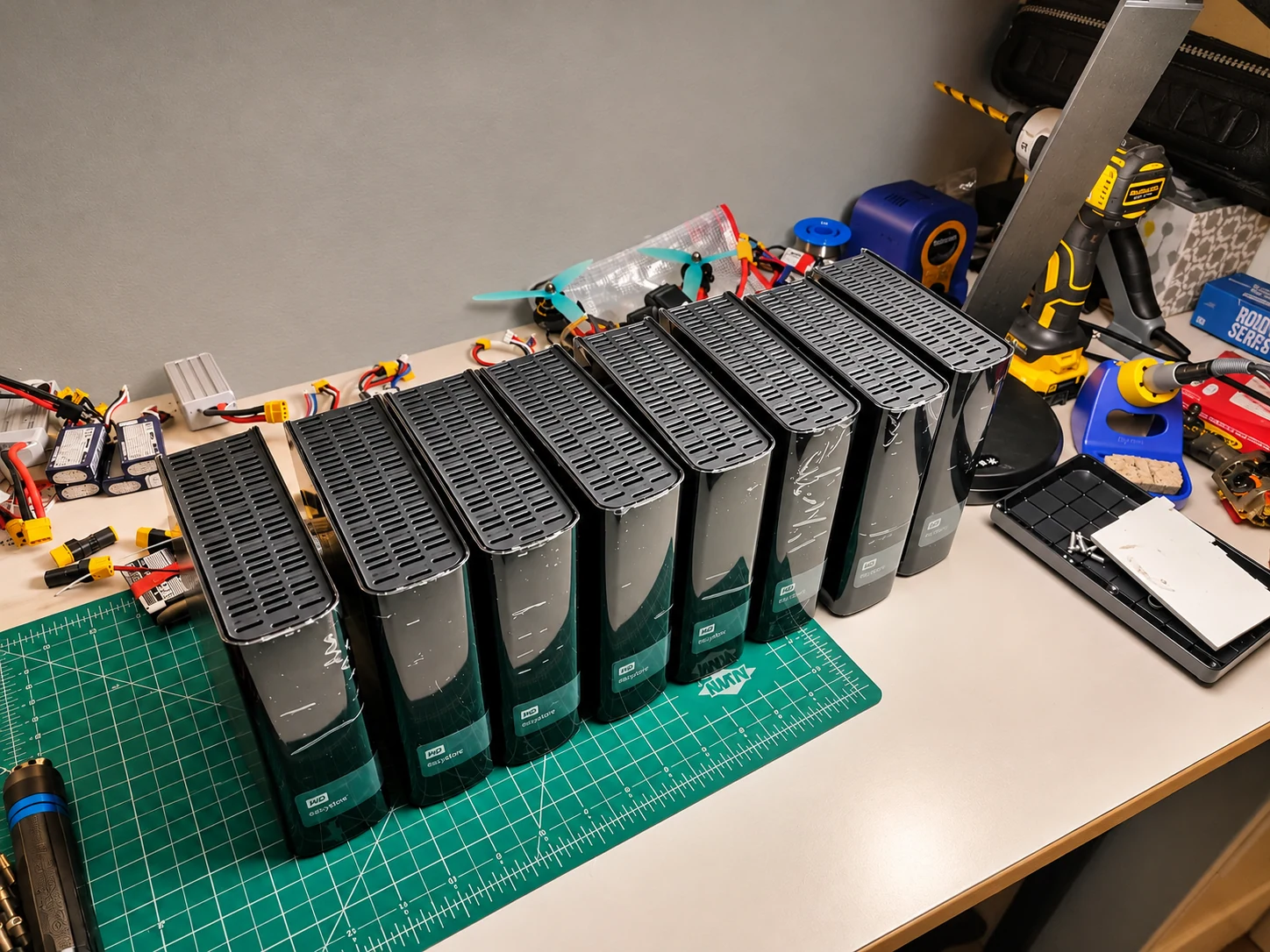
The 20TB WD EasyStore was listed at $549.99 at Best Buy on Black Friday 2026, roughly 2.2 times the $249.99 that the blog's author, a self-hoster who replaces a couple of drives every Black Friday, paid for the identical SKU at the same retailer in November 2024. The figure comes from a price diary published on ktz.me that reached the Hacker News front page. Per terabyte, before tax, the drive has gone from $12.50 to $27.50 in two years; the author's previous receipt, from May 2025, read $279.99, which means most of the increase landed within the past 18 months.
Eight years of receipts
The post is built on purchase records going back to 2018. Per-TB pricing started at $18.00 on 10TB drives in November 2018, drifted into the $14s through 2020 and 2021, ticked up in 2022, then bottomed in October 2023, when the author bought three 18TB drives for $599.97, or $11.11 per TB. This year's single 20TB deal falls about $50 short of matching that entire three-drive order. At the old prices, shucking external drives, meaning pulling the SATA disk out of its USB enclosure for server use, was a cheap route to bulk storage. At $27.50 per TB, the post concludes, it no longer is.
Recertified enterprise drives are no escape
The other traditional workaround, refurbished and recertified enterprise disks, has tightened as well. In August 2024 the author bought four recertified 14TB WD Ultrastars from ServerPartDeals for $529.96 before tax, working out to $9.46 per TB. Compared with listings from November 26, 2026, the post records increases on every model checked: the WD Ultrastar HC530 14TB 4Kn went from $9.29 to $14.64 per TB, up 58%; the 512e variant from $9.64 to $30.64, up 218%; the Seagate Exos X20 20TB from $11.80 to $29.45, up 150%; and the Exos X22 20TB from $11.25 to $32.45, up 188%. Three of the four listings were sold out, leaving the Exos X20 as the only drive in stock.
Three manufacturers and a history of shocks
Switching vendors is harder than it sounds because only three major HDD makers remain: Seagate, Western Digital and Toshiba. The post traces the consolidation. Maxtor absorbed Quantum's drive business in 2001 and was bought by Seagate in 2006; Hitachi merged IBM's disk unit into HGST in 2003; Toshiba took Fujitsu's drive business in 2009; Seagate bought Samsung's in late 2011; and Western Digital acquired HGST in March 2012, with the FTC requiring WD to transfer desktop-drive manufacturing assets to Toshiba to preserve a third supplier.
The market's record also includes supply shocks and price-fixing. The 2011 Thailand floods halted production at WD's Thai plants and pushed its average drive selling price from $45 in fiscal 2011 to $62 the following year, and in 2019 the component supplier NHK Spring pleaded guilty to fixing prices on suspension assemblies, drawing a $28.5 million fine. The author's own reading, offered as opinion, is that a market this consolidated now behaves like a cartel, comparable to the memory market. Citing WD's annual report, the post also notes that 89% of the company's fiscal 2026 revenue came from its cloud business, which makes home-server buyers a negligible constituency. The author adds that Best Buy is not to blame for the pricing.
Smaller drives and full builds cost more too
Details relayed in a dev.to summary by GuiadeTI round out the picture. The 8TB EasyStore on Black Friday cost $299.99, or $37.50 per TB, which is $50 more than the author paid for a 20TB drive two years earlier. A four-drive set of the 20TB EasyStores would have cost $999.96 at 2024 prices versus $2,199.96 now, a $1,200 gap before adding a chassis, motherboard or memory, and the per-usable-TB figure climbs further once one disk is set aside for parity.
The author's plan is to consolidate roughly ten physical disks down to five 20TB units, which means rebuilding ZFS pool layouts and migrating data, since ZFS does not accommodate changes to the layout of existing pools. The summary notes he hopes prices return to reasonable levels in 2027, though he suspects the wait may be long.
Why it matters
For anyone budgeting storage, this is a concrete cost signal rather than anecdote: a tracked consumer SKU more than doubled in two years, and the standard mitigations, such as smaller capacities, recertified enterprise stock or alternative retailers, are up 58% to 218% and frequently sold out. Demand is dominated by cloud and datacenter buyers, with 89% of WD's fiscal 2026 revenue coming from its cloud business, mirroring memory and GPU markets where retail customers are deprioritized. Storage refresh cycles and expansion plans priced against 2023-2024 per-TB costs now face materially higher spend, and with only three manufacturers left, the supply side has little incentive to chase retail demand.
- #hard-drives
- #storage
- #hardware
- #pricing
- #self-hosting