· via Hacker News – Front Page (native)
World Labs unveils Atlas, a world model that generates and reconstructs 3D worlds
World Labs' Atlas is a multimodal world model that generates camera-controlled video, reconstructs scenes from a handful of photos, and outputs explicit 3D geometry for creative and robotics work.
What World Labs announced
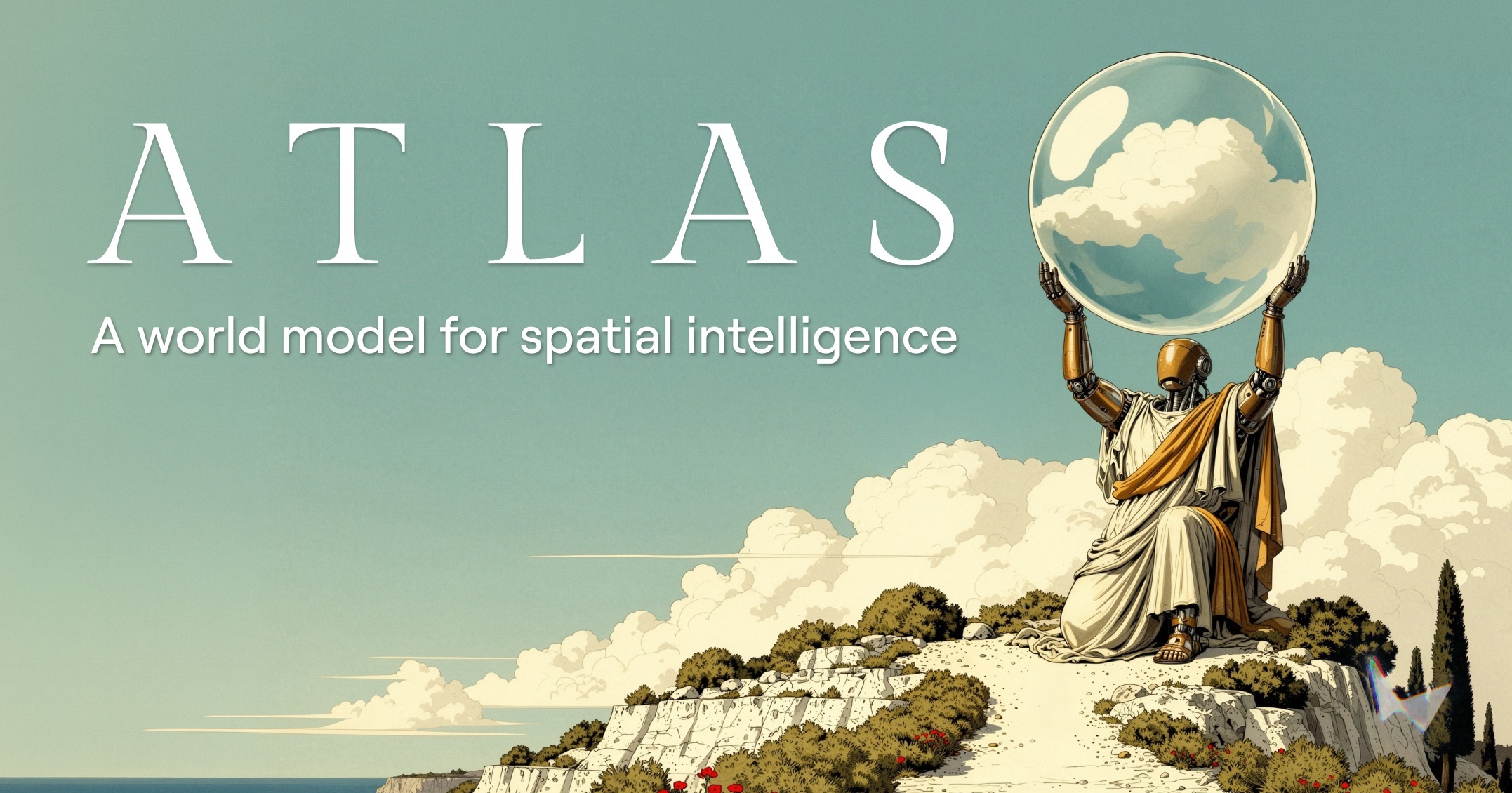
World Labs has announced Atlas, a general-purpose world model the company positions as its next step toward spatial intelligence. According to a company blog post that surfaced on the Hacker News front page, world models are systems that generate, reconstruct and simulate environments, capturing how they look, behave and change over time, with uses in creative rendering, high-fidelity simulation of the real world and robot planning.
Atlas is described as an omni model, pretrained from scratch to work natively with text, images, video and 3D data. Architecturally, World Labs calls it a multimodal autoregressive diffusion transformer: all inputs are merged into a single spatial context, and the model generates what comes next while staying geometrically consistent with everything already in that context. The company says the model scales, with performance improving as training compute increases, and expects that trend to hold.
Four capability areas
World Labs groups Atlas's abilities into four buckets.
Camera-controlled generation takes one or more reference images and produces new views from a camera position and angle the user specifies, extrapolating parts of a scene that never appeared in the inputs. Videos are generated from one to six input images along manually designed camera paths, with output of up to one minute at 1440p. Camera geometry is a native input type, so shots are framed directly rather than described in text.
Spatial reconstruction rebuilds real-world scenes from one to dozens of photos, and can absorb more than a hundred, producing both novel views and explicit 3D outputs. World Labs says two or three images are usually enough for an accurate reconstruction, and that Atlas beats specialized systems trained only for 3D reconstruction. Those benchmarks come from the company's own announcement rather than independent evaluation.
Space-time simulation works with space and time from input videos, allowing footage to be reframed for visual effects and enabling Real-to-Sim workflows for robotics.
Image generation covers text-to-image and 360-degree panoramas, with support for complex prompts, rendered text and a range of visual styles.
A spatial context, not just a prompt
The mechanism World Labs emphasizes most is the spatial context. Like a language model, Atlas encodes its inputs and generates conditioned on them, but each image is anchored to a 3D position in space. That anchoring enables controls text prompts cannot express: two unrelated reference images can be placed at different positions, and Atlas will invent a coherent world connecting them, complete with doorways, hallways and other transitions.
Long-video generation works the same way. Users stage the scene and design each camera move, and the model fills in a consistent world along the path, rather than the user hoping for a usable result.
On the reconstruction side, how much the model imagines depends on how much it sees. In one example, Atlas generated an aerial view from a single ground-level photo, accurately recreating a visible garden while inventing the surrounding scene; adding photos of a cottage and a main house brought the output into line with reality. In another, the model reconstructed Stanford's Main Quad from two to twenty-five ground-level photos and generated aerial paths flying above the campus.
Explicit 3D output
Atlas operates on both 2D image frames and 3D depth maps, so it can output worlds as point clouds or 3D Gaussian splats. From a single image, the model jointly generates new views and estimates their geometry; from a video, it predicts depth for each frame and merges them into a reconstruction, filling in areas the camera never captured. World Labs says the resulting splat scenes can be rendered locally on device at high resolution and frame rates, using the same representation as Marble, the company's existing product. Atlas will power future versions of Marble and other World Labs products.
Why it matters
Novel view synthesis from sparse images is a problem the field of 3D computer vision has worked on for decades, and a general-purpose model claiming to beat specialized systems on it would ripple across robotics, mapping and content production. The Real-to-Sim capability is significant for robotics in particular, since converting real video into simulated environments is a bottleneck for training and testing. Explicit 3D outputs such as splats make generative results usable in game engines, design tools and VFX pipelines rather than confining them to video playback. The open question is verification: every performance claim so far comes from World Labs itself, and third-party benchmarks have yet to appear.
- #world-models
- #generative-ai
- #3d-reconstruction
- #robotics
- #spatial-intelligence