· via Hacker News – Front Page (native)
Zed launches Delta public beta, a multiplayer coding environment that replaces pull requests
Zed has opened the public beta of Delta, a multiplayer environment for coding with AI agents and reviewing their work, replacing pull requests with shareable threads built on the Git-compatible DeltaDB.
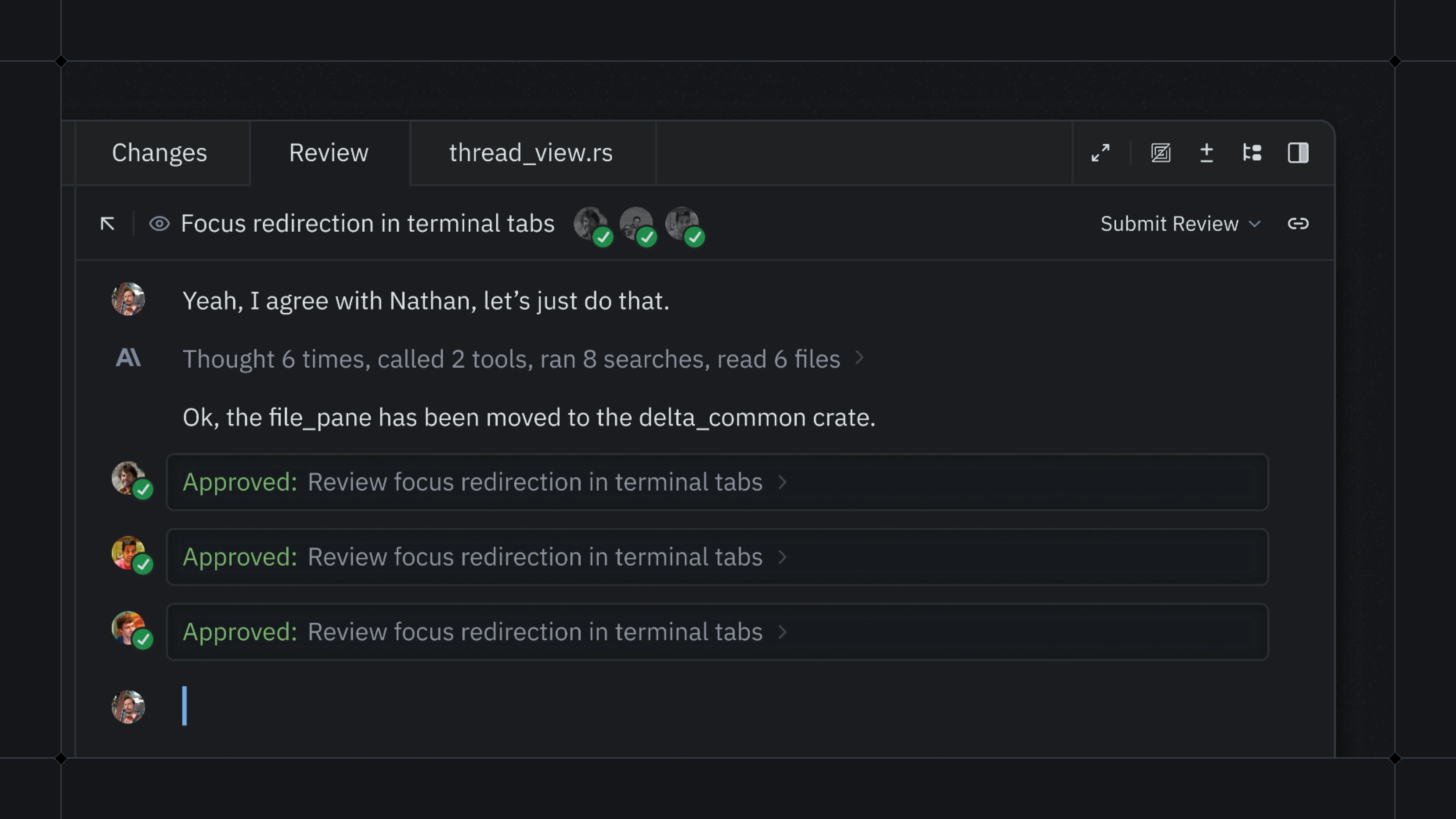
Zed opens Delta to the public
Zed has launched the public beta of Delta, a shared coding environment built for developing software alongside AI agents and reviewing what they produce. According to the company's announcement, which reached the front page of Hacker News, Delta is available as a download for macOS, Linux and Windows, runs in the browser with no install, and lets users follow threads from a mobile browser. The product is free during the beta; Zed says paid plans for individuals and teams are coming soon, and that a free version will always exist.
Zed is also dogfooding the tool aggressively: the team turned off pull requests on Delta's own repository the week before launch and now runs all of its development through Delta threads. Since that switch, 33 people have landed 570 changes to the main branch, according to the company.
Collaboration through threads instead of pushes
The central break with conventional workflows is that collaboration in Delta does not hinge on committing and pushing code. A developer brings teammates directly into the agent conversation. Anyone who joins sees the same worktrees on their own machine and can interrogate the agent itself — Zed's example is asking why a Mutex was chosen over an RwLock. If the original developer signs off, teammates can pick up the session with the agent and continue where it was left.
Review that keeps the agent's context
Zed argues that pull requests, which GitHub popularized more than 15 years ago, are buckling under agent-written code because the diffs people are asked to review have ballooned. Splitting a large diff across stacked branches eases navigation but sheds the reasoning behind the code, so a reviewer's own agent ends up reconstructing decisions the original session already made.
Delta's alternative is the review subthread. A reviewer is walked through a branch's changes with access to the original agent's context, and each review spins up its own copy of the parent thread's worktrees, so reviewers can use agents to explore the code or attempt fixes without disturbing the original work. When a reviewer spots a problem they can request a revision or fix it themselves with an agent; those fixes can be folded back into the parent thread before the change is landed.
DeltaDB underneath, Git compatibility on top
Delta is built on DeltaDB, which Zed describes as an extension of Git's content-based versioning with incremental versions based on deltas. It records the edits between commits alongside messages from humans and agents, preserving how code evolved across a thread. Commits remain the checkpoints developers push, pull and build from; DeltaDB retains everything in between.
Compatibility means teams can adopt Delta partially. Zed says its main editor repository will stay on GitHub for now, because that is where the community files issues and submits changes. Contributors are being encouraged to share Delta threads alongside their pull requests, while teammates who never open Delta simply see a normal Git repository.
A stated ambition to replace GitHub.com
Zed positions Delta as the opening move in a broader effort to replace GitHub.com, arguing that most current rivals promise better uptime on unchanged primitives — branches, commits and diffs — while it believes threads, modelled as deltas, will become the basic unit of software development. It calls the resulting style "continuous engineering": the idea, implementation, review and landing of a change all happen in one place, extending the pattern of continuous integration and delivery to the rest of engineering. Longer term, Zed says content-based builds could bring CI-style verification directly into threads; for now, an agent can trigger a run with an existing CI provider and check the results before landing a change. The company concedes the product is still taking shape, with the capabilities it cares most about still ahead.
Why it matters
Pull requests are among the most entrenched primitives in software development, and agent-generated code is exposing their limits: reviewers increasingly face enormous diffs with no visibility into the reasoning that produced them. Delta is one of the most concrete attempts to rebuild review around the agent conversation itself, keeping human-and-agent context attached to the code rather than discarding it at commit time. Its Git compatibility lowers the cost of trying it, and its dogfooding numbers — 570 changes landed without a single pull request — will be watched closely by everyone else building collaboration tools for the agent era. Whether teams embrace threads as readily as they once adopted PRs is the question this beta begins to answer.
- #zed
- #developer-tools
- #ai-agents
- #code-review
- #git