· via Hacker News – Front Page (native)
AI Agents 'Discovered' a Maya Site That Archaeologists Had Already Mapped
A hobbyist's 48-agent pipeline flagged a Maya plaza and pyramid in NASA lidar and drew an official reply from Mexico within 72 hours — but the site was already mapped in a 2025 paper, exposing a verification gap in agentic research.
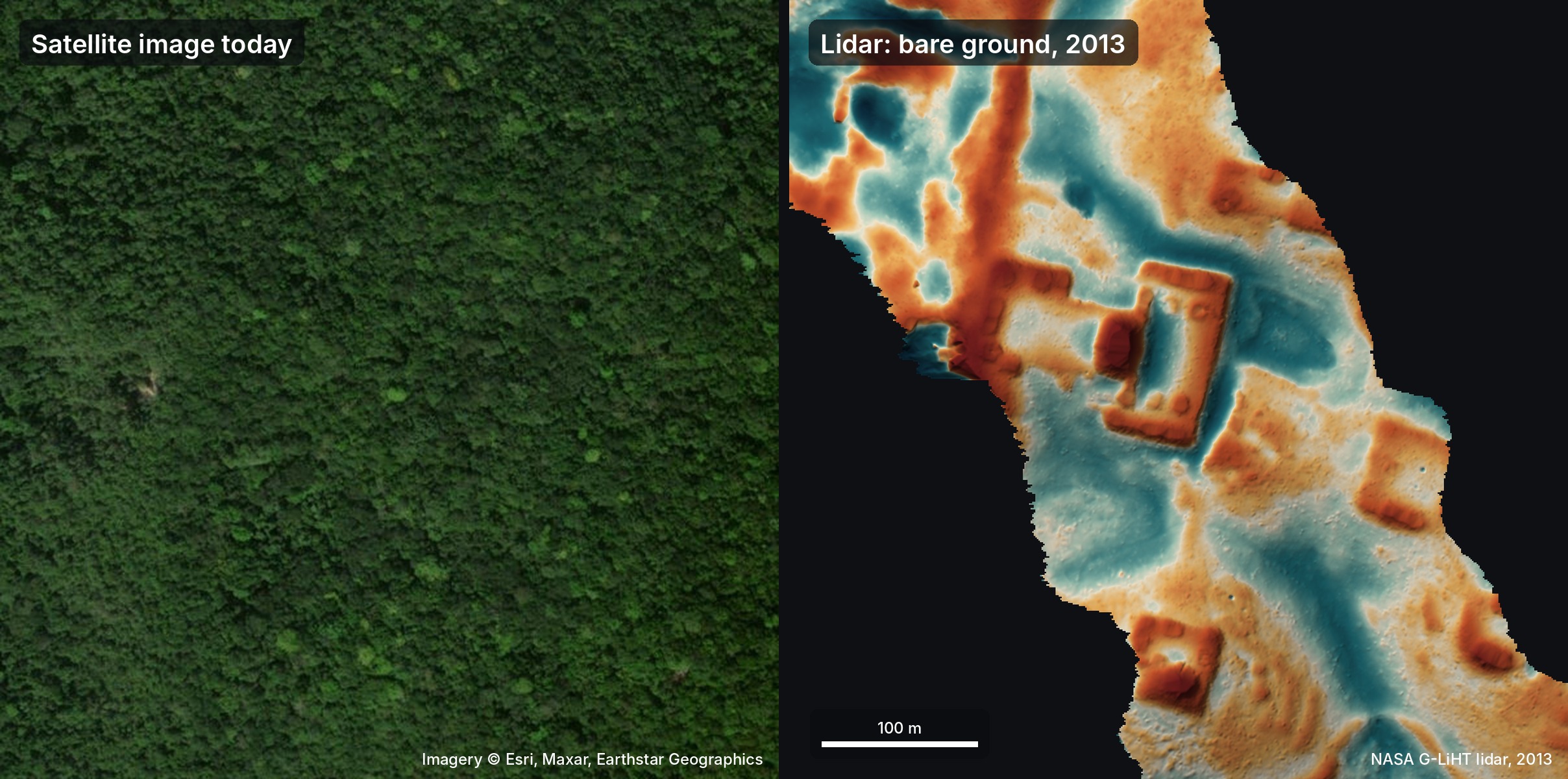
An amateur experiment in agent-driven archaeology has ended with a correction that is more instructive than the original claim. According to a write-up by Pietro Miotti, a fleet of AI agents scanning public NASA lidar data of the Maya lowlands in Mexico flagged a hilltop complex with a levelled plaza and an oval pyramid. Less than 72 hours after the idea first occurred to him, Mexico's National Institute of Anthropology and History (INAH) replied that the coordinates matched nothing in its register. Then came the twist: archaeologists had already mapped the site in a 2025 paper the agents never found.
How the search unfolded
Miotti, who states upfront that he is not an archaeologist, started with an idle question on 18 October while traveling in Peru, after reading about Hiram Bingham's 1911 arrival at Machu Picchu. He brainstormed the modern equivalent with several chatbots — Gemini, ChatGPT, Claude and Grok — and all pointed to lidar, which fires laser pulses through gaps in the forest canopy to map the ground beneath. Peru's public coverage proved thin, so the focus shifted to the Maya region.
Overnight, 48 agents worked through roughly 1,200 square kilometres of lidar rendered as images, flagging anything resembling pyramids, platforms or plazas while filtering out hills, sinkholes and roads. There was no custom classifier; the agents simply inspected the pictures against a written guide. The strongest hit was a cliff-edge hilltop with straight edges and sharp corners: a levelled plaza, an oval pyramid at least 8–12 metres tall, a raised courtyard, a possible water reservoir and three platforms that were probably house foundations. The agents' speculative reading, which Miotti stresses is not expert analysis, is a small civic centre from the Classic period, roughly AD 250–900.
A 72-hour round trip to INAH
Asked to check the literature and archives, the agents concluded that one major site appeared unregistered. Following an agent's instructions, Miotti filed a report with INAH — drafted and translated into Spanish by the agents — on 20 October. The institute replied the next day that its records held no archaeological site at the reported location. The post reached Hacker News's front page and, according to a dev.to commentary by Serghei Pogor, passed 800 points within hours.
The rediscovery
On 11 November Miotti added an update: the site had already been mapped in Estrada-Belli et al. 2025. The agents had missed the paper during their literature pass, and because the site was not yet in INAH's register, the official reply had looked like confirmation of a first find. Miotti takes the outcome cheerfully, noting that an outsider with agents converged on what the experts had already found, and says the site is now in the hands of INAH and the archaeologists who mapped it first.
The verification gap
Pogor's commentary draws the sharper lesson: the agents were good at finding and bad at confirming novelty. Spotting a pyramid in noisy lidar is genuinely hard, and they did it. Establishing that nobody had done it before is a different job, one that rewards suspicion rather than enthusiasm, and a single agent session asked to do both tends to default to enthusiasm. He cites a Hacker News commenter's observation that agents often declare something novel after surveying most of the prior work rather than all of it, and he flags a subtler trap: absence from a database is weak evidence. INAH's empty register did not mean the site was unknown, only that it was unregistered.
Notably, the failure was narrow. The agents did not invent a pyramid out of noise — the shapes are real, as the 2025 mapping confirms. What failed was the literature check, not the perception.
Why it matters
As agentic pipelines make pattern-finding cheap, discoveries will multiply, and most of them will be rediscoveries. That is fine as long as verification keeps pace, but this episode shows how easily an authoritative-looking signal — a government register coming back empty — gets read as proof of novelty. Research workflows built on agents need the same discipline software teams apply to code review: separate the generation step from an adversarial check, open the cited sources yourself, ask a domain expert, and treat silence in any database as a hypothesis rather than a verdict.
- #ai-agents
- #archaeology
- #lidar
- #verification
- #remote-sensing