· via Hacker News – Front Page (native)
CircuitHub unveils The Grid, a robot-run US PCB plant it says beats Shenzhen turnaround by five days
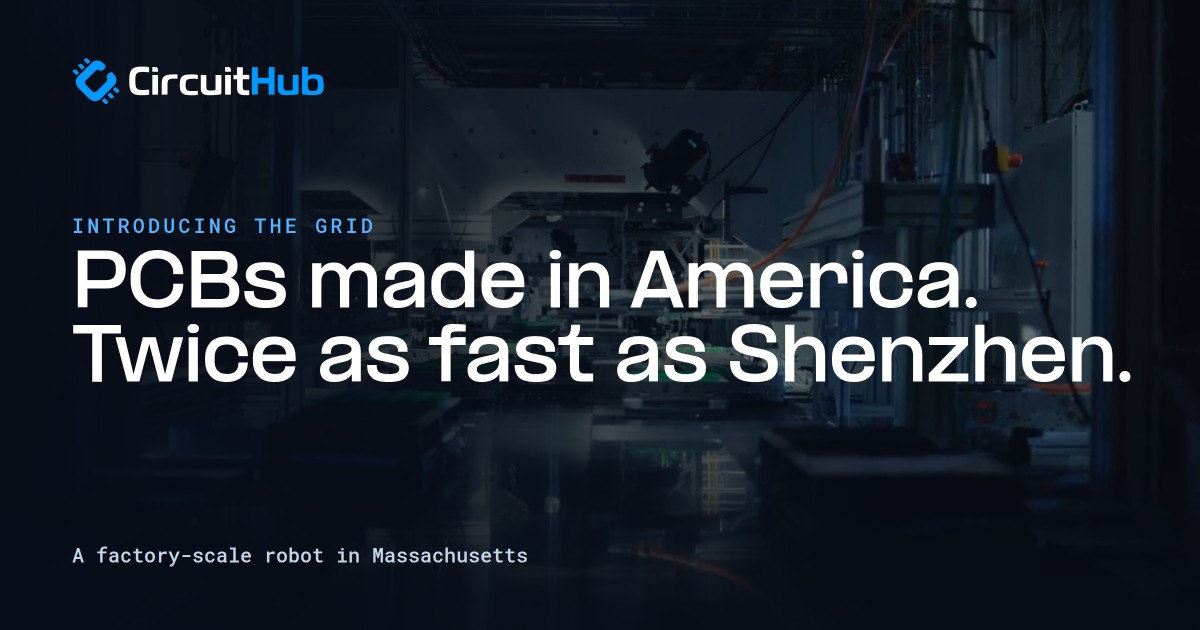
CircuitHub has unveiled The Grid, a Massachusetts factory robot that assembles PCBs on demand. The company says a sample board arrives in four days for $630, versus nine days and $465 from a Shenzhen shop.
The announcement
CircuitHub, an electronics manufacturing service, has publicly revealed The Grid, a robotic production system at its Massachusetts facility that assembles printed circuit boards on demand. The announcement, which reached the front page of Hacker News, came with a notable caveat in the company's favor: The Grid has supposedly been running quietly for customer orders for the past five years and already produces tens of millions of dollars' worth of electronics each year.
The problem it targets
According to CircuitHub, most Western electronics assembly migrated to Asia over the past three decades because assembly was labor-intensive and wages were lower abroad. Automation has pulled some production back, but mainly at enormous volumes — the company points to SpaceX building Starlink dishes by the million in Texas as the kind of operation that justifies a dedicated line.
Most hardware teams do not operate at that scale. The typical company needs ten units of one board, a hundred of another, and a revised design next week. CircuitHub says this high-mix, low-volume work has long resisted automation because every new design traditionally demands hours of manual setup and changeover, pushing it either overseas or into expensive domestic quick-turn shops.
How the system works
Rather than a fixed line reconfigured for each product, CircuitHub describes The Grid as a single large robot. Levitating carriers shuttle each board and its components between stations that apply solder paste, place parts, reflow, solder, and inspect. Scheduling across the whole system is handled by a mix of learned models, AI agents, and conventional optimization algorithms.
Because each board follows its own route through the factory, a new design requires no changeover. The company says a batch of 100 different boards runs as easily as 100 copies of one design, and prototypes and production lots share the same machines. Customers reportedly include a leading EV manufacturer, a top AI lab, and several household-name technology companies — organizations that need steady streams of small runs for test stations, tooling, and R&D.
The cost comparison
To make the economics concrete, CircuitHub priced an example board both ways: a four-layer motor controller with 118 components per board, 38 of them unique, five assembled boards, parts included, delivered to a US address.
On The Grid, the order arrives in four days for $630. From a typical Shenzhen quick-turn shop, the same order costs about $465 once shipping and US tariffs are added, with a median turnaround of nine days. Buyers therefore pay roughly $165 more to receive boards five days sooner, with no customs involvement. CircuitHub argues that five days of engineering time is worth far more than $165 to most hardware teams.
Scale and expansion
Across its business, CircuitHub says it has shipped more than 2.2 million boards, placed over 150 million components, and served more than 26,000 engineers. Demand is already outstripping The Grid's capacity, so the company plans a five-fold capacity increase this year followed by another major jump in 2027, and it is hiring to support the buildout.
Why it matters
Every figure above comes from CircuitHub's own announcement, so the speed and pricing claims are not independently verified. But the underlying story speaks to a genuine inflection point in hardware manufacturing. If a highly automated domestic facility can assemble small PCB batches within shouting distance of Shenzhen on price — and beat it decisively on turnaround — startups and large firms alike gain faster iteration cycles and a supply chain insulated from tariffs, customs delays, and geopolitical friction. More broadly, The Grid is a bet that AI-driven scheduling and flexible robotics can finally crack the high-mix manufacturing problem that drove electronics production out of the West in the first place. If that bet pays off, designing hardware in the US and building it in the US stop being competing priorities.
- #pcb
- #hardware
- #manufacturing
- #robotics
- #supply-chain