· via Hacker News – Front Page (native)
ERICI defines open boot-to-OS reference stack for RISC-V industrial computers on RVA23 silicon
ERICI, a new non-commercial European initiative, is defining and verifying an open firmware-to-OS reference stack for industrial computers running on newly available RVA23 RISC-V hardware.
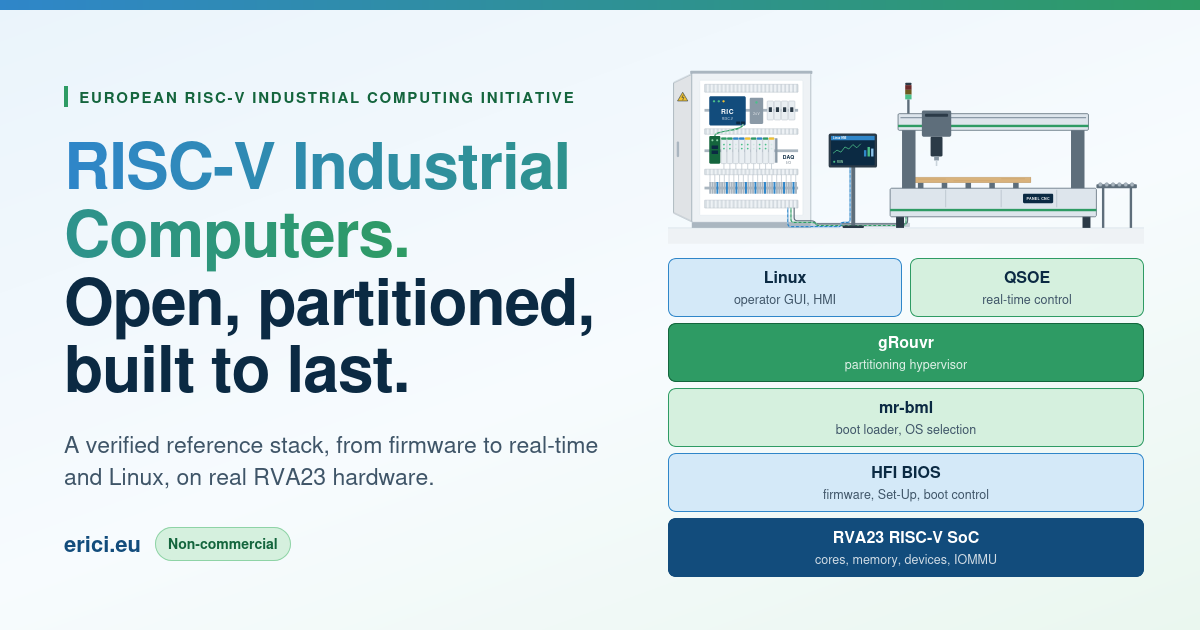
A new non-commercial European initiative called ERICI — the European RISC-V Industrial Computing Initiative — has published its plan for an open reference software stack for industrial computers, spanning firmware, a partitioning hypervisor, a real-time operating system and Linux. According to the project's website, the stack is defined and tested as a whole: ERICI documents the interface between each pair of layers and verifies that everything boots together on real RVA23-compliant RISC-V hardware. Any machine that boots the complete stack can be described as ERICI-compatible.
A stack verified layer by layer
The reference stack places five software layers above the silicon. At the bottom, HFI BIOS provides firmware based on U-Boot, adding a power-on self-test and a BIOS-style setup menu intended for industrial boards. Above it sits mr-bml, a menu-driven boot loader delivered as a UEFI application, which lets an operator choose which systems to start. Next comes gRouvr, a resource-partitioning hypervisor that hands each partition its own CPUs, memory and devices, using the IOMMU among its isolation mechanisms.
Those partitions are the heart of the design. One runs Linux for everything that is not time-critical: the operator GUI, HMI and networking. The other runs QSOE for real-time control loops and machine I/O, described on the site as a QNX-style environment that can run on its own Skimmer microkernel or on seL4 while sharing the same userspace. ERICI says the reference components are developed by a company called QSOE Systems, with Linux provided by its community.
The boot flow is deliberately conventional. The firmware initializes the system, runs its self-test and hands control to the UEFI boot loader. From there, gRouvr is loaded the same way a Linux kernel is, with an initrd, and its boot package is a CPIO archive holding the kernel and initramfs image of every partition — which means GRUB can load it as well.
Two computers in one box
The point of the partitioning hypervisor is consolidation: real-time control and the operator's Linux environment run side by side on a single SoC, isolated from each other, replacing what the project characterises as a two-box setup. This only became practical with RVA23, the RISC-V profile ratified in October 2024, which makes the hypervisor and vector extensions mandatory on every compliant chip rather than optional extras that software cannot assume.
Hardware you can buy, but not industrial computers yet
The first RVA23 SoCs and boards became available in 2026, and ERICI points to two examples: the Firefly AIBOX-K3 edge mini PC and the Milk-V Jupiter2 single-board computer, both built on the SpacemiT K3 with eight X100 RISC-V cores at up to 2.4 GHz, up to 32 GB of LPDDR5 and an IOMMU. The Jupiter2 adds 10 GbE SFP+, Wi-Fi 6 and expansion for EtherCAT and CAN-FD real-time I/O modules.
Even so, the site frames these as development and edge platforms rather than finished industrial machines, which must tolerate harsher conditions and stay serviceable for a decade or longer. The partitioned stack has so far been demonstrated on a SpacemiT K3 PicoITX board, not on those two products. ERICI also acknowledges that the first RVA23 silicon comes from Chinese vendors, and says the stack depends on the profile and open interfaces rather than on any particular chip, so a future move to RVA23 parts from other regions would mainly require a firmware port.
Why it matters
Today's industrial computers run on x86 or Arm — two instruction sets, each controlled and licensed by a single company. RISC-V, by contrast, is an open ISA governed by the non-profit RISC-V International, which has been based in Switzerland since 2020. For machines expected to remain in production for 15 years, ERICI argues, deployment should not hinge on one vendor's roadmap or one government's decisions — a hardware-sovereignty argument aimed squarely at European industry.
The project also diagnoses a coordination failure: manufacturers hold off until software support exists, software teams wait for boards to target, and buyers wait for both. A public, non-commercial reference stack that demonstrably boots on hardware developers can purchase today is an attempt to break that loop. One caveat: all of this comes from the initiative's own launch material, and no finished ERICI-compatible industrial products exist yet — the current proof point is a boot demonstration on a development board, not a machine installed in a control cabinet.
- #risc-v
- #open-source
- #embedded
- #industrial-computing
- #hypervisor