· via Hacker News – Front Page (native)
Google Labs turns CC into a household AI agent with its own Google account
Google Labs has expanded its experimental CC assistant into an AI agent for households, giving the agent its own Google account and letting up to six members share emails, calendars and tasks with it.
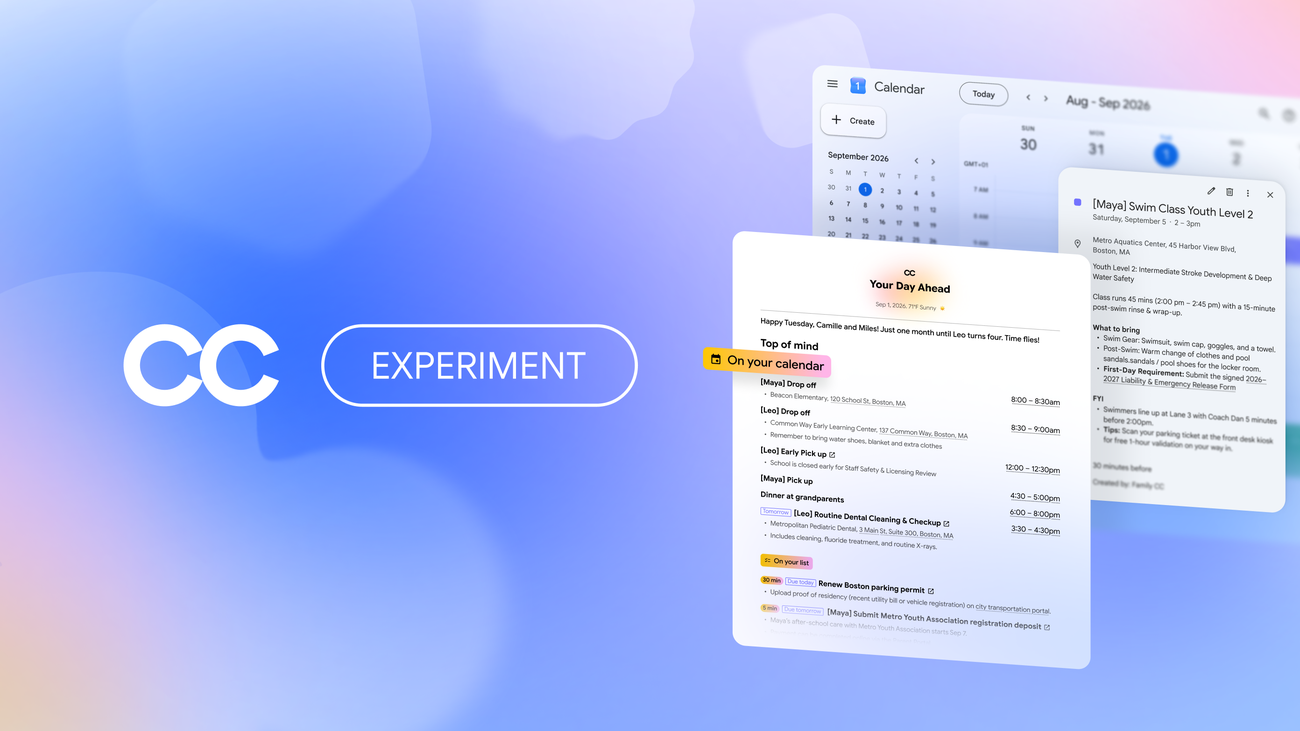
Google Labs opens CC to households
Google Labs has repositioned CC, its experimental AI assistant, as an agent for families. According to the announcement on Google's blog, CC now runs on its own Google account, which gives the agent a distinct identity and a permissions model that lets up to six people manage and collaborate with it.
CC started as a personal agent meant to help a single user stay on top of their day, and Google says it became a daily habit for many early testers before it was folded into the Gemini app as Daily Brief in May. One of the most common requests, the company says, was for more help running a busy home — school schedules, sports practices, bills and dinner plans — a shared job that gets harder when information sits scattered across multiple accounts.
What the family agent does
Each morning, CC delivers a shared "Your Day Ahead" brief showing who needs to be where, what needs to be done, and what the agent already finished the previous day. Google frames this as a way to keep household logistics from being trapped in one person's inbox or mental checklist.
The agent also tracks important dates and to-dos on its own, pulling shared information into a family Calendar or Tasks list and keeping it current as plans change. Beyond reminders, CC can take on time-consuming chores: filling out permission slips and activity registration PDFs, building school supply shopping lists, and drafting weekly meal plans. When details are missing, CC asks for them and updates its group memory so it can be more useful next time.
Sharing and privacy controls
CC only sees what each member chooses to share — for instance emails from a child's school, the local swim center or the vet — and members can adjust those choices at any time. Google describes several mechanisms for feeding the agent:
- Auto "cc" lets members designate senders, such as a school or travel bookings, whose messages should always be shared, and each week CC sends a private list of new senders that can be approved or ignored.
- One-off items can be handed to CC directly: forward an email or a text, or send a photo of a birthday invitation or soccer schedule via email or Google Chat, and CC will update the Calendar. Members can also share Drive folders or files, or add CC to a calendar event.
- CC connects to the Google tools households already use, including Gmail, Chat, Docs and Calendar.
Because CC holds a verified Google account of its own, it appears as a distinct participant, responds only to group members, and will not take action or share information outside the group without permission, according to the post.
Under the hood
Every CC instance runs on an isolated cloud computer powered by Google's agentic harness, Antigravity, and the latest Gemini models. That architecture is what allows it to pre-fill registration PDFs, check live drive times between back-to-back activities through the Google Maps API, and create shared Docs and Sheets.
The agent also maintains a shared memory that separates household-level knowledge, like a go-to grocery list or favorite restaurants, from individual details such as dietary preferences or local time zones.
Availability
CC remains an early Google Labs experiment. It is available on web and mobile in the U.S. for people 18 and over with a personal Google account. Existing users will receive an email in the coming days to upgrade their accounts, and new users can join a waitlist.
Why it matters
The update signals where major vendors see consumer AI agents heading: from single-user assistants to shared entities that act on behalf of a whole household. Giving the agent its own verified account is the most interesting design choice here — it treats the AI as a first-class participant with explicit permissions rather than a feature buried inside one person's app, a pattern other vendors are likely to copy.
It also concentrates a lot of sensitive household data in one place. An agent that reads school emails, fills out forms and remembers family preferences will be judged on how well its opt-in sharing model holds up in practice, and Google is framing control — per-member sharing, weekly sender reviews, no action outside the group without permission — as central to the product. All claims so far come from Google's own announcement, so real-world behavior remains to be tested.
- #ai-agents
- #gemini
- #google-labs
- #family-tech