· via Hacker News – Front Page (hnrss.org)
Nikon strips microscope video contest winner after scientists flag AI-generation signs
Nikon has disqualified the winner of its Small World in Motion microscopy contest after cell biologists flagged structures that flickered between frames and an AI watermark in the source image.
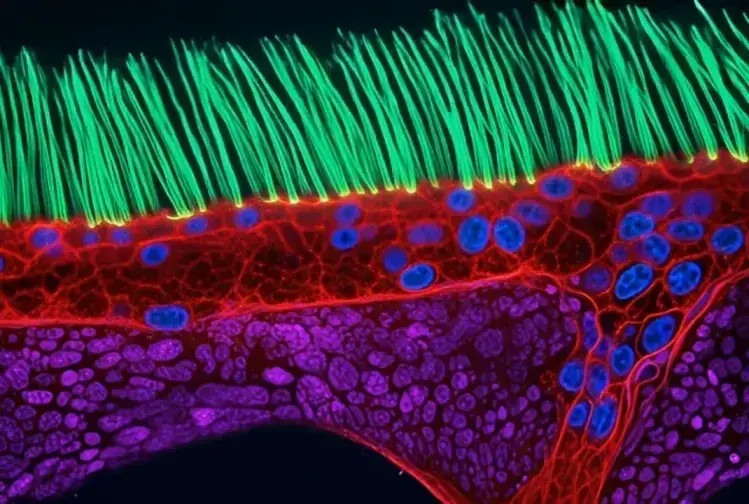
Nikon revokes the winning entry
Nikon has withdrawn the top prize from its Small World in Motion microscopy competition after an investigation concluded the winning video violated contest rules. According to TechSpot, the decision followed a public challenge from cell biologists who identified several signs that the footage had been produced with AI, making this one of the most concrete cases yet of expert scrutiny overturning a major competition result.
The 16th edition of the contest, which accepts any movie or digital time-lapse captured through a microscope, was initially won by Dr. Ning Xu of Tsinghua University in China. His entry showed cilia, microscopic hair-like structures, beating in the airways of a child with primary ciliary dyskinesia, a rare respiratory disorder.
How researchers spotted the problem
The doubts came from the scientific community rather than from contest organizers. Some researchers reported irregularities in the size and structure of the cells in the video, noting that certain features appeared and vanished in ways that do not occur in real cellular biology. A University of Florida associate professor observed that structures flickered in and out of the frame and that cilia seemed to materialize without origin, patterns he considered characteristic of generated video.
A more decisive finding came from Ian Donovan, a PhD student at UT Southwestern Medical Center, who said the source image appeared to carry a distinctive watermark associated with AI generation. Two former competition judges also questioned the legitimacy of the clip, according to TechSpot.
Xu's explanation and its limits
In a LinkedIn post that has since been deleted, Xu admitted to using AI, but said it was limited to identifying and rendering features within the reconstructed grayscale images produced by his super-resolution optical imaging, as part of post-processing. He denied that AI had generated the video itself, the cilia, or their movement.
Xu maintains that he broke no rules. Making microscopic structures easier to see is a common and permitted practice, though researchers typically achieve it by applying stains and dyes to the physical sample. As TechSpot notes, that defense does not account for the anomalies the scientists identified, and several of them said the doubts could have been resolved simply by Xu releasing the raw grayscale footage.
The outcome
Nikon's investigation found that the rules had been broken, and Xu was stripped of the title. First place now goes to Nguyen Nam Nhat of Vietnam, who submitted a video of a tiny roundworm alongside a single-celled organism. Nikon said it plans to review its rules and judging procedures for future entries.
A familiar pattern
Generated images have been entering competitions for years. A Midjourney image won a category at the Colorado State Fair's art competition in 2022, an AI creation won a photography contest run by Australian photo retailer digiDirect in 2023, and an artist who won a 2023 Sony World Photography Awards category refused the prize after revealing his image was AI-generated. In 2024, a winner of a digital art competition with an AI-generated image complained that people were copying his work, which he could not copyright.
Why it matters
The case is a concrete example of AI-content detection moving from theory into practice, and notably it was driven by domain expertise rather than automated detection tools. Cell biologists recognized that the footage violated the rules of their field, with structures appearing and disappearing in impossible ways, long before any software flagged it. In specialist domains, human expertise remains the front line of verification.
It also shows how provenance is becoming the deciding factor in disputes. The scientists' central request was simple: release the raw grayscale video. Competitions, journals and institutions that require original source files alongside polished final images give themselves a straightforward way to settle exactly this kind of argument. Nikon's promise to rewrite its rules suggests the boundary between legitimate enhancement and generation now has to be defined explicitly, for microscopy contests and, most likely, well beyond them.
- #ai
- #photography
- #microscopy
- #image-forensics
- #research-integrity