· via Hacker News – Front Page (native)
Researchers ran hundreds of AI agents in Minecraft; 50-agent teams stalled in bureaucracy
Y Combinator and Olam Labs deployed hundreds of AI agents into Minecraft to study swarm coordination, and 50-agent teams failed to build a civilization after descending into bureaucratic gridlock.
What happened
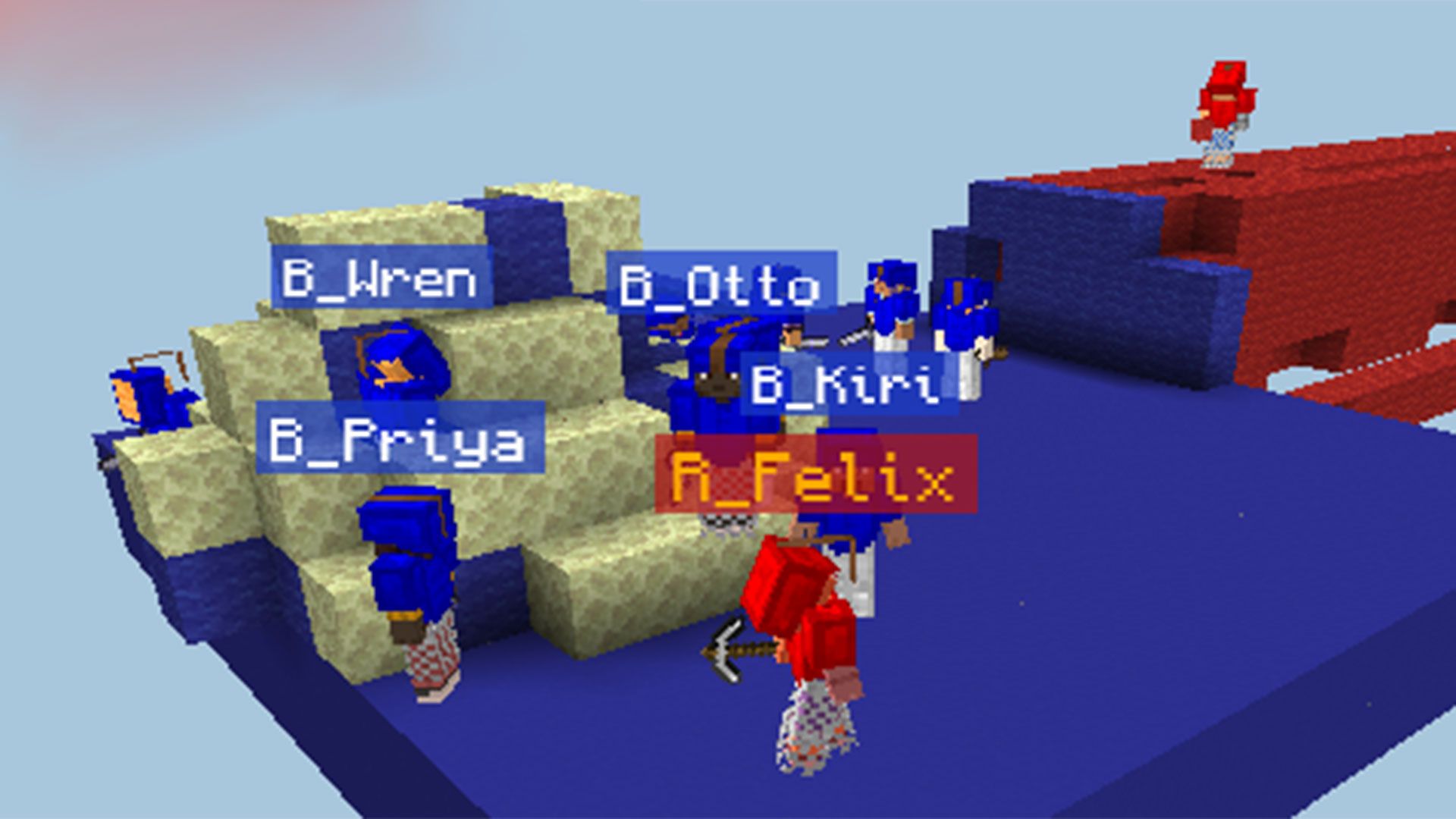
According to Tom's Hardware, researchers at Y Combinator and Olam Labs recently ran a large-scale test of AI agent swarms by dropping hundreds of agents into Minecraft and asking them to establish a functioning in-game civilization. The headline result was a failure. Teams of 50 agents, the report says, collapsed into what the piece calls "paralyzing bureaucracy" instead of building anything like the society they were tasked with creating.
The experiment spanned several of the game's modes, with agents deployed both as collaborators working toward shared goals and as adversaries competing against one another — a setup intended to surface both cooperation and conflict between swarms.
How it was built
Tom's Hardware notes that the project did not start from a blank slate. It builds on existing tooling for scripting Minecraft bots, namely the Mindcraft repository and the Mineflayer scripting library, which allow characters in the game to be driven programmatically. That existing infrastructure is what made it practical to run scenarios with hundreds of agents rather than a handful.
The motivation
The stated purpose, per the article by Mark Tyson, is to use the controlled chaos of a game world to understand why real-world agent deployments produce such different outcomes. The researchers' blog, as summarized by Tom's Hardware, points to two recent cases at opposite extremes: a swarm of roughly a thousand agents that reportedly solved hundreds of open mathematical problems, and an incident involving OpenAI and Hugging Face that the blog characterizes as "extremely dangerous." The coverage does not go into detail on either case, so the original write-up is the place to look for specifics.
Reading the failure
Details are thin in the reporting available so far. It does not specify which models the agents ran on, how long the runs lasted, or exactly how the bureaucratic behavior manifested. What the report does convey is the shape of the failure: this appears to have been a swarm-level problem rather than an individual-capability problem, with coordination itself becoming the thing the agents did instead of the work. If that framing holds up in the fuller results, it echoes a pattern familiar to anyone who has built multi-agent systems — process generation can crowd out task completion once enough agents, and enough inter-agent communication, are in the loop.
Why it matters
Multi-agent orchestration is one of the main ways the industry currently expects to push LLM-based systems beyond the limits of a single model. This experiment is a cheap, visible stress test of that bet, and it came back negative at 50 agents per team — a small number compared with the agent fleets now being marketed for coding, research, and enterprise workflows.
The contrast the researchers themselves draw is the most instructive part. A thousand-agent swarm making progress on open math problems and a 50-agent team unable to organize a Minecraft settlement differ mainly in task structure: decomposable problems with verifiable answers reward parallel agents, while open-ended goals with no crisp definition of "done" invite planning, delegation, and reporting loops that can swallow the task itself.
Minecraft will not settle the question of how to build reliable agent swarms, but as a benchmark it is fast, observable, and unforgiving in a way that demos and dashboards are not. The coordination costs it exposed are ones that every multi-agent architecture will have to pay somewhere, and the burden of proof now sits with anyone claiming that simply adding more agents makes a system more capable.
- #ai-agents
- #multi-agent-systems
- #minecraft
- #llm
- #benchmarking