· via Hacker News – Front Page (native)
Trakkr Research: only 40% of AI-cited statistics trace back to a real study
Trakkr Research traced 1,285 statistics quoted by ChatGPT, Perplexity, Gemini, Claude and Google AI Overviews, and found only 40% trace to a supporting study; 11% lead to no research at all.
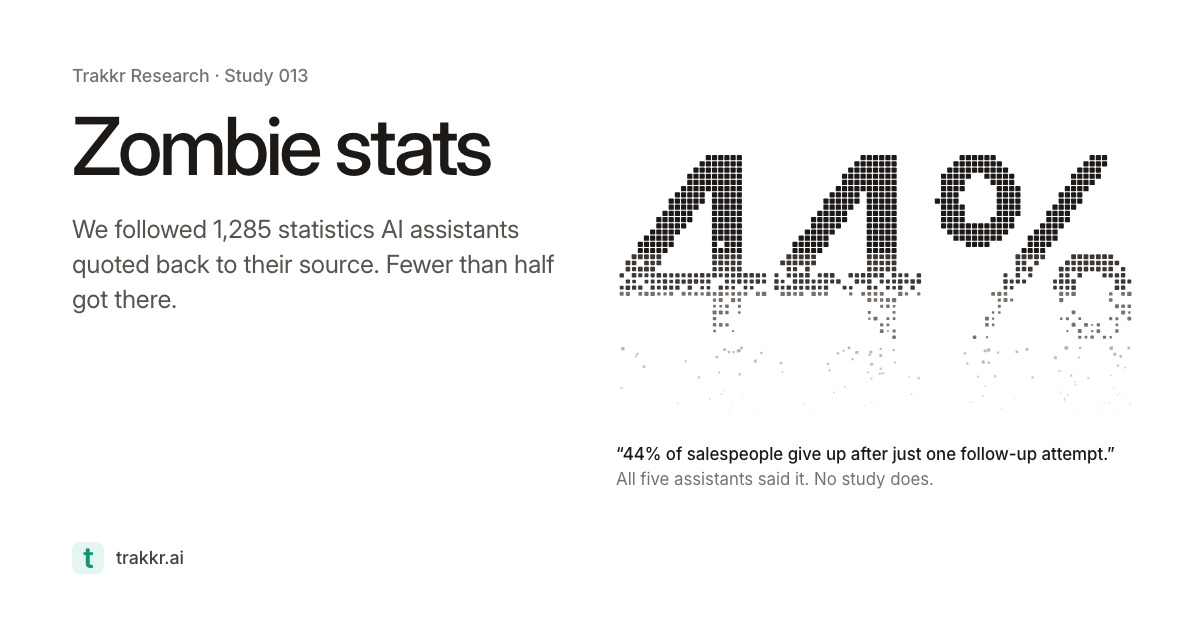
An investigation by Trakkr Research puts a hard number on a familiar risk: only 40% of the statistics quoted by major AI assistants trace back to a study that supports them. The researchers posed 200 everyday questions that call for a number to ChatGPT, Perplexity, Gemini, Claude and Google's AI Overviews, then followed the citations behind a sample of 1,285 statistics, moving from the cited page to that page's own sources, up to five pages deep, and searching wherever a source was named without a link. The work, surfaced on Hacker News, was carried out in October 2026.
The outcomes split four ways:
- 40% reached a study that says the same thing, with a 95% confidence range of 34% to 46%.
- 8% reached a study, but the figure or its context had changed along the way.
- 40% stalled at a source that could not be checked, because it was locked, removed or silent on the number.
- 11% led to no research at all, with every page in the chain repeating the figure and crediting no one.
Trakkr says 150 of the trails were re-checked by hand.
The anatomy of an unsupported number
One example shows the pattern. Asked what percentage of salespeople give up after one follow-up, all five assistants answered 44%, and only ChatGPT flagged the evidence behind the figure as unclear. Google's AI Overviews credited a sales firm's statistics page from 2020, whose own source link pointed to a freelance writer's sample article that was online by 2017. That article listed slide decks, blog roundups and news stories, none of them a study of follow-ups. The trail simply ends there. Trakkr calls such figures "zombie stats": numbers that keep circulating long after any supporting research has vanished, or never existed.
Crucially, the assistants were generally not inventing numbers. The page a model cited contained the figure 82% of the time. The failure is in which page gets cited: only 21% of citations pointed to the research itself, while 54% pointed to company blogs, with news stories and statistics roundups making up most of the rest. These are pages built to collect figures from elsewhere, often without linking back to any original source.
Source type predicts the outcome
Where a trail starts largely determines where it ends. Citations to research firms made up 13% of the total and reached a matching study 62% of the time, while government and official sources were 7% of citations with a 61% success rate. Company blogs, at 54% of all citations, succeeded 37% of the time, and statistics roundups 35%. Even research-firm citations failed 38% of the time, frequently because the full report sat behind a lead-capture form.
Numbers drift as they travel
Reaching a study did not guarantee the number survived the journey: 17% of the statistics that got that far had changed en route. The digits themselves moved only about one time in four; more often the context shifted, covering what was measured, the year, the source, or who was asked. A case in point is the widely repeated claim that 94% of first impressions of a website are design-related. It descends from a 2004 CHI paper by Sillence and colleagues, in which 15 British women reviewed health websites and 94% of their comments about rejecting a site concerned its design.
Same question, five answers
The assistants also disagreed with each other. On 28 of the 71 questions where all five returned a percentage, they produced four or five different figures. Asked on the same day what percentage of marketers use marketing automation tools, the answers ranged from 49% to 96%.
ChatGPT performed best on sourcing, with 57% of its statistics traced to a supporting study, while also quoting the fewest numbers at 1.3 per answer. Perplexity followed at 46% with 2.2 per answer, AI Overviews at 39% with 4.8, Gemini at 38% with 6.2, and Claude at 38% with 6.8. Trakkr cautions that the four behind ChatGPT sit within each other's statistical ranges and declines to rank them. A separate control set of 300 statistics drawn from AI Overviews answers to real user searches produced the same 40% share, suggesting the result is not an artifact of the question set.
Why it matters
Citations are the primary trust signal in AI answers, especially for products positioned as research tools. This study suggests that signal is weak: a citation marks where a model picked up a number, not who actually measured it. Unsupported figures arrive with the same confidence and the same footnote as well-sourced ones, and when five assistants agree on a number, as the 44% follow-up statistic shows, the agreement itself proves nothing. For anyone using these numbers in a presentation, article or business decision, the practical lesson is to treat an AI citation as a lead to verify rather than proof. The findings also point to a fixable product gap: systems that prioritise primary sources such as research reports and government data over company blogs and roundups would meaningfully raise the odds that a quoted number is real.
- #ai
- #hallucinations
- #citations
- #misinformation
- #search