· via Vercel blog
Vercel instant deployments add CSS, images and fonts for build-free static sites
Vercel's instant deployments can now put static sites containing CSS, images, fonts and other assets live in about a second, with no build step required.
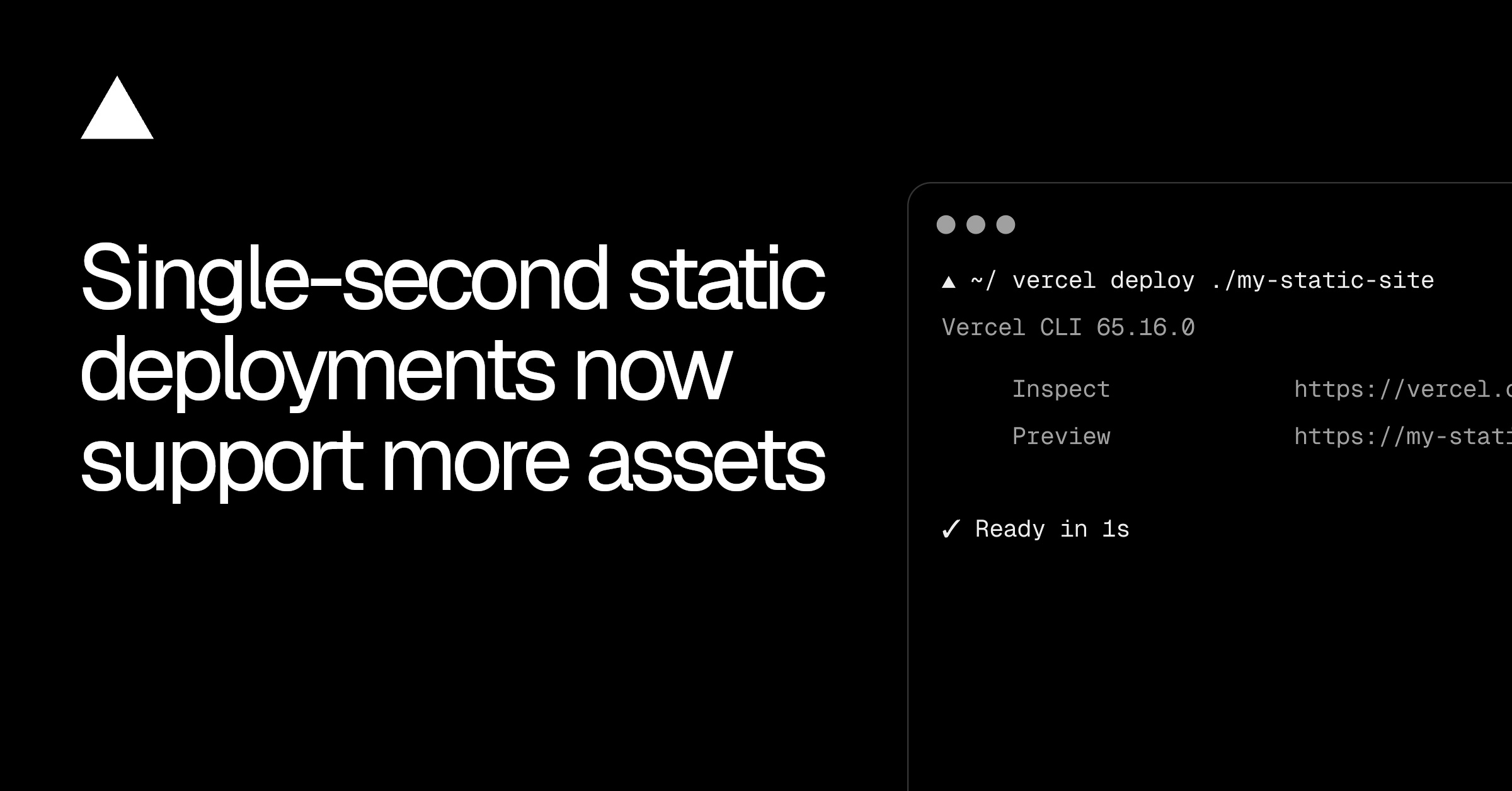
Vercel has widened the scope of its instant deployment feature, which pushes qualifying static sites live in roughly a second with no build step. According to the Vercel blog, the fast path now accepts CSS, images, fonts and a range of other assets, where previously it covered HTML and Markdown. The update is rolling out across all of the company's plans.
The practical effect is that a self-contained page — a landing page together with its stylesheet and images, or an HTML report produced by a coding agent — can be published straight from a local directory instead of passing through a build pipeline. Vercel names agent-generated reports as an explicit use case, which hints at how the company expects the feature to be used: machine-produced pages that need a shareable URL immediately.
How a deployment runs
There is nothing to configure. The changelog explains that Vercel inspects a project automatically and decides whether it qualifies for the instant path. From the command line, a single command handles it: running vercel deploy against a directory of static files returns a live preview URL, and the example output in the changelog shows a deployment becoming ready in one second. The REST API offers the same capability for programmatic use.
What is now supported
The expansion extends coverage well beyond markup. According to Vercel, the accepted file types now include:
- Styles and data: CSS, JSON, XML, plain text and web manifests
- Images: SVG, PNG, JPEG, GIF, WebP, AVIF and ICO
- Fonts: WOFF, WOFF2, TTF, OTF and EOT
- Documents and media: PDF, MP4, WebM, MP3, WAV and OGG
Where the limits sit
Instant deployments are capped at 100 files totalling 25 MB or less, per the changelog. Projects that exceed either bound, or that contain JavaScript or other unsupported file types, revert to the standard build-based deployment flow. The same fallback applies to deployments triggered through Git rather than the CLI or API, and to projects carrying a framework preset, custom build settings, a root-level package.json, a vercel.json configuration file, or a public directory.
The exclusion of JavaScript marks the notable boundary: anything interactive still requires the conventional pipeline, so the feature is aimed at genuinely static output rather than framework sites.
Why it matters
Build time dominates the deploy experience for small sites, and this feature removes it entirely for projects that fit the constraints. For developers, a sub-second turnaround shrinks the gap between editing a file and seeing it live to almost nothing. For tooling, it offers a natural endpoint: an agent that generates an HTML report with embedded styling can hand back a hosted URL in about a second, with no repository, framework or configuration standing in the way. The tight file and size caps keep the feature clear of full applications, but as a mechanism for publishing simple pages quickly, the update makes Vercel a considerably lighter-weight option for static hosting.
- #vercel
- #static-sites
- #deployment
- #web-development
- #frontend