· via Hacker News – Front Page (native)
Pollen Robotics opens $399 pre-orders for Microduck, a trainable open-source biped robot
Pollen Robotics is taking $399 pre-orders for Microduck, a 25 cm bipedal robot whose behaviours are reinforcement-learning policies that owners can retrain and share.
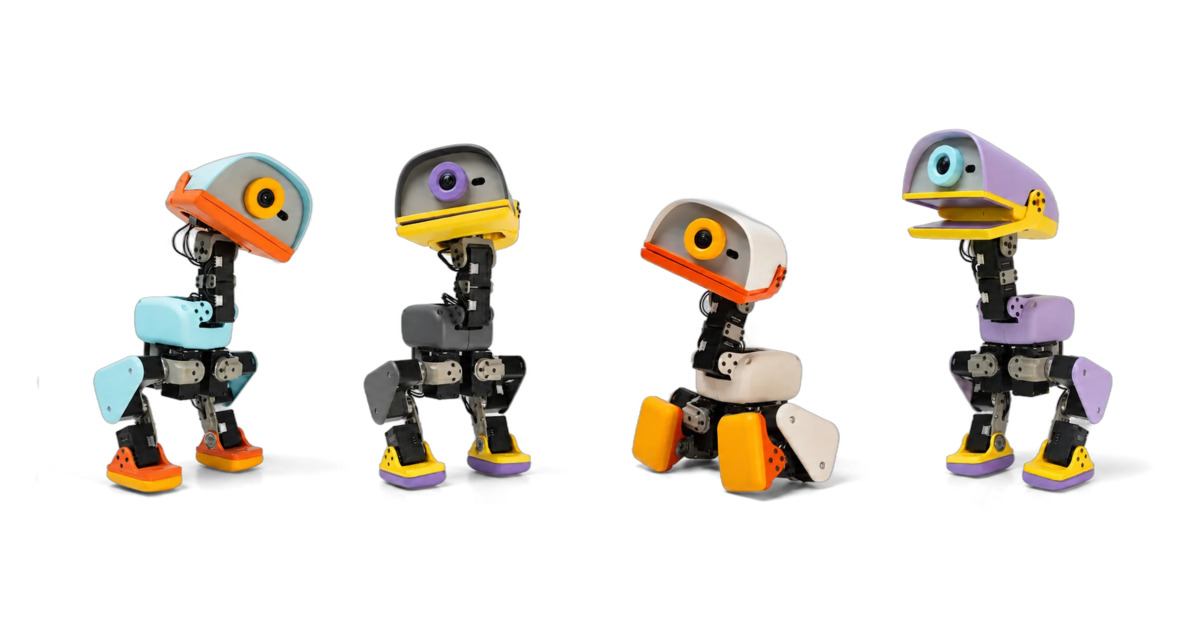
Pollen Robotics has opened pre-orders for Microduck, a 25 cm bipedal robot priced at $399 that owners can retrain themselves using reinforcement learning. According to the company's product page, the robot ships with pre-trained behaviours out of the box and is due to reach buyers before Christmas 2026, at an introductory price that excludes taxes and shipping.
A small biped with a full sensor suite
Microduck stands 25 cm tall, weighs 800 g and uses 15 motors to move. Its sensing hardware includes a camera, a LiDAR unit and two IMUs, and the learned control policy runs on board in a loop the company rates at 50 Hz. The box contains the robot, a battery, a USB-C cable and a game controller, and each unit ships in one of four shell colours, with identical internals regardless of the colour picked.
Seven moves in the box
The product page promises seven trained moves at delivery and describes six of them:
- a velocity-tracking walking gait
- sitting down, holding the pose and standing back up unaided
- a one-shot kick that transitions straight back into walking
- a grab move in which the robot dips its beak to the ground, scoops something up and returns upright
- roller-skating locomotion when the skates are fitted
- recovering from flat on its back to standing, ready for the next command
Crucially, each behaviour is a policy the owner can retrain rather than a fixed routine baked into firmware.
How the training loop works
Pollen Robotics lays out a four-step workflow. Behaviours are first learned in a physics simulation — MuJoCo — running either on the owner's own machine or as Hugging Face Jobs. The resulting policy is then deployed to the physical robot, which the company presents as a single step from simulation to hardware. From there, the simulation can be tuned and training repeated, and finished policies can be published for others to swap in. The page also shows the simulated twin on which the shipped behaviours were trained.
An Apache-2.0 stack on GitHub
The SDK, the simulation and the complete reinforcement-learning training pipeline are published in the pollen-robotics/microduck repository on GitHub under the permissive Apache-2.0 licence, along with all seven shipped policies, each of them retrainable. A command-line tool called robotctl handles monitoring, configuring and updating the robot. The company stresses that the software the robot actually runs is the same code owners can read and fork, and it hosts a community on Discord for sharing builds, policies and troubleshooting.
Packs and pricing
Alongside the $399 robot, three add-on packs are offered: a $39 charger pack with a dual charger and two batteries; a $39 accessory pack with a laser pointer, an NFC polaroid, two rollers, a ball and ten NFC tags; and a $119 dev pack containing three spare motors, five motor cables, two batteries, the dual charger, ten NFC tags, Hugging Face credit, a screwdriver and a screw pack.
Why it matters
Sim-to-real reinforcement learning — training a controller in simulation and transferring it onto physical hardware — has largely been a research-lab exercise, with tooling to match. Microduck packages it as a consumer product at a maker-level price, and the fully open, permissively licensed stack means nothing about the robot's behaviour has to stay a black box.
The Hugging Face connection does real work here: training can run as jobs on Hugging Face infrastructure, the dev pack includes platform credit, and policies are meant to circulate the way model weights do — as community artefacts rather than vendor firmware. If the shipped behaviours hold up outside the launch footage, a $399 biped with retrainable locomotion could become a practical entry point for hobbyists and educators experimenting with learned control.
The usual pre-order caveats apply. Every claim above comes from the company's own product page, and the promised pre-Christmas 2026 shipping date is still months away.
- #robotics
- #reinforcement-learning
- #open-source
- #hugging-face
- #hardware